Solar Inverters: String vs Microinverter vs Optimizer
Stepping into the world of home solar can feel like learning a whole new language, especially when you start digging into the technical bits like inverters. It's completely normal to feel a bit lost among terms like "string inverter," "microinverter," and "power optimizer." Many homeowners get confused, wondering which one is actually right for their specific situation, or if there's a "best" option overall. This guide is here to demystify these crucial components of your solar energy system, breaking down how each works, its advantages and disadvantages, and helping you understand what might be the perfect fit for your home.
What is a Solar Inverter and Why Does It Matter?
Before we dive into the specifics of different inverter types, let's nail down what a solar inverter actually does and why it's such a vital part of your photovoltaic (PV) system. Think of it as the brain or the translator of your entire solar setup. Without it, the clean energy captured by your panels would be pretty useless for most of your household appliances.
The Essential Role in a Solar System
Your solar panels, those beautiful rectangles soaking up the sun on your roof, produce direct current (DC) electricity. This is the kind of power you'd find in a battery. However, almost everything in your home—from your refrigerator to your smart TV to your electric vehicle charger—runs on alternating current (AC) electricity. This is the standard power format supplied by the utility grid.
The solar inverter’s job is to bridge this gap. It takes the DC electricity generated by your solar panels and converts it into usable AC electricity for your home. Without this critical conversion, your panels might as well be fancy roof decorations. The inverter also plays a crucial role in managing the flow of power, ensuring it's delivered safely and efficiently, and often communicating with the grid and your home energy monitoring system. It's the unsung hero that ensures your solar panels genuinely power your life.
The DC to AC Conversion Process
The actual process of converting DC to AC is a sophisticated dance of electronics. When sunlight hits your solar panels, it excites electrons, creating a flow of DC current. This DC current then travels from the panels to the inverter. Inside the inverter, electronic switches rapidly turn the DC current on and off, creating a waveform that mimics AC current. This waveform is then smoothed out and regulated to match the precise voltage and frequency of your home's electrical grid (for example, 120/240 volts and 60 Hz in North America).
This conversion isn't always 100% efficient; some energy is always lost as heat during the process. The efficiency of your inverter, therefore, directly impacts how much of the power generated by your panels actually makes it to your home. A high-quality inverter will boast higher efficiency ratings, meaning less wasted energy. Beyond conversion, modern inverters also have features like Maximum Power Point Tracking (MPPT), which constantly adjusts to find the optimal voltage and current from your panels to maximize power output, even as conditions like sunlight intensity change throughout the day. This technology is key to maximizing your Solar Panel Efficiency & Degradation Explained.
Deep Dive into String Inverters
String inverters are often considered the traditional workhorse of the solar industry. They've been around the longest and are still a very popular choice, especially for homes with straightforward rooflines and minimal shading. If you've looked at older solar installations, chances are you've seen a system powered by a string inverter.
How String Inverters Work
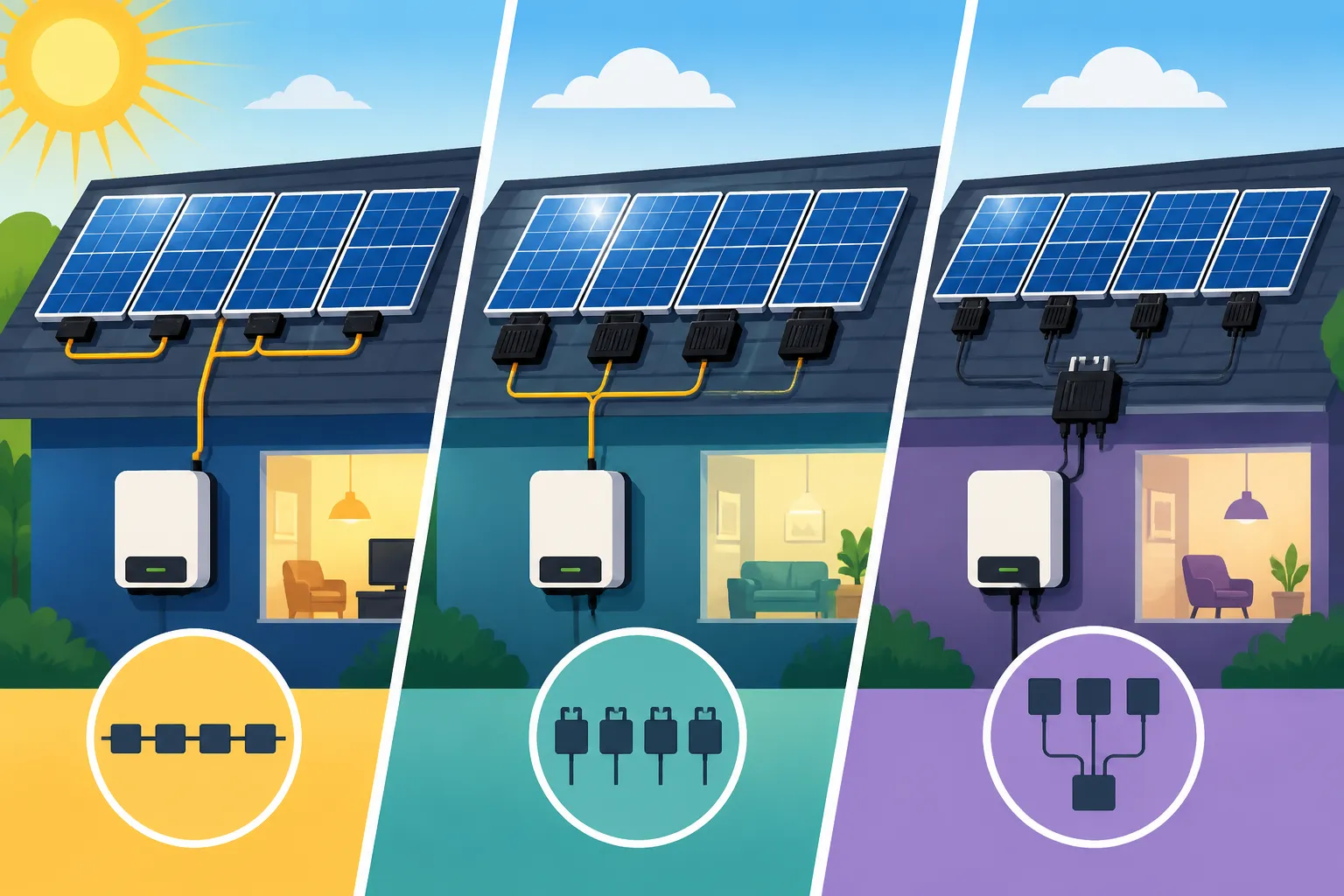
With a string inverter setup, multiple solar panels are wired together in a "string" or series. Think of it like a string of old-fashioned Christmas lights: the DC electricity from each panel flows into the next, and all panels in that string feed their combined DC power to a single, central inverter. This inverter is usually located on a wall in your garage, basement, or outside near your electrical meter. Once the combined DC power from the entire string reaches this central inverter, it performs the DC to AC conversion for all the panels simultaneously.
Larger solar systems might have several strings of panels, each feeding into the same central inverter, or into multiple string inverters if the system is very large or has different orientations. The crucial point is that all panels in a given string are treated as a single unit by the inverter, which processes their collective output. This simplified architecture is what often makes string inverter systems more economical upfront.
Pros and Cons of String Inverters
Like any technology, string inverters come with their own set of advantages and disadvantages. Understanding these trade-offs is crucial when deciding if this is the right option for your specific home and energy needs.
Pros:
- Lower Upfront Cost: Generally speaking, string inverters tend to be the most budget-friendly option when it comes to initial equipment and installation costs. You're buying one or two larger units rather than many smaller ones, which simplifies the supply chain and installation labor. This can significantly impact your overall How Much Do Solar Panels Cost? 2026 Guide.
- Simpler Installation: With fewer individual components to install on the roof, the installation process can be quicker and less complex. The bulk of the electrical work happens at the central inverter location rather than on each panel. This can sometimes lead to lower Solar Installation Labor Cost.
- Proven Technology: String inverters have a long track record in the solar industry. They are well-understood by installers, and replacement parts or servicing can be more readily available if an issue arises.
- Easy Troubleshooting for Basic Failures: If a string inverter completely fails, it's often clear that it's the culprit because the entire system's production will cease. Identifying the problem can sometimes be simpler than pinpointing an issue with a single microinverter out of many.
Cons:
- "Christmas Light Effect" or Shading Impact: This is the most significant drawback. If even one panel in a string is shaded by a tree branch, a chimney, or even dirt buildup, its reduced performance will drag down the output of all other panels in that same string. This is because the entire string's output is limited by the weakest link, just like how old Christmas lights would all go out if one bulb failed. This can severely impact overall system efficiency, especially if your roof has complex shading patterns.
- Limited Monitoring: Most traditional string inverter systems offer only system-level monitoring, meaning you can see the total output of your entire array. You can't usually see how each individual panel is performing, making it harder to diagnose a specific underperforming panel without manual inspection.
- Not Ideal for Complex Roofs: If your roof has multiple angles, different orientations (e.g., some panels facing south, some east), or significant obstacles that cause shading throughout the day, a string inverter system will likely underperform compared to other options.
- Single Point of Failure: If the central string inverter fails, your entire solar system goes down. There's no partial production, leaving you entirely reliant on the grid until it's repaired or replaced.
Ideal Scenarios for String Inverters
String inverters truly shine in specific situations where their limitations are less impactful. They are often the best choice for homes that meet these criteria:
- Uniform, Unshaded Roofs: If your roof has a large, consistent plane that receives direct, uninterrupted sunlight for the majority of the day, with little to no shading from trees, chimneys, or neighboring buildings, a string inverter can be a highly efficient and cost-effective solution. Think of a sprawling ranch house in Arizona with a perfectly south-facing roof.
- Budget-Conscious Projects: For homeowners primarily driven by the lowest possible upfront cost, string inverters often present the most attractive initial investment. They can still deliver significant savings on electricity bills over time, especially if the panels are consistently well-exposed to the sun.
- Systems with Simple Layouts: Homes with a single roof plane or two planes with similar orientation that can accommodate all panels in one or two long strings will benefit most from the streamlined design of string inverter systems. The less complex the array, the better a string inverter performs relative to more advanced options.
- Owners Not Concerned with Granular Monitoring: If you're content with knowing your total daily or monthly solar production and aren't interested in tracking the performance of each individual panel, a string inverter system's basic monitoring capabilities might be perfectly sufficient for your needs.
Exploring Microinverters
Microinverters represent a significant leap in solar technology, addressing many of the inherent limitations of string inverters. They've become increasingly popular, especially as homeowners seek more granular control and better performance in less-than-ideal conditions.
How Microinverters Work
Instead of having one central inverter for a whole string of panels, microinverters take a different approach: each solar panel gets its own dedicated inverter. These small, often palm-sized devices are mounted directly to the racking underneath each individual solar panel. Each microinverter converts the DC electricity from its single panel into AC electricity right there on the roof. The AC power from all the panels then flows directly to your home's electrical panel.
This "module-level power electronics" (MLPE) approach means that every panel operates independently. If one panel is shaded, dirty, or underperforming for any reason, it only affects that single panel's output, not the performance of any other panel in your array. This is a game-changer for overall system efficiency and reliability. The most well-known brand in this space is Enphase, offering popular microinverter solutions like their IQ series.
Benefits and Drawbacks of Microinverters
Microinverters offer distinct advantages that make them a compelling choice for many homeowners, but they also come with their own set of considerations.
Benefits:
- Superior Performance in Shaded Conditions: This is arguably the biggest selling point. Because each panel operates independently, shading on one panel won't affect the output of the others. This maximizes energy harvest, particularly for roofs with intermittent shading from trees, chimneys, or dormers. If you're worried about How Does Roof Shading Affect Solar?, microinverters offer a robust solution.
- Module-Level Monitoring: Microinverter systems provide incredibly detailed data. You can often monitor the production of each individual solar panel through a user-friendly app on your phone or computer. This makes it incredibly easy to spot an underperforming panel due to dirt, debris, or a fault, allowing for quick diagnosis and maintenance. Many homeowners appreciate this level of transparency and control.
- Increased Reliability and Redundancy: If one microinverter fails, only that single panel's production is lost. The rest of your system continues to operate normally, minimizing the impact on your overall energy output. This distributed architecture provides a higher level of system resilience compared to a single point of failure with a string inverter.
- Easier System Expansion: Want to add more panels in the future? It's generally straightforward to expand a microinverter system. You simply add more panels with their own microinverters, and they integrate seamlessly into the existing setup.
- Longer Warranties: Many microinverter manufacturers offer longer warranties than traditional string inverters, often extending for 20-25 years, matching the typical performance warranty of solar panels themselves. This offers homeowners greater peace of mind regarding long-term reliability.
Drawbacks:
- Higher Upfront Cost: Due to the increased number of components and more complex installation on the roof, microinverter systems typically have a higher initial price tag than string inverter systems. This is a primary consideration for many homeowners when evaluating the Solar Panel Cost Per Watt Explained.
- More Complex Installation (on the roof): While the wiring to the main electrical panel is simpler (AC all the way), installing and wiring individual microinverters under each panel on the roof can add complexity and time to the installation process.
- Maintenance Can Be More Challenging: If a microinverter fails, it needs to be accessed on the roof, underneath the panel it serves. This can make diagnosis and replacement more labor-intensive than simply swapping out a central string inverter in a garage. However, the module-level monitoring helps pinpoint the exact location.
- Temperature Sensitivity: Being mounted directly under solar panels, microinverters are exposed to higher temperatures than a string inverter placed in a cooler location like a garage. While designed to withstand these conditions, extreme heat can potentially affect their lifespan, though modern designs have significantly improved thermal management.
When Microinverters Shine
Microinverters are an excellent choice for a wide array of homes, particularly those that present challenges for traditional string inverter setups.
- Roofs with Shading Issues: This is where microinverters truly excel. If your home is surrounded by trees, has multiple chimneys, dormers, or even experiences periodic shading from utility poles or neighboring structures, microinverters will maximize your system's energy production. For example, a home in a tree-lined neighborhood in Portland, Oregon, where morning or late afternoon shade is common, would see significant benefits.
- Complex Roof Designs: Homes with multiple roof planes facing different directions (e.g., east, west, and south), or roofs with limited contiguous space, benefit from the flexibility of microinverters. Each section can operate at its peak, regardless of how other sections are performing. This allows for more panels to be installed efficiently, even on awkward roof layouts.
- Desire for Detailed Monitoring: If you're a homeowner who loves data and wants to keep a close eye on the performance of every single panel, microinverters are ideal. The granular data allows you to track individual panel health and quickly identify any performance dips. Many homeowners find peace of mind and satisfaction in this level of detailed oversight.
- Future Expansion Plans: If you anticipate expanding your solar array in the future – perhaps adding more panels as your energy needs grow or if you get an electric vehicle – microinverters make this process simpler and more cost-effective since each new panel just needs its own microinverter.
Understanding Power Optimizers
Power optimizers offer a hybrid solution, aiming to combine the best features of both string inverters and microinverters. They provide module-level optimization without requiring a full microinverter on every panel, often working in conjunction with a central string inverter.
How Power Optimizers Work
Power optimizers are also module-level power electronics (MLPEs), similar to microinverters, but they don't perform the full DC to AC conversion. Instead, an optimizer is installed on the back of each individual solar panel. Its job is to "condition" the DC power from that specific panel before sending it down the string to a central string inverter. The optimizer performs the Maximum Power Point Tracking (MPPT) at the panel level, ensuring each panel operates at its optimal voltage and current regardless of shading or performance issues from other panels.
After being optimized, the DC power from all panels is then sent in a string to a single, central string inverter, which then performs the final DC to AC conversion for the entire array. This hybrid approach allows for the benefits of module-level performance optimization while still leveraging a more traditional and sometimes more efficient central inverter. SolarEdge is a leading brand in the power optimizer market, with their inverters specifically designed to work seamlessly with their optimizers. This combination is often a point of discussion in articles like Enphase vs SolarEdge: Which Inverter Is Better?.
Advantages and Disadvantages of Power Optimizers
Power optimizers strike a balance, offering a unique set of benefits and trade-offs that make them suitable for a specific range of solar projects.
Advantages:
- Improved Shading Performance: Like microinverters, power optimizers mitigate the "Christmas light effect." If one panel is shaded, its optimizer ensures that panel's reduced output doesn't drag down the performance of the others in the string. This significantly enhances energy harvest compared to a pure string inverter system. This makes them a great option for roofs that experience varying levels of shade throughout the day.
- Module-Level Monitoring: Power optimizer systems also typically offer module-level monitoring. This means you can track the performance of each individual panel, much like with microinverters, allowing for precise diagnostics and performance insights.
- Centralized DC to AC Conversion: The main DC to AC conversion still happens at a single, central inverter. This central inverter can sometimes be more robust and easier to access for maintenance or replacement than individual microinverters scattered across the roof. It also means less complex AC wiring on the roof itself.
- Flexibility in System Design: Optimizers provide significant flexibility. They can accommodate different panel orientations, angles, and even different types of panels within the same array, making them ideal for complex or challenging roof configurations.
- Safety Features: Many power optimizer systems include rapid shutdown capabilities. In an emergency, such as a fire, these systems can quickly reduce the voltage at the panel level to safe limits, which is a crucial safety feature for first responders.
Disadvantages:
- Mid-Range Cost: While generally less expensive than microinverters, power optimizers paired with a compatible string inverter typically cost more than a standalone string inverter system. They represent a middle ground in terms of initial investment.
- More Components than String Inverters: You still have an optimizer on every panel, which means more individual components on the roof compared to a simple string inverter setup. This can marginally increase installation time and the potential points of failure, though component reliability is generally high.
- Reliance on a Specific Inverter: Power optimizers are often proprietary and designed to work exclusively with a specific brand of central inverter (e.g., SolarEdge optimizers with SolarEdge inverters). This can limit your choice of central inverter and potentially make future upgrades or replacements more complex if that specific brand's products become unavailable or incompatible.
- Failure Point: Optimizer or Inverter: While one optimizer failing won't take down the whole system, if the central string inverter fails, your entire system will still go offline, similar to a traditional string inverter system.
Best Use Cases for Power Optimizers
Power optimizers carve out a sweet spot for specific homeowner needs, offering a blend of performance and cost-effectiveness.
- Roofs with Moderate Shading: For homes with some, but not extreme, shading from trees or architectural features, optimizers are a fantastic solution. They ensure that shaded panels don't negatively impact the entire string, significantly improving overall energy production compared to a string-only setup. Consider a suburban home in Raleigh, North Carolina, with a few mature trees that cast shadows during parts of the day.
- Complex or Varied Roof Orientations: If your roof has multiple surfaces facing different directions, or if you need to place panels on different angles, power optimizers allow each panel to perform optimally based on its specific sun exposure. This is crucial for maximizing output from every available inch of roof space.
- Desire for Module-Level Monitoring without Microinverter Cost: Homeowners who want the detailed insights into individual panel performance but find the full cost of microinverters a stretch will appreciate optimizers. They get the data without the highest price tag.
- Safety-Conscious Homeowners: The rapid shutdown capabilities inherent in many optimizer systems are a significant draw for those prioritizing safety, providing an extra layer of protection for their home and first responders. If you're looking into ways to ensure your solar system is as safe as possible, discussing rapid shutdown with your installer is key.
Comparing String Inverters, Microinverters, and Optimizers
Now that we've explored each type individually, let's put them side-by-side to highlight their key differences. Choosing the right inverter type is one of the most critical decisions you'll make for your solar system, as it impacts everything from daily performance to long-term maintenance and future expandability.
Performance Differences in Various Conditions
The way each inverter type handles real-world conditions, especially shading, is a major differentiator. This table summarizes how they stack up:
| Feature/Condition | String Inverter | Microinverter | Power Optimizer |
|---|---|---|---|
| Shading Impact | High (entire string affected) | Very Low (only individual panel affected) | Low (only individual panel affected) |
| Panel Degradation | Weakest panel in string affects others | Each panel operates independently | Each panel operates independently |
| Complex Roof Layouts | Poor performance if panels face different directions | Excellent (each panel optimized for its position) | Excellent (each panel optimized for its position) |
| System Outage | Total system failure if inverter fails | Partial system failure if one microinverter fails | Total system failure if central inverter fails |
| Monitoring | System-level (total array output) | Module-level (each panel's output) | Module-level (each panel's output) |
| Efficiency in Ideal Sun | High (inverter itself is efficient) | High (module-level MPPT maximizes each panel) | High (module-level MPPT maximizes each panel) |
As you can see, the impact of shading is the starkest contrast. If your home has even moderate shading at different times of the day, opting for microinverters or power optimizers can drastically improve your system's overall energy production and, by extension, your long-term savings. For instance, consider a system where a single panel is consistently shaded for 2 hours a day. With a string inverter, that 2 hours of reduced production might affect 10-15 other panels. With microinverters or optimizers, only that one panel's output is affected, preserving the output of the rest of your array.
Cost Implications and Return on Investment
The initial cost is often a primary factor for homeowners. Here's a general overview of the cost implications:
- String Inverters: Lowest upfront cost. This makes them attractive for homeowners looking to minimize their initial investment. The simplicity of fewer components and less roof work contributes to this lower price point. However, if your roof has significant shading, the long-term energy loss might offset these initial savings, impacting your overall Solar Panel Payback Period Explained.
- Power Optimizers: Mid-range cost. They are more expensive than string inverters due to the added optimizers on each panel, but generally less costly than full microinverter systems. They offer a good balance of enhanced performance (especially in shading) and cost-effectiveness, making them a popular choice for homeowners who want better performance without the absolute highest price tag.
- Microinverters: Highest upfront cost. The cost per watt is typically higher because you're essentially buying many small inverters instead of one large one. However, their superior performance in shaded or complex roof conditions, coupled with module-level monitoring and redundancy, can lead to greater energy production and faster payback in certain situations. It's a premium investment often justified by maximized yield and peace of mind.
When considering cost, it's vital to look beyond the sticker price. Think about the value you're getting. A slightly higher upfront investment in microinverters or optimizers could lead to significantly more electricity generated over the 25+ year lifespan of your system, especially if you have any shading. This higher production directly translates to greater savings on your utility bills and a potentially faster return on your investment.
Installation and Maintenance Considerations
The choice of inverter also influences the practical aspects of getting solar panels installed and keeping them running smoothly over the years.
-
Installation Process:
- String Inverters: Generally the quickest and least complex to install on the roof, as only DC wiring runs from the panels to the central inverter. The bulk of the electrical work is concentrated at the inverter's location.
- Microinverters: Involve more individual connections on the roof, as each microinverter must be physically mounted and wired to its panel. However, the wiring from the roof down to the electrical panel is simpler AC wiring. This can add a bit more time to the roof portion of the installation.
- Power Optimizers: Similar to microinverters in that each optimizer is mounted on the roof, adding complexity there. The DC wiring then runs to a central string inverter, which can be located elsewhere. The overall Solar Installation Timeline: What to Expect can be a factor here.
-
Maintenance and Troubleshooting:
- String Inverters: If a central inverter fails, it's usually a clear-cut replacement job. However, if a single panel in a string is underperforming due to dirt or minor damage, it can be hard to pinpoint without system-level monitoring. A general dip in production might prompt a full-system check.
- Microinverters and Power Optimizers: These systems, with their module-level monitoring, make troubleshooting much easier. If a panel's output drops, the monitoring software will immediately flag it, often showing exactly which panel is underperforming. This allows installers to address the specific issue without guessing. However, the physical replacement of a microinverter or optimizer requires roof access and removing the associated panel, which can be more involved than replacing a central unit in a garage.
Understanding these differences helps set realistic expectations for the installation process and potential future service needs. Many installers, for example, are very comfortable with all three systems and can offer advice tailored to your specific roof and energy goals. When you're asking What Questions to Ask a Solar Installer, inquiring about their experience with different inverter types is always a good idea.
Choosing the Right Inverter for Your Home
Deciding on the best inverter for your solar system isn't a one-size-fits-all answer. It's about weighing various factors unique to your home, your roof, and your personal priorities. Don't worry, you don't have to become an electrical engineer overnight, but understanding these key considerations will empower you to make an informed decision.
Roof Characteristics and Orientation
The physical attributes of your roof are paramount in determining which inverter type will serve you best.
- Uniformity and Size: Do you have one large, unobstructed roof plane that faces predominantly south (in the Northern Hemisphere)? This is the ideal scenario for a string inverter. A single, consistent plane means all panels receive similar sun exposure, and the "weakest link" effect of a string inverter is minimized. If your roof is like a giant, flat canvas, a string inverter can be a highly efficient and cost-effective choice. However, if your roof is chopped up with dormers, vents, or has multiple facets facing east, west, and south, then string inverters will likely lead to significant energy losses.
- Roof Pitch and Material: While not directly affecting inverter type, the pitch and material of your roof influence installation complexity and potential shading from other roof elements. For instance, a very steep roof might make module-level installations (microinverters/optimizers) a bit more time-consuming for installers, but the benefits of individual panel optimization might still outweigh the extra labor, especially if you're installing a large number of Solar Panel Wattage Guide (400W, 450W & More) panels across various sections.
It's really about maximizing the potential of your available roof space. If you're struggling to figure out how many panels you'll need and where they'll go, remember that this initial design phase will heavily influence your inverter choice.
Shading Considerations
This is probably the single most important factor when choosing between inverter types. Shading is the arch-nemesis of solar panel efficiency.
- Persistent vs. Intermittent Shading:
- No or Minimal Shading: If your roof is blessed with uninterrupted sunlight from dawn till dusk, with no trees, chimneys, or other structures casting shadows, a string inverter could be a perfectly adequate and economical choice. This might be common for homes in sprawling, open areas or those in newer developments with strict landscaping rules.
- Moderate, Intermittent Shading: If you have some trees that cast shadows for a few hours in the morning or late afternoon, or if a chimney shades a couple of panels, then power optimizers are often the ideal solution. They effectively counteract the "Christmas light effect," allowing your unshaded panels to continue producing at their maximum potential, even while some are temporarily shadowed. This is a common scenario in many suburban neighborhoods.
- Heavy, Complex Shading: For roofs with significant, unpredictable, or changing shade patterns throughout the day, or from multiple obstacles, microinverters are usually the superior choice. Their complete module-level independence ensures that even if several panels are heavily shaded at different times, the overall system production remains as high as possible. This scenario is particularly prevalent in older neighborhoods with mature trees or in urban settings with tall adjacent buildings.
Before making a decision, a good solar installer will perform a detailed shade analysis of your roof, often using specialized software that maps out sun paths throughout the year. This analysis will give you a clear picture of how much shading your panels will experience and help guide your inverter choice.
Budget and Future Expansion Plans
Your financial situation and your long-term vision for your home energy system also play a significant role.
- Initial Investment vs. Long-Term Savings: As we discussed, string inverters have the lowest upfront cost. If your budget is tight and your roof is unshaded, this might be the best route. However, if your roof has shading, investing a bit more in microinverters or optimizers could lead to significantly higher energy production over the life of the system, potentially resulting in greater overall Solar ROI & 25-Year Savings Breakdown despite the higher initial outlay. It's a balance between what you can afford now and what will save you the most money in the long run.
- System Expandability: Do you anticipate increasing your energy consumption in the future? Maybe you're considering buying an electric car, installing a heat pump, or getting Do I Need a Battery With Solar?. If so, systems with microinverters or power optimizers are generally easier to expand. You can add more panels and their corresponding MLPEs without having to worry about overhauling your entire inverter setup. With string inverters, adding more panels might require a new string inverter or more complex re-wiring if your existing inverter is already at capacity.
- Monitoring Preferences: Are you the type of person who loves seeing detailed data, knowing exactly how much each panel is producing? If so, the module-level monitoring offered by microinverters and optimizers will be a huge benefit and worth the extra cost. If you're content with just seeing your total system production, then string inverters might suffice. Remember, you can often find accessory monitoring devices on platforms like Amazon if you want to enhance basic string inverter monitoring, but it won't be at the individual panel level.
Considering these personal factors alongside your roof's specifics will help you and your solar installer design a system that truly meets your needs and expectations for years to come. Don't be afraid to ask for quotes with different inverter options to compare the costs and projected savings.
Common Inverter Issues and Troubleshooting
Even with the best equipment, sometimes things go awry. Inverters are sophisticated electronic devices, and like any electronics, they can experience issues. Understanding common problems and knowing how to troubleshoot them can save you a lot of headache and keep your solar system running smoothly.
Recognizing Inverter Failure Signs
Knowing what to look for can help you quickly identify if your inverter is having trouble. These signs can vary slightly depending on the type of inverter you have.
- No Power Production: This is the most obvious sign. If your solar monitoring system shows zero production, or if your utility meter isn't spinning backward during daylight hours, your inverter might be offline. For string inverter users, this means the whole system is down. For microinverter or optimizer users, check if the entire system is down, or just a few panels.
- Error Codes or Warning Lights: Most modern inverters have a display screen or LED indicator lights. If you see an error code (often a numerical code) or a red/orange warning light instead of the usual green "operating" light, your inverter is trying to tell you something. Refer to your inverter's manual for what specific codes mean. Sometimes, a simple issue like a tripped circuit breaker can cause a fault.
- Flickering Display or Unusual Noises: While inverters often make a low humming sound, any loud buzzing, grinding, or flickering on the display could indicate an internal problem. These are signs that professional attention is needed.
- Inconsistent Production: If your system's production is unusually low compared to historical data for similar weather conditions, or if it fluctuates wildly, this could also point to an inverter issue, especially if you have string inverters where a partial fault can degrade overall performance. Module-level monitoring with microinverters or optimizers can help pinpoint if this is isolated to one panel or widespread.
- System Shuts Down Intermittently: If your system repeatedly turns off and on, especially during peak production hours, it could be due to overheating, grid voltage fluctuations, or an internal fault in the inverter struggling to maintain operation.
If you notice any of these signs, it's always best to contact your solar installer or a qualified electrician. Attempting to troubleshoot complex electrical issues yourself can be dangerous.
Environmental Impacts and Degradation
Inverters are built to be robust, but their performance and lifespan can be affected by their environment.
- Heat and Ventilation: Heat is the enemy of electronics. Inverters generate heat as they convert power, and if they can't dissipate that heat effectively, their components can degrade faster. This is why string inverters are often installed in garages or shaded outdoor locations. Microinverters and optimizers, mounted on the roof, are designed to withstand higher temperatures, but extreme, prolonged heat waves (common in places like Phoenix, Arizona) can still test their limits. Ensuring proper ventilation around a string inverter or adequate airflow under roof-mounted MLPEs is crucial for longevity.
- Moisture and Dust: While outdoor-rated inverters are designed to be weather-resistant, continuous exposure to extreme moisture, humidity, or fine dust (e.g., in dusty rural areas or coastal regions with salty air) can shorten their lifespan. Regular checks for cracks in the casing or excessive dust buildup can help prevent premature failure.
- Grid Stability: Inverters constantly monitor the grid and will shut down if grid conditions are outside safe parameters (e.g., voltage too high or low). While this is a safety feature, frequent grid instability can put stress on the inverter over time, potentially impacting its long-term reliability.
- Inverter Lifespan: String inverters typically have a lifespan of 10-15 years, meaning they often need to be replaced at least once during the 25-30 year lifespan of your solar panels. Microinverters and power optimizers often come with longer warranties, sometimes matching panel warranties (20-25 years), reflecting their expected longer lifespan, though this isn't always a guarantee. Understanding these typical lifespans helps homeowners budget for potential replacements down the line. It's also part of understanding your overall Solar Panel Warranties Explained.
Basic Troubleshooting Steps
Before calling a professional, there are a few simple things you can check if your system isn't producing power or showing an error:
- Check Your Breaker Box: Sometimes, a circuit breaker for your solar system or inverter might have tripped. Locate your main electrical panel and the sub-panel for your solar system (if you have one). Look for any breakers that are in the "off" or middle position and flip them fully off, then back to "on." Wait a few minutes to see if the system restarts.
- Inspect the Inverter Display/Lights: If your string inverter has a display, check for error messages. Note down any codes you see. For microinverters or optimizers, check your monitoring app for specific panel issues. If you’re checking lights, ensure they're showing the expected operating status.
- Verify DC Disconnect and AC Disconnect: Your solar system will have both a DC disconnect (near the panels or string inverter) and an AC disconnect (near your utility meter or main panel). Ensure both are in the "on" position. Sometimes, these can be accidentally switched off.
- Check for Obvious Obstructions: If you have microinverters or optimizers and notice only one or two panels are down, check visually for anything blocking that specific panel, like a fallen branch, heavy debris, or even a build-up of leaves. While you should never climb on your roof, sometimes issues are visible from the ground.
- Reboot the System (Carefully): For some minor glitches, cycling the power to the inverter can resolve the issue. This typically involves turning off the AC disconnect first, then the DC disconnect, waiting a few minutes, and then turning them back on in reverse order (DC then AC). Always consult your installer or manual before doing this. Incorrectly cycling power can sometimes cause more issues or be unsafe.
If these basic steps don't resolve the problem, it's time to call in the experts. Your solar installer is the best first point of contact, as they know your specific system and can provide professional service.
The Future of Solar Inverter Technology
The world of solar energy is constantly evolving, and inverters are no exception. Far from being simple DC-to-AC converters, they are becoming increasingly intelligent, integrated, and capable of much more than just power conversion. This evolution is driven by the growing demand for smarter homes, more resilient grids, and cleaner energy.
Smart Inverters and AI Integration
The "smart inverter" is already a reality and will become the standard. These aren't just converters; they're sophisticated devices capable of two-way communication with the grid and your home energy management system.
- Advanced Grid Services: Smart inverters can help stabilize the grid by providing various ancillary services. For example, they can adjust their power output in real-time to help regulate voltage and frequency, acting as active participants rather than just passive generators. This capability is becoming increasingly important as more intermittent renewable energy sources like solar are integrated into the grid.
- Predictive Maintenance: Through AI and machine learning, future inverters will be able to predict potential failures before they happen. By continuously monitoring their own internal performance and environmental conditions, they could alert you or your installer to a developing issue, allowing for proactive maintenance and preventing unexpected downtime. Imagine your inverter sending an alert to your phone from an app you might download from the Apple App Store or Google Play store, or even just receive notifications directly to an email, indicating a component might need attention in the next few weeks.
- Optimized Energy Flow: Integrated AI will allow inverters to make real-time decisions about where your solar energy should go: directly to your home's loads, to a battery for storage, or back to the grid. This optimization will maximize your self-consumption and economic benefits, based on current electricity prices, weather forecasts, and your household's historical usage patterns.
This intelligent integration means your solar system will become a truly dynamic part of your smart home, contributing not just to your energy independence but also to the stability of the wider electrical grid.
Enhanced Battery Integration
As more homeowners look to increase their energy independence and backup power capabilities, the role of inverters in managing battery storage becomes paramount.
- Hybrid Inverters: We're seeing a rise in "hybrid inverters" that can manage both solar panel input and battery charging/discharging directly. This streamlines the system by eliminating the need for a separate battery inverter, simplifying installation and improving efficiency. Instead of DC going to one inverter, then AC to a battery charger/inverter, the hybrid inverter handles it all. This is key for systems that want to integrate a Tesla Powerwall or an Enphase IQ Battery seamlessly.
- DC-Coupled Systems: Future systems will increasingly favor DC-coupled architectures, where solar panels and batteries share the same DC bus. This means the DC power from your panels can go directly to your battery without an intermediate DC-to-AC-to-DC conversion, reducing energy losses and improving overall system efficiency. This is particularly attractive for off-grid or grid-tied homes aiming for maximum self-sufficiency. If you're pondering Is There a Tax Credit for Adding a Solar Battery?, or just the overall benefit of a battery, the inverter's role in this integration is critical.
- Vehicle-to-Home (V2H) Capabilities: Imagine your electric vehicle (EV) not just charging from your solar panels but also acting as a giant battery to power your home during an outage or peak demand. Future inverters will facilitate this vehicle-to-home (or even vehicle-to-grid, V2G) bidirectional power flow, turning your EV into a powerful energy asset for your home.
This tighter integration with battery storage will be crucial for homes seeking greater resilience and to truly detach from fluctuating grid prices and outages.
Grid Interaction and Microgrids
Beyond individual home systems, advanced inverters will play a crucial role in enabling localized energy systems and greater grid flexibility.
- Microgrid Management: Inverters are essential for forming and managing microgrids, which are small, localized grids that can operate independently from the main utility grid, especially during outages. Future inverters will be even more adept at coordinating power flow, managing multiple energy sources (solar, battery, generator), and maintaining grid stability within a microgrid context. This could be particularly impactful for communities in regions prone to extreme weather, offering enhanced energy security.
- Virtual Power Plants (VPPs): Inverters will connect individual home solar and battery systems into "virtual power plants." These VPPs can aggregate the stored or generated electricity from many homes and dispatch it to the main grid when needed, acting like a single large power plant. This allows homeowners to earn revenue by selling their excess energy to the grid, transforming their home systems into valuable grid assets. This is an evolution of concepts like Net Metering Explained: How It Works by State and SRECs Explained: Selling Solar Renewable Energy Credits.
- Standardization and Interoperability: As inverter technology advances, there will be an increased focus on standardization to ensure different brands and types of inverters, batteries, and smart home devices can communicate and work together seamlessly. This will make future solar installations more adaptable, upgradable, and easier for homeowners to manage through centralized platforms or even universal applications downloaded from app stores. While it's hard to predict exactly which standard will win out, the drive for open communication is clear.
The inverter, once a humble converter, is rapidly evolving into the central nervous system of your home's energy future, capable of intelligent management, seamless integration with storage, and active participation in a more decentralized, resilient energy grid. It's an exciting time to go solar!
Disclaimer
The information provided in this guide is for general informational purposes only and does not constitute professional advice. Solar energy system design, equipment selection, and installation should always be performed by qualified and licensed professionals. Energy savings and system performance can vary based on location, system design, weather conditions, electricity rates, and individual energy consumption. Always consult with a certified solar installer and a financial advisor before making any purchasing decisions.