Solar Panel Payback Period Explained
One of the biggest questions that keeps homeowners up at night when considering solar panels is, "When will I actually get my money back?" The initial investment can feel substantial, and it’s completely natural to wonder about the financial finish line. This comprehensive guide is dedicated to demystifying the solar panel payback period, breaking down exactly what it is, what influences it, and how you can estimate when your solar investment will start paying you back.
Understanding the Solar Panel Payback Period: What It Really Means
When you decide to go solar, you're making a significant investment in your home's future and your energy independence. But unlike buying a new car or renovating a kitchen, solar panels aren't just an expense; they're a system designed to generate savings over many years. The "payback period" is a critical metric that helps you understand how long it will take for those savings to equal your initial investment.
More Than Just a Number: What Goes Into the Calculation
At its core, the solar payback period is the amount of time it takes for the money you save on electricity bills, plus any financial incentives you receive, to equal the total upfront cost of your solar panel system. It's a key financial indicator that helps homeowners gauge the return on their investment. However, it's not a static number written in stone; it's a dynamic calculation influenced by a multitude of factors, some predictable and some less so.
Think of it this way: you invest X dollars today. Each month, your solar panels generate Y dollars in electricity savings. The payback period is simply X divided by Y (on an annual basis). But "Y" isn't just your electricity bill savings; it can also include the value of Solar Renewable Energy Credits (SRECs) if your state has a program for them, or other performance-based incentives. It's a projection, a calculated estimate that gives you a realistic timeframe, not a guaranteed date. External factors like changes in utility rates or incentive programs can shift this timeline, which is why it's important to understand the underlying variables.
Why the Payback Period Matters for Homeowners
For many homeowners, the financial viability of solar is a primary concern. Understanding the payback period allows you to make informed decisions about whether solar is the right investment for your specific situation. It helps with financial planning, allowing you to budget and set expectations for when your system will move from being an expense to a pure money-saving asset. If you're comparing solar to other major home upgrades, knowing the payback period provides a concrete metric for comparison.
Consider a scenario where you're weighing whether to replace an old, inefficient HVAC system or install solar. The HVAC might offer immediate comfort and some efficiency gains, but solar offers a predictable path to recouping its cost through energy production. The payback period is a crucial piece of the puzzle, helping you see the long-term financial picture. It also offers peace of mind; knowing when you're likely to break even can alleviate concerns about the upfront cost and boost confidence in your decision to invest in renewable energy for your home.
Key Factors Influencing Your Solar Payback Period
The solar panel payback period isn't a one-size-fits-all number. It's highly personalized, depending on a unique combination of factors related to your specific home, location, energy usage, and the broader economic and regulatory landscape. Understanding these influences is crucial for accurately estimating your own payback timeline.
Initial System Cost and Installation Expenses
The sticker price of your solar system is, of course, the most obvious component of the payback calculation. This total cost encompasses everything from the solar panels themselves to the inverters, racking, wiring, and the labor involved in installation. But it doesn't stop there. You also need to factor in additional expenses like permitting fees from your local municipality, utility interconnection fees, and potentially any electrical upgrades required to integrate the system into your home's grid. These "hidden costs" can sometimes catch homeowners by surprise if they aren't detailed upfront.
The size of your system, measured in kilowatts (kW), directly impacts this initial cost; a larger system generally costs more. The quality and brand of equipment also play a significant role. Premium panels from brands like Maxeon (SunPower) or REC might have a higher upfront cost but often come with better efficiency and longer warranties, potentially leading to greater long-term savings and a quicker payback despite the initial expense. Geographic location also affects installation costs. For instance, solar panel costs in California might differ from those in Texas due to varying labor rates, regulatory environments, and market competition. Getting multiple quotes from reputable installers, something services like Modernize can facilitate, is an excellent way to ensure you're getting a competitive price without compromising on quality or service.
Local Electricity Rates and Consumption Habits
One of the most powerful drivers of a short solar payback period is high electricity rates. Simply put, the more expensive your grid electricity, the more money you save by generating your own. If you live in a state like Hawaii or California, where electricity prices are significantly above the national average, your solar savings will be substantial from day one, helping you recoup your investment much faster. Conversely, if you reside in a region with historically low electricity rates, your annual savings might be smaller, extending the payback timeline.
Your household's energy consumption habits are equally important. A family that uses a lot of electricity, perhaps due to multiple air conditioning units, electric vehicles, or extensive electronics, stands to save more by going solar than a household with very low usage. The larger your electricity bill, the greater the potential savings from solar. Furthermore, understanding your utility's rate structure, such as time-of-use (TOU) rates where electricity costs more during peak demand hours, can help you maximize your savings by strategically shifting energy use or pairing solar with a battery to discharge during expensive periods.
Available Solar Incentives and Rebates
Incentives and rebates are game-changers for solar affordability and payback. These programs effectively reduce your net upfront cost, directly shortening the time it takes to break even. The most well-known incentive is the federal solar tax credit, which significantly reduces the total cost of a solar installation. While discussions about its future often arise, you can still find substantial information on Federal Solar Incentives That Still Exist in 2026. This credit directly reduces the amount of income tax you owe, making solar a much more attractive proposition.
Beyond the federal level, many states and local municipalities offer their own robust incentive programs. These can include state tax credits, cash rebates, or performance-based incentives like Solar Renewable Energy Credits (SRECs), where you earn credits for the clean energy your system produces. For example, states like Maryland and Massachusetts have vibrant SREC markets that can add thousands of dollars in annual income for solar owners. Understanding how to navigate and apply for these can be complex, so a comprehensive resource like our State Solar Incentives: Complete 2026 Guide can be incredibly valuable. These incentives, when stacked, can drastically reduce your out-of-pocket expenses and accelerate your path to a positive return. Learning about SRECs Explained: Selling Solar Renewable Energy Credits is also crucial for maximizing your savings where applicable.
System Efficiency, Production, and Degradation
The efficiency of your solar panels plays a direct role in how much electricity your system can generate from the sunlight it receives. Higher efficiency panels mean more power generated per square foot of roof space, which can be particularly advantageous for homes with limited roof area. Factors like the angle and orientation of your roof, as well as any shading from trees or nearby buildings, also heavily influence actual energy production. A south-facing roof with no obstructions will generally yield the best results, maximizing your kWh output and, consequently, your savings.
It's also important to consider the natural degradation of solar panels. All panels gradually lose a small percentage of their efficiency each year. Most manufacturers guarantee their panels to produce at a certain percentage (e.g., 80-85%) of their original output after 25 years. While this degradation is typically slow and predictable, it means your annual savings might slightly decrease over a very long period. However, modern solar technology has incredibly low degradation rates, so the impact on your payback period is usually minor, especially when factored into the long lifespan of the system.
Calculating Your Solar Payback Period: A Step-by-Step Guide
Estimating your solar payback period might sound intimidating, but it's a straightforward process once you have the right information. By following a few simple steps, you can get a realistic idea of when your investment will pay for itself.
Gathering Your Financial Data
Before you can calculate anything, you need to collect all the relevant financial figures. The first piece of data is your total upfront cost for the solar system. This isn't just the price your installer quotes; it's the net cost after any federal, state, or local incentives have been applied. For example, if your system costs $30,000 and you qualify for a $9,000 federal tax credit, your net upfront cost is $21,000. Don't forget to include any other fees, like those for permitting or utility interconnection.
Next, you'll need your average monthly or annual electricity bill before solar. Dig out your old utility statements for the past 12 months to get a good average. This figure represents the money you would have spent without solar. Finally, you'll need the estimated annual solar production of your proposed system, usually measured in kilowatt-hours (kWh). Your solar installer will provide this estimate based on your roof's characteristics, local sunlight levels, and the system design. This projection is crucial because it tells you how much electricity your system is expected to generate, which directly translates to how much you can save.
Estimating Your Annual Savings
Once you have your data, the next step is to figure out how much money your solar system will save you each year. This is where the magic really happens! Your annual savings primarily come from avoiding the cost of electricity you would have otherwise purchased from your utility.
The basic formula is:
(Estimated Annual kWh Production × Current Electricity Rate per kWh) + (Value from SRECs and other performance-based incentives) = Annual Savings
Let's break that down. If your system is projected to produce 10,000 kWh per year and your average electricity rate is $0.20/kWh, you're looking at $2,000 in direct electricity bill savings. If your state offers SRECs and you earn, say, $500 per year from those credits, your total annual savings would be $2,500. It's also wise to consider the factor of future electricity rate increases. Utility rates have historically risen over time. While not always easy to predict with certainty, assuming a modest annual increase (e.g., 2-4%) can make your long-term savings projections even more compelling. This foresight helps paint a more realistic picture of how much you can truly save with solar panels. For a deeper dive into potential savings, check out our guide on How Much Can You Save With Solar Panels().
Performing the Simple Payback Calculation
Now that you have your net upfront cost and your estimated annual savings, calculating the simple payback period is straightforward.
The formula is:
Total Net Cost of System / Estimated Annual Savings = Simple Payback Period (in years)
Let's walk through an example to make this clear:
Scenario: The Smith Family in Arizona
The Smith family installs a solar system with the following details:
- Total Upfront System Cost: $25,000
- Federal Solar Tax Credit (30%): $7,500
- Net Upfront Cost: $25,000 – $7,500 = $17,500
- Estimated Annual kWh Production: 12,000 kWh
- Average Electricity Rate: $0.15/kWh
- State Incentives/SRECs: None in this hypothetical example for Arizona
First, let's calculate their annual savings:
- Electricity Bill Savings: 12,000 kWh * $0.15/kWh = $1,800 per year
- Total Annual Savings: $1,800 (since no SRECs in this example)
Now, for the payback period:
- Payback Period: $17,500 / $1,800 = 9.72 years
So, for the Smith family, their solar panels are projected to pay for themselves in just under 10 years. After this point, every dollar saved is pure profit!
Here's a table summarizing this example:
| Item | Value | Calculation / Notes |
|---|---|---|
| Gross System Cost | $25,000 | Initial cost before incentives |
| Federal Tax Credit (30%) | $7,500 | Assumes eligibility for the full 30% credit |
| Net Upfront Cost | $17,500 | This is your actual out-of-pocket expense |
| Annual kWh Production | 12,000 kWh | How much electricity your panels generate annually |
| Average Electricity Rate | $0.15/kWh | Your current cost of electricity |
| Annual Electricity Savings | $1,800 | 12,000 kWh * $0.15/kWh |
| Other Annual Incentives (e.g., SRECs) | $0 | For this example, assuming none; could be significant in other states |
| Total Annual Savings | $1,800 | |
| Simple Payback Period | 9.72 Years | $17,500 / $1,800 |
Advanced Considerations: Time Value of Money
While the simple payback period is a fantastic starting point, financial professionals often look at more sophisticated metrics that account for the time value of money. This concept recognizes that a dollar today is worth more than a dollar tomorrow due to factors like inflation and potential investment returns. For a truly exhaustive financial analysis, you might delve into calculating the "discounted payback period," which discounts future savings to present-day values.
This approach gives you an even more accurate picture of your investment's true value, considering that inflation erodes the purchasing power of money over time. It also allows you to compare the return on your solar investment to other potential investments you could have made with that capital (your "opportunity cost"). However, for most homeowners, the simple payback period provides a perfectly adequate and actionable estimate for decision-making without getting bogged down in complex financial modeling.
Average Solar Payback Periods Across the US
Just like the weather, the typical solar panel payback period can vary dramatically depending on where you live in the United States. There's no single "average" that applies to everyone, as local conditions, state policies, and even regional electricity markets all play a crucial role.
State-by-State Variations in Payback
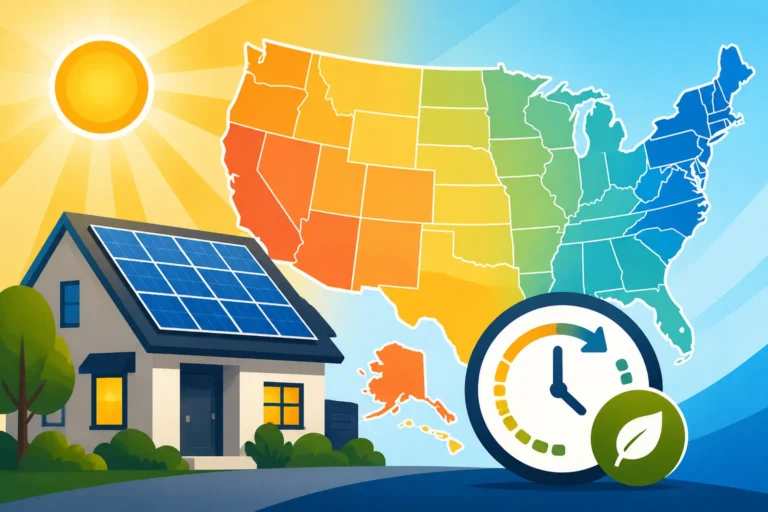
You'll find that some states are veritable solar sweet spots, offering much shorter payback periods than others. This is often due to a powerful combination of high electricity rates, abundant sunshine, and generous state-level incentives. For example, homeowners in Massachusetts and New Jersey often see some of the shortest payback periods, sometimes as low as 5-7 years. This is largely thanks to robust SREC markets, additional state tax credits, and utility rebates that significantly lower the net cost and boost annual savings. California, despite its recent changes to net metering (NEM 3.0), still offers a relatively good payback due to its sky-high electricity rates and strong solar market, even if the savings mechanism has shifted.
On the other hand, states with lower electricity rates or fewer state-specific incentives might see longer payback periods, perhaps ranging from 10-15 years or even more. Think about states in the central U.S. that have historically lower energy costs. While solar still offers long-term savings in these areas, the time it takes to recoup the initial investment will naturally be extended. To get a granular view of how your state stacks up, exploring resources like Best States for Solar Incentives in 2026 can be incredibly insightful. Additionally, understanding the Solar Panel Cost by State helps contextualize the initial investment side of the payback equation across different regions.
How Different Financing Options Impact Payback
The way you pay for your solar system also has a significant impact on your financial timeline. It's not just about the upfront cost; it's about how that cost is spread out and what additional fees might be involved.
- Cash Purchase: This option typically results in the shortest payback period because you avoid all interest charges, loan origination fees, and dealer fees. Your net upfront cost is just the system price minus incentives. All your monthly electricity savings go directly towards recouping that initial lump sum. It's the most financially efficient path if you have the capital readily available.
- Solar Loans: Financing your solar panels with a loan is a popular choice for homeowners who prefer not to pay a large sum upfront. However, a loan will extend your payback period compared to a cash purchase. You'll be paying interest on the loan, which adds to the overall cost of the system. While your monthly loan payments might be less than your previous electricity bill, the total amount you pay over the loan term will be higher than the cash price. The key is to find a loan with competitive interest rates and minimal dealer fees to keep your total costs down. Our guide on Solar Loan vs Lease: Pros and Cons delves into this further, helping you weigh your options.
- Solar Leases or Power Purchase Agreements (PPAs): With leases and PPAs, you don't actually own the solar panels. Instead, you pay a fixed monthly fee (lease) or a per-kWh rate for the electricity generated (PPA) to the solar company. In these scenarios, there isn't a traditional "payback period" for you as the homeowner, because you haven't made an initial investment to recoup. Instead, the benefit is immediate monthly savings on your electricity bill, usually starting from day one. While you won't get the full long-term financial return of ownership, it's a way to go solar with zero upfront cost and predictable energy expenses. For a detailed comparison of options, check out Cash vs Financing Solar: Which Saves More().
Shortening Your Solar Payback Period
Everyone wants to get to that "break-even" point faster. While some factors like electricity rates are beyond your direct control, there are several strategic steps you can take to significantly reduce your solar panel payback period and maximize your financial returns.
Maximizing Incentives and Rebates
The single most impactful way to shorten your payback period is to reduce your net upfront cost, and incentives are your best friend here. It's crucial to be proactive and thorough in researching every available program. Start with federal incentives, making sure you understand the current status of programs like the Investment Tax Credit. Then, dive into state-specific offerings. Some states offer substantial cash rebates or performance-based incentives (PBIs) that pay you for every kilowatt-hour your system produces.
Don't forget local programs either; some cities or counties have their own initiatives. Actively participating in an SREC market, if available in your state, can provide a steady stream of income that directly contributes to your annual savings. For instance, in states like New Jersey or Massachusetts, selling SRECs can dramatically shave years off your payback time. Lastly, a well-structured net metering agreement from your utility is paramount. Net Metering Explained: How It Works by State will show you how these programs allow you to send excess solar electricity back to the grid for credits, effectively expanding your savings potential. The more you reduce your initial outlay or boost your annual financial benefits, the quicker you'll reach payback.
Optimizing System Design and Energy Efficiency
A well-designed solar system is one that produces the maximum amount of electricity possible for your home's needs. This means ensuring your panels are installed at the optimal angle and orientation (typically south-facing in the Northern Hemisphere) and are free from shading throughout the day. Even a small amount of consistent shading can significantly reduce a panel's output, especially with string inverter systems. Work closely with your installer to ensure the system is perfectly sized for your energy consumption, preventing over- or under-production that could impact your financial efficiency.
Beyond the solar system itself, improving your home's overall energy efficiency can be a game-changer. By reducing your household's energy demand before installing solar, you might be able to install a smaller, less expensive system to meet your remaining needs. Simple upgrades like LED lighting, efficient appliances, improved insulation, or even smart thermostats can lower your baseline energy use. This means a smaller initial investment for the solar system, which directly translates to a faster payback period, as you're recouping a lower cost with your generated savings.
Strategic Installer Selection and System Monitoring
The installer you choose is more than just a contractor; they're your partner in this long-term investment. Taking the time to compare multiple quotes is incredibly important. Don't just look at the bottom-line price; scrutinize what's included in the quote, the quality of the equipment being offered (panels, inverters, batteries), and the warranties provided for both equipment and workmanship. Reputable companies will offer transparent pricing and comprehensive warranties that protect your investment for decades. Services like Modernize can connect you with pre-vetted installers, making the comparison process much easier and helping you find the best value.
Once your system is installed and operational, continuous monitoring is key. Most modern solar systems come with monitoring apps that allow you to track your daily, monthly, and annual energy production. Regularly checking these figures helps you ensure your system is performing as expected. If you notice a sudden drop in production, it could signal an issue, like a dirty panel, a malfunctioning inverter, or even a system fault. Catching and addressing these problems quickly ensures your system is always operating at peak efficiency, maximizing your savings and keeping your payback timeline on track.
Beyond Payback: Other Financial Benefits of Going Solar
While the payback period is a crucial metric, it only tells part of the financial story of going solar. Focusing solely on when you break even overlooks the significant and ongoing financial advantages that continue long after your system has paid for itself. These benefits contribute to your overall financial well-being and the long-term value of your home.
Increased Home Value and Market Appeal
One of the often-underestimated financial benefits of solar panels is their positive impact on your property value. Studies consistently show that homes equipped with solar energy systems sell for a premium compared to comparable non-solar homes. For example, a report by Zillow found that solar homes sold for an average of 4.1% more than comparable homes. This isn't just a national average; the premium can be even higher in popular solar markets.
Think of it as adding a valuable amenity that provides immediate, tangible savings to the next homeowner. A solar system not only makes your home more appealing to environmentally conscious buyers but also to anyone looking to reduce their monthly expenses. When you eventually decide to sell, having an established, money-saving solar system can differentiate your property in a competitive market, potentially leading to a faster sale and a higher closing price. This increase in equity and market desirability is a significant part of the overall return on investment, even if it's not directly part of the "payback period" calculation. For more details, consider reading Do Solar Panels Increase Home Value?.
Protection Against Rising Electricity Costs
Perhaps one of the most compelling long-term financial arguments for solar is its ability to shield you from volatile and ever-increasing electricity rates. Utilities frequently petition for rate hikes, and over the decades, the cost of grid electricity has consistently trended upwards. When you install solar panels, you essentially lock in your electricity costs for a significant portion of your energy needs, often for 25 years or more.
Imagine having a predictable energy bill while your neighbors watch their bills climb year after year. This long-term stability provides immense financial security. For example, if your utility rates increase by 3% annually, your savings from solar will grow larger each year, making your investment even more valuable over time. This hedge against inflation and utility rate volatility provides a financial peace of mind that's hard to quantify but deeply felt by homeowners who have made the switch. It's like pre-paying for decades of electricity at today's prices, a truly powerful financial strategy.
Environmental Impact and Energy Independence
Beyond the direct financial returns, many homeowners are also motivated by the significant non-financial benefits of going solar. Reducing your carbon footprint and contributing to a cleaner environment is a powerful driver for many. Every kilowatt-hour your solar panels generate is clean, renewable energy that displaces electricity produced from fossil fuels, leading to fewer greenhouse gas emissions. This aligns with a growing global consciousness about climate change and sustainable living.
Furthermore, solar offers a significant step towards energy independence. By generating your own power, you become less reliant on a centralized utility grid, which can be susceptible to outages, price fluctuations, and infrastructure issues. For some, this means the ability to keep essential appliances running during a power outage, especially when paired with a solar battery. This sense of self-sufficiency and contribution to a more sustainable future offers a profound, intrinsic value that goes beyond mere dollars and cents.
Common Misconceptions About Solar Payback
The world of solar energy can sometimes feel like a maze, especially with all the marketing noise and varying information out there. It's easy to fall prey to common misconceptions that can skew your understanding of the solar payback period and the overall financial picture. Let's clear up some of these popular misunderstandings.
The "Free Solar" Myth and Hidden Costs
You've probably seen ads or heard sales pitches promising "free solar" or "$0 down solar." While it's true that many financing options require no money upfront, it's crucial to understand that solar panels are never truly "free." These $0-down options typically involve either a solar lease, a Power Purchase Agreement (PPA), or a solar loan where the upfront costs are rolled into the financing. With a lease or PPA, you're paying a monthly fee to use the solar panels owned by another company, or buying the power they produce. While you get immediate savings on your electricity bill, you don't own the system and won't get the same long-term financial returns as an owner.
If you choose a $0-down solar loan, you will indeed own the system, but you'll be making monthly loan payments that include interest. What often goes unmentioned are "dealer fees," which are essentially loan origination fees charged by the solar installer to the lender, and then passed on to you, the homeowner, usually by being rolled into the loan principal or a higher interest rate. These fees can add thousands of dollars to your total system cost and can significantly extend your loan's term and, consequently, your true financial payback. Always ask for a transparent breakdown of all fees and interest rates. Our article on Solar Dealer Fees Explained Hidden Loan Costs provides a deep dive into these often-overlooked expenses.
Payback Period vs. Overall ROI
One of the biggest areas of confusion is the difference between the "payback period" and "Return on Investment" (ROI). While related, they are distinct financial metrics that tell you different things. The payback period, as we've discussed, is simply the time it takes for your cumulative savings to equal your initial investment. It answers the question: "When do I break even?"
Return on Investment (ROI), on the other hand, is a broader and more comprehensive measure of profitability over the entire lifespan of your solar system. ROI calculates the total financial gain (or loss) relative to the initial investment, usually expressed as a percentage. It considers not just when you break even, but all the money you save and potentially earn over 25 or 30 years, well beyond the payback point. For example, a system might have a payback period of 8 years, but its overall ROI over 25 years could be 200-300% or more, meaning you've gained two or three times your initial investment. So, while the payback period is a good indicator of when your cash outflow stops, the ROI paints the full picture of your long-term financial prosperity from going solar. To truly understand the long-term gains, you'll want to explore the Solar ROI 25-Year Savings Breakdown.
Disclaimer
The information provided in this article is for general informational purposes only and does not constitute financial, tax, or legal advice. Solar incentive programs, costs, and regulations are subject to change. Readers should consult with qualified professionals for advice tailored to their specific situation.