How Much Can You Save With Solar Panels?
Watching your monthly utility bill climb higher every single year is a special kind of frustration, especially when you feel like you aren't even using more power. You do everything right—turn off the lights, upgrade the fridge, nudge the thermostat—yet the bill stays stubbornly high. This guide is designed to cut through the marketing fluff and show you exactly how much you can save with solar panels, helping you reclaim control over your household budget.
The Mechanics of How Solar Panels Actually Save You Money
To understand savings, you first have to understand that your solar system is essentially a tiny, private power plant sitting on your roof. Every kilowatt-hour (kWh) of electricity your panels produce is a kilowatt-hour you do not have to buy from your utility company. If your utility charges you $0.25 per kWh and your panels produce 1,000 kWh in a month, you’ve essentially "earned" $250 by not spending it. This is the most direct form of savings, often referred to as "behind-the-meter" consumption.
However, solar savings aren't just about what you use while the sun is shining. In many parts of the country, your panels will produce more energy during the middle of the day than your home actually needs. Instead of that energy going to waste, it flows back into the electrical grid. How you are compensated for that excess power is the biggest variable in your total savings. This is where Net Metering Explained: How It Works by State becomes vital. If you live in a state with "retail" net metering, the utility gives you a one-to-one credit for every drop of energy you send back. If you live in a state that has shifted toward net billing, like California under the new rules, the math changes significantly.
The psychological relief of a "zeroed out" bill is real, but there are still fixed costs. Even with a massive solar array, most utilities charge a monthly connection fee, usually between $10 and $30, just to keep your home hooked up to the grid for nighttime use. When calculating your savings, you have to subtract these unavoidable fees from your gross production. I’ve spoken to homeowners in places like Arizona who were shocked to find a $20 bill even though they produced twice as much power as they used; that connection fee is the culprit, and it's a realistic detail you must plan for.
Estimating Your Annual and Lifetime Solar Savings
When we talk about the big picture, annual savings usually range from $1,000 to $3,000 for a standard American home. But looking at it year-by-year actually undersells the value. Solar is a long game. Most panels are warrantied for 25 years, and they often keep humming along well past that. If you save $2,000 in your first year, and utility rates continue to rise at a modest 3% to 5% annually, your savings in year 20 could be closer to $3,500 or $4,000 for that same amount of power.
Lifetime savings often exceed $50,000 to $70,000 in high-cost states like Massachusetts or California. To get a handle on these numbers, you really need to look at Solar Panel Cost by State to see how your local electricity rates compare. In states with cheap coal or gas power, your savings might be lower, extending the time it takes to see a full return on your investment. Conversely, in the Northeast, where electricity prices have historically been some of the highest in the nation, solar panels can pay for themselves in under six years.
Another layer of savings involves the increased equity in your home. It’s a common worry that solar panels make a house harder to sell, but the data often suggests the opposite. A home that comes with a $0 or $20 monthly power bill is significantly more attractive to a buyer than the identical house next door with a $300 bill. You aren't just saving on your monthly cash flow; you are essentially pre-paying 25 years of electricity at a fixed, lower rate, which adds tangible value to the property.
Factors That Dictate Your Specific Savings Potential
Not every roof is created equal, and your neighbor's savings might look nothing like yours. The first major factor is your roof's orientation. In the Northern Hemisphere, south-facing roofs are the "gold standard" because they catch the most direct sunlight throughout the day. If your roof faces east or west, you can still save money, but you might need a few more panels to produce the same amount of power. North-facing roofs are generally a no-go unless the pitch is very shallow, as the lack of direct sun significantly hampers production and kills your ROI.
Shading is the silent killer of solar savings. Even a small chimney or a single limb from a beautiful oak tree can cast a shadow that shuts down a large portion of a traditional string inverter system. This is why many modern installations use microinverters or power optimizers, which allow each panel to operate independently. If one panel is shaded, the others keep cranking out power. When you're using tools like Modernize to find local pros, make sure to ask for a detailed shading analysis. A reputable installer should be able to show you exactly how much production you’ll lose to that neighbor's overgrown pine tree.
Your personal energy habits also play a massive role. If you are a "daytime" user—perhaps you work from home, run the dishwasher at noon, and charge your EV during the day—you are maximizing your solar savings by using your own power directly. If you are away all day and do all your heavy lifting at 8:00 PM, you are relying on your utility's credit system. In states that have moved away from full net metering, like those under What Is NEM 3.0 (California Net Billing)?, using your power as it’s generated is the secret to keeping your savings high.
| Region | Avg. Monthly Bill (Pre-Solar) | Est. Annual Savings | Est. 25-Year Savings |
|---|---|---|---|
| Northeast (NY, MA, NJ) | $220 | $2,400 | $85,000+ |
| Southwest (AZ, NV, CA) | $280 | $3,100 | $105,000+ |
| Southeast (FL, GA, NC) | $160 | $1,700 | $55,000+ |
| Midwest (IL, OH, MI) | $140 | $1,400 | $45,000+ |
Comparing Financing Methods and Their Impact on ROI
How you pay for your system drastically changes the math of your savings. Cash is king if you want the highest total return. By paying upfront, you avoid interest charges and "dealer fees" that can add 20% to 35% to the cost of a financed system. When you own the system outright, every penny of electricity generated is pure profit after you hit the break-even point. You can find more detail on this in our guide on Solar Panel Payback Period Explained, which helps you visualize that "sweet spot" where the system has paid for itself.
Solar loans are the most popular choice because they allow you to go solar with $0 down. The goal here is "bill substitution." If your current electric bill is $200 and your solar loan payment is $150, you are saving $50 a month from day one. However, you have to be careful with interest rates and loan terms. A 25-year loan might have a very low monthly payment, but you’ll end up paying significantly more for the system over time, which eats into your long-term savings. I always tell people to look for shorter-term loans if they can afford the monthly jump, as it clears the debt faster and leads to more years of "free" energy.
Leases and Power Purchase Agreements (PPAs) are a bit different. In these scenarios, a third party owns the panels on your roof, and you simply buy the power they produce at a lower rate than the utility charges. While this offers immediate savings with no maintenance responsibilities, you generally don't get the big tax incentives or the home value boost. It’s a great option for people who can't use the tax credits, but for the average homeowner, it usually results in the lowest lifetime savings compared to owning the system.
Maximizing Savings Through Incentives and Rebates
Even though the landscape for solar has shifted, there are still significant ways to shave thousands off your initial costs. Local utility rebates are often the most overlooked. Some power companies offer a flat "thank you" check for installing solar, while others might offer a rebate based on the size of your system. These programs are often capped and operate on a first-come, first-served basis, so it's worth checking State Solar Incentives: Complete 2026 Guide to see what’s currently active in your zip code.
Property tax exemptions are another hidden gem for savings. In many states, adding solar panels increases the value of your home, but the state forbids the tax assessor from raising your property taxes because of that specific upgrade. This means you get the benefit of a more valuable home without the annual penalty of higher taxes. Similarly, many states offer sales tax exemptions, which can save you 6% to 9% right off the top of your installation contract. When you're browsing Modernize to compare quotes, ask the installers if their price includes these local tax considerations.
Performance-based incentives, such as SRECs Explained: Selling Solar Renewable Energy Credits, provide an ongoing "paycheck" for your solar production. In states like New Jersey or Massachusetts, you earn credits for every megawatt-hour your system produces, which you can then sell on an open market. This is "found money" that sits on top of your utility bill savings. For a large residential system, SREC income can add up to several hundred dollars a year, significantly shortening your payback period.
The Role of Battery Storage in Protecting Your Savings
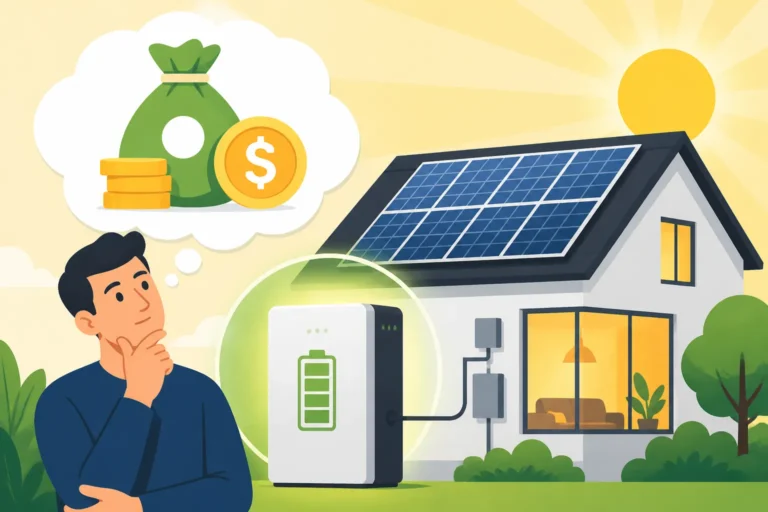
The conversation about solar savings is inseparable from battery storage. As utilities shift toward Time-of-Use (TOU) rates, electricity becomes much more expensive during the late afternoon and early evening—exactly when your solar panels are starting to wind down for the day. Without a battery, you are forced to buy expensive power from the grid during these "peak" hours. With a battery, you can store the cheap solar energy you produced at noon and use it at 6:00 PM when rates are highest.
This "load shifting" can save you an additional 20% to 40% on your bill in high-TOU areas. Beyond the daily financial math, there is the "resilience value" of a battery. While it’s hard to put a specific dollar amount on the peace of mind that comes from keeping your lights, fridge, and Wi-Fi running during a blackout, most homeowners find it's worth the extra investment. You should definitely look into Solar Battery Incentives in 2026 to see if your state offers "Bring Your Own Device" (BYOD) programs, where the utility actually pays you to use your battery to help stabilize the grid during heatwaves.
It's also important to consider the long-term maintenance. Batteries generally have a 10-to-15-year lifespan, which is shorter than the panels themselves. When calculating your 25-year savings, you should factor in the cost of one battery replacement. Even with that future cost, the ability to avoid high peak-hour rates usually makes the battery a net positive for your wallet. If you're still on the fence, check out Are Solar Panels Worth It in 2026? for a deeper dive into the total value proposition of modern solar-plus-storage systems.
Common Misconceptions That Inflate Savings Expectations
One of the biggest mistakes I see people make is assuming they will never have another electric bill. As I mentioned earlier, those connection fees are persistent. Additionally, if you have a particularly cloudy month or a snowy winter, your production will dip. You have to look at solar savings as an annual average rather than a guaranteed monthly amount. Some months you will have a massive credit sitting on your account, and other months you might owe the utility $40. It’s all about how it balances out over the year.
Another misconception is that solar panels require zero maintenance. While they are incredibly durable, they aren't magic. Dust, pollen, and bird droppings can create a film over the panels that reduces efficiency by 5% to 10%. In most cases, a good rainstorm handles this, but in arid climates, you might need to hosing them down or hire a professional cleaner once a year. This is a small cost, but it's one you should track. If you're worried about the long-term durability, reading about Solar Panel Warranties Explained can help you understand what's covered and what's on you to maintain.
Finally, don't assume that a bigger system always means bigger savings. There is a point of diminishing returns. If you install a system that produces 150% of your energy needs, but your utility only pays you a "wholesale" rate for that extra 50%, you are spending thousands of dollars on panels that will take 20 years to pay for themselves. Sizing your system correctly—ideally aiming for 100% to 110% of your historical usage—is the smartest way to ensure a high ROI. Use a platform like Modernize to get multiple expert opinions on the right system size for your specific roof and usage patterns.
Final Thoughts on Achieving Maximum Savings
At the end of the day, home solar is one of the few home improvements that actually pays you back. Unlike a kitchen remodel or a new deck, which are "sunk costs" that you hope to recover when you sell, solar panels start putting money back into your pocket the moment the utility company gives you What Is Permission to Operate (PTO)?. It’s about more than just the environment; it’s about insulating your family from the unpredictable nature of energy markets.
To get the most out of your investment, be an active participant in your energy usage. Monitor your system's production through its app, try to run your heavy appliances when the sun is high, and keep an eye on your utility's rate changes. The homeowners who save the most aren't just the ones with the best roofs; they are the ones who understand how to make the technology work for their specific lifestyle. Whether you are looking for a massive 25-year profit or just a little extra breathing room in your monthly budget, solar remains a powerful tool for financial independence.
Disclaimer
The information provided in this guide is for educational purposes only and does not constitute financial, legal, or tax advice. Solar savings, incentives, and utility regulations vary significantly by location and are subject to change. Always consult with a qualified solar professional and a tax advisor to understand the specific costs and benefits for your situation. Information regarding 2026 incentives is based on current projections and available program data at the time of writing.