How to Compare Solar Installer Quotes
It's no secret that getting solar quotes can feel like navigating a maze blindfolded. You're trying to compare different companies, varying equipment, and wildly diverse price structures, all while wondering if you're truly getting the best deal. This guide is designed to cut through that confusion, giving you the practical tools and insights you need to confidently compare solar installer quotes and choose the right system for your home.
Understanding the Basics of a Solar Quote
When you first start collecting solar quotes, it can feel like you're reading a foreign language. Every company seems to present information a little differently, using terms that might not be immediately clear. But don't let that intimidate you! The key is to understand the fundamental building blocks of any solar proposal, so you can break down each quote into manageable, comparable pieces.
Key Components You'll See
A standard solar quote isn't just a price tag; it's a detailed blueprint of your potential solar energy system. You should expect to see several core components clearly outlined. First and foremost, every quote will specify the system size, typically measured in kilowatts (kW). This refers to the total power output capacity of your solar array. It's a crucial number because it directly relates to how much electricity your system will generate and, consequently, how much of your current utility bill it will offset. For instance, a 7 kW system will produce significantly more power than a 4 kW system, assuming similar sun exposure.
Next, you’ll find a breakdown of the equipment. This usually includes the specific brand and model of solar panels, inverters (which convert the DC electricity from panels into AC electricity your home uses), and sometimes racking systems or monitoring hardware. You might see a quote for premium panels like those from Maxeon (SunPower) or REC, known for their high efficiency, versus more budget-friendly options from brands like Jinko Solar or Canadian Solar. Each component has its own specifications, warranties, and performance characteristics, all of which contribute to the overall value and longevity of your system.
Finally, the quote will detail the total cost of the system, often presented as a lump sum or broken down into equipment, labor, and permitting fees. This section is where things can get particularly tricky because it often includes various payment options and potential incentives. You might see the "gross cost" before any incentives, and then a "net cost" after applying an estimated federal solar tax credit or state rebates. Understanding these different cost layers is vital for an accurate comparison.
Recognizing Common Terminology
Beyond the basic components, solar quotes are riddled with industry jargon that can be baffling if you're not prepared. One of the most important terms is price per watt ($/W). This metric is calculated by dividing the total system cost by the system size (in watts, not kilowatts). For example, a 10,000-watt (10 kW) system costing $30,000 would have a price per watt of $3.00. This is an excellent standardized way to compare the cost-effectiveness of different quotes, even if the total system sizes vary. You'll want to aim for a competitive price per watt for your area.
Another term you'll frequently encounter is net metering. This refers to a billing mechanism that credits solar energy system owners for the electricity they add to the grid. If your solar panels produce more electricity than you use, that excess power is sent back to the utility grid, and your meter essentially runs backward, earning you credits. The specifics of net metering policies vary significantly by state and utility provider, so understanding how it applies to your situation, especially if you're in a state like California with its NEM 3.0 rules, is crucial for projecting your long-term savings. You can learn more about how it works by state by checking out our guide on Net Metering Explained: How It Works by State.
You’ll also see discussions around production estimates, often in kilowatt-hours (kWh) per year. This is the projected amount of electricity your system will generate annually, taking into account factors like your roof's tilt, orientation, shading, and local weather patterns. Installers use sophisticated software to calculate these estimates, which are vital for determining your expected energy bill savings. A reliable quote should include a clear, conservative production estimate, often backed by industry-standard tools. Don't be afraid to ask an installer to walk you through their production modeling and explain how they arrived at their numbers.
Decoding System Design and Equipment
Once you've got a handle on the basic layout and language of a solar quote, it's time to dive into the specifics of the actual system. This is where the real differences between proposals often emerge, influencing not just the upfront cost but also the long-term performance and reliability of your investment. Think of it like comparing cars: two might get you from A to B, but the engine, features, and build quality vary wildly.
Panel Type, Efficiency, and Wattage
The solar panels themselves are often the most visible component of your system, and quotes will provide details about their type, efficiency, and individual wattage. Most residential solar panels today are monocrystalline, known for their sleek black appearance and higher efficiency compared to older polycrystalline panels. You might even see advanced technologies like TOPCon or HJT (heterojunction technology) panels, which push efficiency boundaries even further. The higher the panel efficiency (expressed as a percentage, e.g., 21%), the more electricity it can generate from a given area of sunlight. This is particularly important if you have limited roof space.
Alongside efficiency, you'll see the wattage of individual panels, typically ranging from 350 to 450 watts or more. A higher wattage panel means you need fewer physical panels to achieve a certain system size. For instance, if you need a 8 kW system, you could achieve that with twenty 400W panels (20 x 400 = 8000W) or eighteen 450W panels (18 x 450 = 8100W). Fewer panels can sometimes mean less labor and a cleaner aesthetic. It's crucial to compare not just the total system size, but also the specific panel models offered and their specs, as this impacts how well your system performs in various conditions and how long it will last. Quality brands like Qcells, Silfab, and LG (though LG has scaled back solar panel production) are often highlighted for their performance and durability. Our guide on the Best Solar Panels of 2026 can offer more insights into leading options.
Inverter Technology: Microinverters vs. String Inverters
The inverter is the brains of your solar system, converting the DC electricity from your panels into usable AC power for your home. You'll typically be offered one of two main technologies: string inverters or microinverters. A string inverter connects multiple panels in a "string" to a single central inverter, usually located near your electrical panel. While more cost-effective upfront, if one panel in the string is shaded or underperforms, it can affect the output of all panels in that string.
Microinverters, on the other hand, are small inverters attached to each individual solar panel. This means each panel operates independently, optimizing its own output. If one panel is shaded by a tree branch or bird droppings, the rest of your system continues to produce at full capacity. Brands like Enphase are leading the charge with microinverter technology. SolarEdge offers a hybrid solution with power optimizers on each panel that feed into a central string inverter, combining some benefits of both. Microinverters and optimizers also often come with panel-level monitoring, allowing you to track the performance of each individual panel, which can be invaluable for troubleshooting. Understanding the pros and cons of these technologies is key, especially if your roof experiences partial shading. Learn more about the differences in our article Microinverter vs String Inverter: Pros and Cons.
Battery Storage Options
Increasingly, solar quotes include options for battery storage, and this is a component that can significantly impact both your upfront cost and long-term energy independence. A solar battery, like a Tesla Powerwall or Enphase IQ Battery, stores excess solar energy produced during the day for use at night or during power outages. This is especially valuable in areas with less favorable net metering policies, where storing and self-consuming your solar power maximizes savings.
When comparing battery options, look at the storage capacity (measured in kWh), power output (kW, indicating how many appliances it can run simultaneously), and the round-trip efficiency. Also, consider the battery's warranty, cycle life, and whether it offers whole-home backup or just critical load backup. Some batteries are designed to seamlessly integrate with specific inverter brands (e.g., Enphase batteries with Enphase microinverters), creating a more unified and efficient system. The inclusion of a battery can drastically alter the overall system cost, but it can also provide immense peace of mind and greater financial returns in certain scenarios, especially if grid outages are common in your area.
The Financial Deep Dive: Costs and Savings
This is often the section that causes the most stress and confusion. Solar quotes can have wildly different bottom lines, and it’s not always obvious why. To truly compare, you need to dissect the financial proposals, understanding not just the sticker price but also the underlying cost per watt, the incentives that apply, and the long-term implications of different financing methods.
Total System Cost and Price Per Watt
The total system cost is the headline number everyone looks at first. However, it's really just the starting point for your financial analysis. This figure should encompass everything: panels, inverters, racking, labor, design, permitting, and interconnection fees. Be wary of quotes that seem unusually low; they might be excluding vital components or services that you'll have to pay for later. It's perfectly acceptable to ask for a detailed line-item breakdown if the quote is vague.
As mentioned earlier, the price per watt ($/W) is your equalizer. This metric allows you to compare the value of different-sized systems fairly. While the national average price per watt can fluctuate, it gives you a benchmark. For instance, in 2024, a good price per watt might be in the range of $2.75 to $3.50, depending on your location, equipment choices, and installer. If one quote comes in at $4.50/W and another at $2.80/W for similar equipment and services, that's a significant red flag or green light, respectively, that warrants further investigation. Don't just accept the total price; always calculate the price per watt yourself to ensure you're getting a competitive deal. Our comprehensive guide on Solar Panel Cost Per Watt Explained offers more details on how this works.
Unpacking Incentives and Rebates
One of the biggest factors influencing your final cost is the availability of solar incentives and rebates. The most significant incentive is usually the federal solar tax credit (also known as the Investment Tax Credit, or ITC), which allows you to claim a percentage of your system cost as a credit on your federal taxes. This credit is available until 2032, making a substantial difference in the net cost of your system. You'll want to ensure that all quotes accurately reflect the current federal tax credit. For instance, you can learn more about Federal Solar Incentives That Still Exist in 2026.
Beyond the federal incentive, many states, local governments, and utility companies offer their own programs. These can include:
- State tax credits: Some states, like New York, offer additional state tax credits for solar installations.
- Performance-based incentives (PBIs): Programs like Solar Renewable Energy Credits (SRECs) or similar mechanisms in states like New Jersey (SREC-II/SuSI) or Massachusetts (SMART program) pay you for the electricity your system generates. These can add significant value over time.
- Property and sales tax exemptions: Many states offer exemptions that prevent solar panels from increasing your property taxes or exempt you from paying sales tax on the equipment.
- Utility rebates: Your local utility company might offer a direct rebate for installing solar.
A comprehensive quote should clearly outline all applicable incentives, providing estimated savings. Be sure to verify these incentives yourself, as they can change, and not all installers are equally knowledgeable about every local program. Don't just assume the installer has found every available incentive; do your own research or use resources like the DSIRE database. For general information on where to look, our guide on State Solar Incentives: Complete 2026 Guide can be a good starting point.
Understanding Financing Options (Loans, Leases, PPAs)
How you pay for your solar system is just as important as the system's cost itself. Installers typically offer several financing options, each with its own advantages and disadvantages.
- Cash Purchase: This is the simplest option, offering the greatest long-term savings and the highest ROI, as you avoid interest payments and capture all available incentives directly.
- Solar Loan: A common choice, solar loans allow you to own the system with little or no upfront cost. You make monthly payments, similar to a mortgage. Be sure to compare interest rates (APR), loan terms, and any hidden fees, like "dealer fees" or "loan origination fees," which can inflate the true cost of your loan. A good solar loan should have transparent terms and competitive rates. Our Solar Loans: Complete Guide covers everything you need to know.
- Solar Lease: With a solar lease, you don't own the system. Instead, you pay a fixed monthly fee to the solar company for the right to use the electricity it generates. The solar company owns, maintains, and monitors the system. While it often means $0 down, you typically don't qualify for the federal tax credit or other ownership-based incentives, and your long-term savings are usually less compared to ownership.
- Power Purchase Agreement (PPA): Similar to a lease, a PPA means the solar company owns the system on your roof, but instead of a fixed monthly payment, you agree to buy the electricity produced by the panels at a fixed, usually lower-than-utility, rate per kWh. This can offer predictable savings with no upfront cost, but again, you don't receive ownership incentives.
A good quote will present these options clearly, detailing the expected monthly payments, total costs over the contract term, and estimated savings. It's critical to understand the distinction between owning and leasing, as it impacts everything from tax benefits to how the system affects your home's value. Check out our in-depth comparison of Solar Lease vs PPA vs Buy: Which Is Best? for more insight.
Evaluating Installer Reputation and Service
Even the best equipment and the most attractive pricing can fall short if the installer isn't reputable. The solar industry has seen its share of fly-by-night operations, and choosing the right partner for such a significant home improvement project is paramount. This isn't just about installation day; it's about a relationship that could last for decades.
Experience, Certifications, and Warranties
When you're evaluating installers, look beyond the sales pitch. Experience matters. How long has the company been in business? How many installations have they completed in your area? A company with a proven track record, especially with local references, indicates stability and expertise. Ask about their team's certifications, particularly if they have NABCEP (North American Board of Certified Energy Practitioners) certified installers on staff. This is a gold standard for solar professionals.
Warranties are another critical piece of the puzzle. There are generally three types you'll encounter:
- Equipment warranty: Covers the solar panels (typically 25-30 years for performance, 12-25 years for product defects) and inverters (10-25 years).
- Workmanship warranty: Covers the quality of the installation itself, typically ranging from 10 to 25 years. This is crucial; you want assurance that your roof won't leak and your system will be properly installed.
- Production guarantee: Some installers offer a guarantee on how much power your system will produce. If it falls short, they might compensate you or fix the issue.
Make sure these warranties are clearly spelled out in your quote and contract. Are they directly from the manufacturer, or is the installer providing an additional layer of coverage? What happens if the installer goes out of business? These are questions you need answers to, as they speak to the long-term protection of your investment. You can delve deeper into what to expect from these guarantees with our guide on Solar Panel Warranties Explained.
Customer Reviews and Red Flags
In today's digital age, information about installer reputation is readily available. Take the time to scour online reviews on platforms like Google, Yelp, and the Better Business Bureau. Look for consistent themes: are customers praising good communication, on-time installation, and effective problem-solving? Or do you see recurring complaints about delays, poor customer service, or unmet promises? Don't just look at the star rating; read the actual comments. A few negative reviews are normal for any business, but a pattern of serious issues should give you pause.
Beyond online reviews, be aware of common red flags in the sales process. High-pressure sales tactics, demands for immediate decisions, or quotes that seem too good to be true are all warning signs. Some installers might quote an incredibly low price per watt, only for hidden fees to emerge later. Others might try to push you into a financing option that benefits them more than you. A reputable installer will be transparent, patient, and willing to answer all your questions without rushing you. If an installer seems unwilling to explain their process or provides vague answers, it's probably best to move on. Our article on Solar Installer Red Flags to Watch For offers more detail on what to look out for.
Post-Installation Support and Monitoring
Your relationship with a solar installer doesn't end when the panels are on your roof. What kind of post-installation support do they offer? Do they provide assistance with getting your Permission to Operate (PTO) from the utility? Will they help you set up and understand your monitoring system? Many systems come with apps (e.g., from Enphase or SolarEdge) that allow you to track your real-time production and consumption. A good installer will ensure you know how to use these tools and are comfortable with your new system.
Think about long-term maintenance. While solar panels require minimal maintenance, occasional cleaning or troubleshooting might be necessary. Will the installer be responsive if you have an issue years down the line? Some companies offer maintenance packages, while others rely on their robust warranties. Asking about their service response times and what resources they provide for ongoing support is a smart move. After all, you're making an investment that should last 25-30 years, and reliable support for that entire duration is invaluable.
Asking the Right Questions and Making the Final Choice
You've gathered quotes, parsed the equipment, analyzed the finances, and vetted the installers. Now comes the crucial step: putting it all together and making an informed decision. This stage involves proactive questioning and a methodical approach to comparison.
Essential Questions for Each Installer
Don't be shy about asking questions. A good installer will appreciate your thoroughness. Here's a checklist of questions to ask every solar company you're considering:
- "Can you provide a detailed breakdown of all costs, including equipment, labor, permitting, and interconnection fees?" This helps uncover hidden costs.
- "What specific panel and inverter models are you proposing, and what are their individual warranties (product, performance, and workmanship)?" This ensures you understand the hardware quality and protection.
- "How did you calculate my energy offset and annual production estimate? Can you show me the modeling software you used?" This helps verify the accuracy of their savings projections.
- "What financing options do you offer, and what are the full terms, including APR, loan origination fees, and any escalation clauses for leases or PPAs?" Critical for understanding the true cost of financing.
- "What is your typical installation timeline, from contract signing to Permission to Operate (PTO)?" Managing expectations for the process.
- "What are your customer service hours and response times for issues after installation?" Essential for long-term support.
- "Can you provide references from recent installations in my neighborhood?" Hearing directly from other homeowners is invaluable.
- "Are your installers employees or subcontractors? What certifications do they hold?" Addresses workmanship quality and company structure.
- "How do you handle the permitting and utility interconnection process?" Ensures they manage the bureaucratic hurdles. Our article on Solar Permitting & Interconnection (PTO) Explained provides a good overview of this process.
- "What happens if my system doesn't produce the amount of energy you've guaranteed?" Clarifies any production guarantees.
Asking these questions consistently across all installers will give you a wealth of comparable information. If you’re having trouble finding installers or don't know where to start, platforms like Modernize can help you connect with pre-screened local solar professionals who can provide competitive quotes.
Comparing Apples to Apples
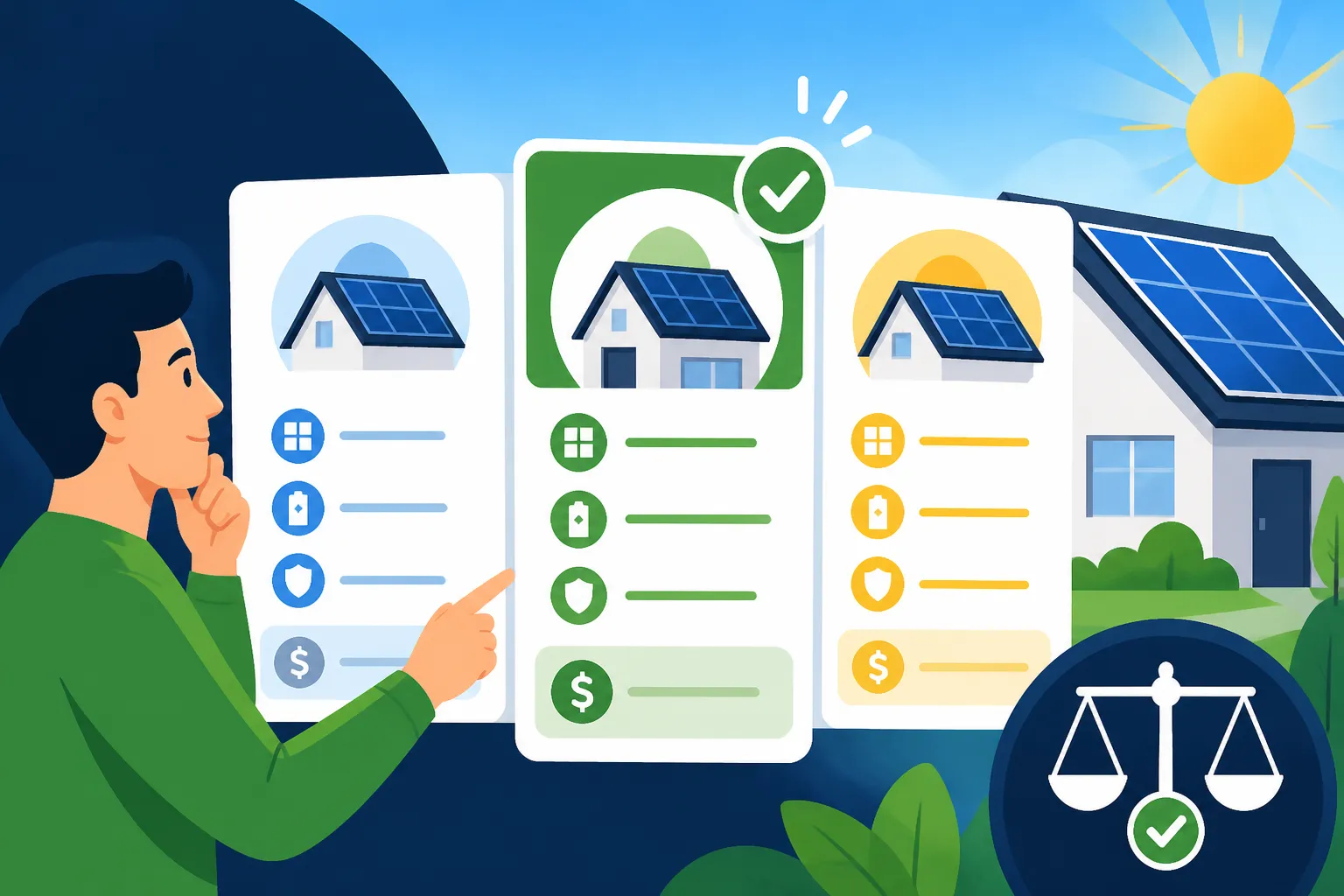
With all your questions answered and quotes in hand, it’s time for a side-by-side comparison. This is where a table can be incredibly helpful. Create a spreadsheet or simply a piece of paper with columns for each installer and rows for key metrics.
Here's a sample comparison table:
| Feature/Metric | Installer A (Example: "SunPower Dealers") | Installer B (Example: "Local Solar Pro") | Installer C (Example: "National Solar Company") |
|---|---|---|---|
| System Size (kW) | 8.0 kW | 7.8 kW | 8.2 kW |
| Panels (Brand/Model) | Maxeon 420W | Qcells Q.PEAK DUO G10+ 400W | Jinko Solar Eagle G2 390W |
| Inverter Type | Enphase IQ8 Microinverters | SolarEdge HD-Wave + Optimizers | String Inverter (SMA) |
| Total System Cost | $28,800 | $25,740 | $24,600 |
| Price Per Watt ($/W) | $3.60 | $3.30 | $3.00 |
| Est. Federal Tax Credit | $8,640 | $7,722 | $7,380 |
| Net Cost (after ITC) | $20,160 | $18,018 | $17,220 |
| Workmanship Warranty | 25 Years | 15 Years | 10 Years |
| Est. Annual Production (kWh) | 11,500 kWh | 11,000 kWh | 10,800 kWh |
| Financing Offered | Cash, Loan (1.99% APR) | Cash, Loan (2.99% APR, 10% Dealer Fee) | Cash, Loan (0.99% APR, 20% Dealer Fee), PPA |
| Online Review Rating | 4.8 Stars (150 reviews) | 4.5 Stars (80 reviews) | 3.9 Stars (500 reviews) |
Looking at this table, you can immediately see the nuances. Installer A offers premium equipment and a fantastic workmanship warranty, but at a higher price per watt. Installer C has the lowest price per watt, but perhaps less favorable warranties and a lower review score. Installer B is a good middle ground. This structured approach helps you weigh your priorities: Is a higher warranty more important than the absolute lowest price? Are you willing to pay more for microinverters if your roof has shading? How much does the financing impact the true cost?
Negotiating and Finalizing Your Contract
Once you've narrowed down your choices, don't be afraid to negotiate. You might even use competing quotes to encourage your preferred installer to match a lower price or offer a better warranty. However, remember that the cheapest quote isn't always the best. Value often lies in the balance of price, equipment quality, warranty, and installer reputation. If an installer is unwilling to budge or seems offended by negotiation, that's another data point about their customer service approach.
Before signing anything, meticulously read the entire contract. Ensure that everything discussed and promised verbally is explicitly written into the agreement. This includes system size, specific equipment models, warranties, payment schedules, production guarantees, and cancellation policies. Pay close attention to any clauses about transferring warranties if you sell your home. It's a significant financial commitment, so take your time, ask for clarifications on anything you don't understand, and perhaps even have an attorney or trusted advisor review it. Making a well-informed decision now will ensure a smooth solar journey for years to come.
Disclaimer
The information provided in this article is for general informational purposes only and does not constitute financial, tax, or legal advice. Solar incentives, costs, and regulations vary significantly by location and change frequently. We strongly recommend consulting with a qualified solar professional, financial advisor, and tax expert to discuss your specific situation before making any decisions related to solar energy.