Microinverter vs String Inverter: Pros and Cons
Deciding to go solar is a huge step, but once you start digging into the details, you quickly realize there are a lot of choices to make – and one of the most critical is selecting the right inverter for your system. It can feel overwhelming trying to understand the technical jargon and figure out which option truly fits your home's unique needs, especially when you hear terms like "microinverter" and "string inverter" being thrown around. This guide is here to break down the pros and cons of these two main types of solar inverters, helping you understand their differences so you can confidently choose the best setup for your clean energy journey.
Understanding the Role of a Solar Inverter in Your System
Before we dive into the nitty-gritty of different inverter types, let's clarify why this piece of equipment is so fundamentally important to your solar setup. It's often called the "brain" of your solar system, and for good reason! Without it, your solar panels would be generating power you couldn't actually use in your home.
What Exactly Does an Inverter Do?
At its core, a solar inverter performs a crucial electrical conversion. Your solar panels, those beautiful rectangles on your roof, produce direct current (DC) electricity when sunlight hits them. Think of DC as a one-way flow of electrons, like what you find in a car battery. However, almost all the appliances in your home – from your refrigerator to your phone charger, your lights to your TV – run on alternating current (AC) electricity. The electrical grid itself operates on AC.
This is where the inverter steps in. Its primary job is to take that DC power from your solar panels and convert it into usable AC power. This conversion needs to be done efficiently and reliably, ensuring that your home can seamlessly draw power from your solar panels, and if you're connected to the grid, that any excess power can be safely sent back to your utility company. It's a continuous process that happens from the moment your panels start generating electricity until the sun sets.
Why Your Inverter Choice Matters So Much
The type of inverter you choose isn't just about converting DC to AC; it impacts almost every aspect of your solar system's performance, reliability, and future flexibility. A good inverter choice can maximize your energy production, make monitoring easier, and allow for smoother system expansion down the line.
For instance, the efficiency of your inverter directly affects how much of that raw DC power actually makes it to your home as usable AC power. A less efficient inverter means you're leaving potential energy on the table. Beyond pure conversion, inverters are also responsible for safety features, like rapid shutdown capabilities, which are now often required by electrical codes to protect first responders. Furthermore, many modern inverters offer advanced monitoring features, giving you insights into how each panel is performing, which can be invaluable for diagnosing issues or simply understanding your energy production. Whether you're considering adding a Solar Battery Incentives in 2026 later or want to see detailed performance data, your inverter choice will dictate your options.
The Traditional String Inverter: Reliability and Simplicity
String inverters have been the workhorse of the solar industry for decades, representing a tried-and-true technology that's known for its straightforward design and robust performance in many scenarios. They are often the default choice for installers due to their cost-effectiveness and relatively simple installation process.
How String Inverters Work
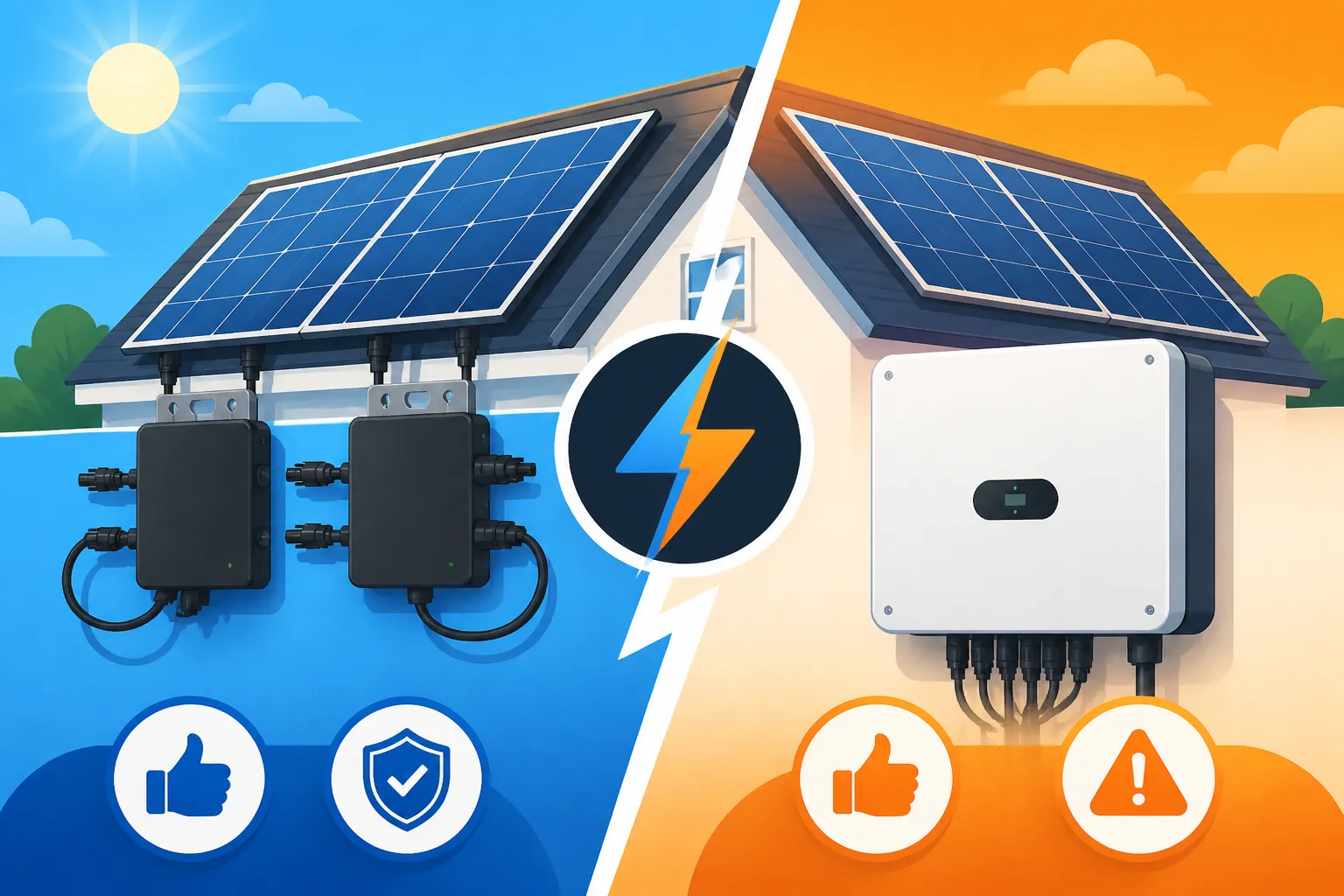
With a string inverter system, multiple solar panels are wired together in a "string" or series. Imagine a string of holiday lights where each bulb is a solar panel. The DC electricity from these panels flows down the string to a central inverter, typically located on the side of your house, in your garage, or in a utility area. This single, central unit then converts all the DC power from the entire string into AC power.
In a larger system, you might have two or more strings, each feeding into the same central inverter or, in some cases, multiple string inverters if the system is very large. The key characteristic here is the series connection: the output of the entire string is limited by the weakest performing panel within that string. If one panel is shaded or underperforming for any reason, it can reduce the output of all other panels in that specific string, much like how one dim bulb can affect the brightness of an entire string of older Christmas lights.
Advantages of String Inverter Systems
One of the most appealing aspects of string inverters is their lower upfront cost. Because you're typically dealing with one or two larger units rather than many smaller ones, the equipment and often the installation labor can be less expensive than other options. This makes them a very attractive choice for budget-conscious homeowners looking to get into solar.
Another significant advantage is their simpler troubleshooting. Since there's a central point of conversion, if your system isn't producing power, it's often easier to diagnose whether the issue lies with the inverter itself or the panel array. Technicians only have one or two main units to check, which can sometimes lead to quicker service calls. They also have a long track record, meaning the technology is well-understood, and many installers are highly experienced with them. You can learn more about how different inverters compare in our comprehensive guide to Solar Inverters: String vs Microinverter vs Optimizer.
Disadvantages and Limitations
Despite their advantages, string inverters come with notable limitations, especially when conditions aren't ideal. The biggest drawback is their susceptibility to shading. As mentioned, if even one panel in a string is shaded by a tree branch, a chimney, or even accumulated dust or bird droppings, the output of all panels in that string can be reduced to match the output of the weakest panel. This can significantly impact your overall energy production and, by extension, your savings. This is a critical consideration for homes with complex rooflines or nearby obstructions.
Another limitation is the single point of failure – if the string inverter fails, your entire solar system goes down. While modern inverters are very reliable, component failure is always a possibility. Furthermore, string inverters typically offer limited monitoring capabilities at the individual panel level. You usually see the total system output, but not how each specific panel is performing. This can make it harder to identify and address individual panel issues. Finally, future expansion can be challenging, as adding more panels might require a new string, which may not be compatible with the existing inverter's capacity or voltage requirements.
The Modern Microinverter: Performance and Flexibility
Microinverters represent a more recent technological advancement in the solar industry, designed to address many of the limitations inherent in traditional string inverter systems. They've gained significant traction for their ability to optimize panel performance, especially in less-than-ideal conditions.
How Microinverters Operate
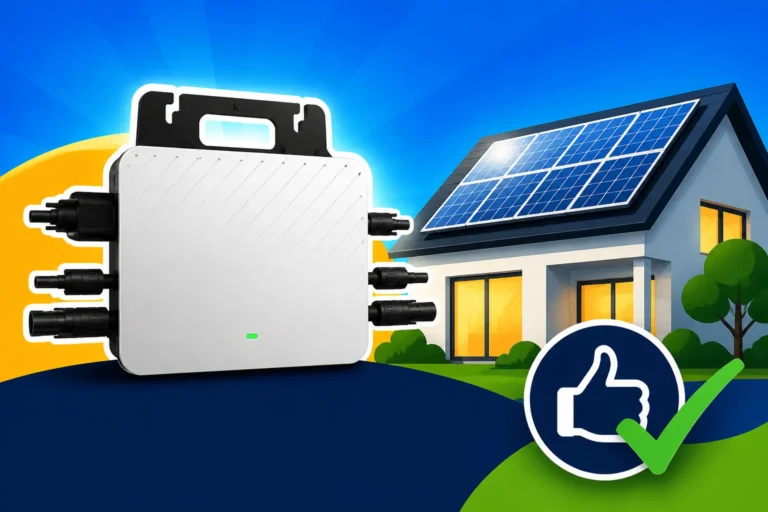
Instead of a single central inverter, microinverter systems utilize a small inverter installed directly underneath each individual solar panel. This means that the DC-to-AC conversion happens right at the panel level. Each microinverter independently takes the DC power from its assigned panel and converts it into AC power. These AC outputs are then combined and sent to your home's electrical panel.
This "panel-level power electronics" approach fundamentally changes how your system performs. Because each panel operates independently, the performance of one panel does not affect the others. If one panel is shaded, only that panel's output is reduced, while all other unshaded panels continue to produce at their maximum potential. This is a game-changer for homes with varied sun exposure throughout the day. Major brands like Enphase Energy are pioneers in this technology, offering advanced microinverter solutions. For a deeper dive into popular microinverter solutions, you might want to read Enphase vs SolarEdge: Which Inverter Is Better?.
Key Benefits of Microinverter Systems
The most compelling benefit of microinverters is their superior performance in shaded conditions. They effectively mitigate the "Christmas light effect" seen in string systems, ensuring that partial shading on one or a few panels doesn't bring down the entire array's output. This leads to higher overall energy production over the lifetime of your system, particularly for roofs with any amount of shading.
Another major advantage is panel-level monitoring. With microinverters, you get detailed data on the performance of each individual solar panel. This granular insight is incredibly valuable for identifying specific panels that might be underperforming due to dirt, damage, or manufacturing defects. Many manufacturers, like Enphase, provide user-friendly apps that let you track this data right from your smartphone, which can be a fun way to engage with your system. They also offer enhanced modularity and expandability, as adding more panels in the future simply means installing more microinverters. Finally, microinverters inherently offer improved safety. Since the DC voltage is converted to AC at the panel level, high-voltage DC lines are contained on the roof for a much shorter distance, reducing potential fire hazards and simplifying rapid shutdown requirements. This is a significant factor in meeting stringent electrical codes.
Potential Drawbacks and Considerations
While microinverters offer many advantages, they also come with a few considerations. The most notable is their higher upfront cost. Because you're buying multiple small inverters instead of one larger one, the per-watt cost of the inverter component is typically higher. This can increase the overall How Much Do Solar Panels Cost? 2026 Guide of your system. However, this higher initial investment often pays off over time through increased energy production and improved system longevity.
Another point to consider is the increased number of components on your roof. Having a microinverter under each panel means more individual pieces of equipment exposed to the elements. While microinverters are designed to be extremely durable and often come with excellent Solar Panel Warranties Explained, this can theoretically mean more potential points of failure, though in practice, their reliability is very high. Roof-level maintenance can also be a slight drawback; if a microinverter needs servicing, a technician will need to get on the roof to access it, whereas a string inverter is typically easily accessible at ground level. However, given their long lifespans (often matching that of solar panels, 25 years or more), these instances are generally rare.
Comparing Microinverters and String Inverters Side-by-Side
Choosing between a microinverter and a string inverter system often comes down to weighing various factors like cost, performance, and specific site conditions. Let's lay out a clear comparison to help you visualize the differences.
Cost, Efficiency, and Performance Differences
When you're looking at the big picture, the two inverter types offer distinct profiles. Here’s a summary of how they stack up across key metrics:
| Feature | String Inverter System | Microinverter System |
|---|---|---|
| Upfront Cost | Lower initial cost | Higher initial cost |
| Shading Impact | High – one shaded panel reduces string output | Low – individual panels operate independently |
| Efficiency | Good, but system efficiency limited by weakest panel | Excellent, maximized panel-level efficiency |
| Monitoring | System-level production data only | Panel-level production data |
| Expandability | More challenging, might require new string/inverter | Easy, simply add more panels with their own microinverters |
| Reliability | Centralized point of failure; if inverter fails, system stops | Distributed failure; if one microinverter fails, others still produce |
| Lifespan | Typically 10-15 years (often needs replacement) | Typically 20-25 years (often matches panel lifespan) |
| Safety | High DC voltage runs through house to inverter | DC-to-AC conversion at panel; lower voltage runs through house |
As you can see, what you save in upfront costs with a string inverter, you might potentially give up in terms of performance optimization, especially if your roof has any shading issues throughout the day. For example, if you're in a sunny region like Arizona, and your roof is completely unshaded, a string inverter might offer excellent value. However, if you're dealing with morning shade from a neighbor's tree in, say, New York, microinverters will likely deliver significantly more power over the long run.
Best Use Cases for Each Technology
Understanding the pros and cons makes it clearer which inverter type is better suited for certain situations:
String Inverters are generally a good fit for:
- Homes with simple, unshaded roofs: If your roof faces directly south or west and has no obstructions throughout the day, a string inverter can be a highly efficient and cost-effective choice. This allows all panels in a string to consistently perform at their peak.
- Budget-conscious homeowners: For those prioritizing a lower initial investment and where shading isn't a significant concern, string inverters provide excellent value per watt.
- Smaller systems with uniform panel performance: If you have a small, perfectly oriented array, the benefits of panel-level optimization might not outweigh the added cost of microinverters.
Microinverters are often the superior choice for:
- Complex or shaded roofs: This is where microinverters truly shine. If your roof has multiple angles, dormers, chimneys, or is partially shaded by trees at different times of the day, microinverters will maximize your energy harvest by allowing each unshaded panel to perform independently.
- Homeowners prioritizing maximum energy production and detailed monitoring: If you want every last watt from your system and enjoy tracking the performance of each individual panel, microinverters are ideal.
- Systems with potential for future expansion: If you plan to add more panels later, microinverters make this process seamless and flexible.
- Homeowners concerned with long-term reliability and system uptime: While a single microinverter might fail, the rest of your system continues to produce, ensuring you don't lose all power generation.
When considering How Many Solar Panels Do I Need for My Home?, the layout and potential shading on your roof will heavily influence the best inverter choice. Many homeowners even begin their solar journey by researching different system components, sometimes comparing features and prices on platforms like Amazon for various monitoring devices or small solar accessories.
Installation, Maintenance, and Warranties
Beyond the initial purchase and performance, you'll also want to consider the practicalities of living with your solar system, from how it's installed to how it's maintained over its long lifespan. The inverter type plays a role in all these aspects.
Installation Process and Complexity
The installation of solar panels themselves is largely similar regardless of inverter type, but the wiring and integration of the inverters differ significantly.
String Inverter Installation: Typically, solar panels are wired in series on the roof, and these DC "strings" are routed down to a central inverter unit. This unit is usually mounted on an exterior wall, in a garage, or a utility room. The wiring involves fewer, thicker DC cables running from the roof to the inverter. From the inverter, an AC line runs to your electrical service panel. This process can be quicker as fewer, larger components are being installed, and the bulk of the electrical work is centralized. Understanding the full Solar Installation Timeline: What to Expect can help you prepare.
Microinverter Installation: With microinverters, each panel gets its own inverter. These microinverters are usually bolted directly to the racking system underneath each solar panel. The DC current is converted to AC right there, on the roof. Then, AC wiring connects each microinverter to the next in a parallel fashion, creating an AC "trunk line" that runs down to your electrical service panel. While there are more individual components to physically install on the roof, the AC wiring is often simpler and safer to work with compared to high-voltage DC strings.
Long-Term Maintenance and Troubleshooting
What happens if something goes wrong? Maintenance and troubleshooting vary significantly between the two systems.
String Inverter Systems: If you notice a drop in overall system production, the first place to check is often the central string inverter. Many string inverters have display screens that can show error codes. A technician would likely inspect the inverter itself and then check the voltage and current of each string of panels. If one panel is underperforming, it can be harder to pinpoint which one without specialized equipment, as the inverter only provides aggregate data. However, because the inverter is typically at ground level, replacing it if it fails is relatively straightforward.
Microinverter Systems: The beauty of microinverters lies in their granular monitoring. If a panel is underperforming or a microinverter fails, you'll usually see it immediately in your monitoring app, which shows data for each individual panel. This makes troubleshooting much more efficient. A technician can quickly identify the exact panel and microinverter that needs attention. The downside, as mentioned, is that the repair involves getting onto the roof to access the specific microinverter. However, because each unit is independent, the rest of your system continues to function normally while one unit awaits repair, minimizing total downtime. For those who like to be informed, reading reviews and even browsing technical specifications of different microinverter models on sites like Amazon can be a good starting point, though actual purchase of the main components is usually through installers.
Warranty Comparisons
Warranties are a huge factor in the long-term peace of mind with any solar investment. It's crucial to understand what's covered and for how long.
String Inverter Warranties: Traditional string inverters typically come with product warranties ranging from 5 to 12 years, with 10 years being common. Many manufacturers offer extended warranty options that can push coverage to 15 or 20 years, but these usually come at an additional cost. Given their typical lifespan of 10-15 years, it's quite common for a string inverter to need replacement during the 25-year lifespan of your solar panels. This is an important consideration for your Solar Panel Payback Period Explained.
Microinverter Warranties: Microinverters generally boast much longer warranties, often aligning with the 25-year performance warranties of solar panels themselves. Brands like Enphase commonly offer 25-year product warranties, meaning the microinverter is expected to last as long as your panels. This eliminates the need for a costly inverter replacement midway through your system's life, which can be a significant financial benefit over two decades. When you're looking at Best Solar Inverters of 2026, warranty length is always a key factor in their ranking.
Making the Right Choice for Your Home
Ultimately, the decision between microinverters and string inverters isn't one-size-fits-all. It's a personal choice that should be based on your specific circumstances, priorities, and long-term goals for your home solar system.
Assessing Your Roof and Energy Needs
Start by taking a hard look at your roof and your household's energy consumption patterns.
Roof Assessment: This is perhaps the most critical factor. Does your roof have a single, unobstructed plane that gets consistent sunlight from morning to evening? Or is it a complex roof with multiple angles, dormers, chimneys, or is it partially shaded by trees or neighboring buildings at different times of the day? If your roof is largely free of shading throughout the day, a string inverter might serve you well. However, if shading is a concern, even for part of the day, microinverters will likely deliver significantly more overall energy production. Consider how many Solar Panel Cost Per Watt Explained you are paying and how much power each can actually produce under real-world conditions.
Energy Consumption and Goals: How much electricity do you use? Are you aiming to offset 100% of your bill, or just a significant portion? Do you have future plans to electrify your home further, perhaps by getting an electric vehicle or switching to heat pumps? If you anticipate growing your energy needs, the expandability of microinverters can be a major plus. Also, think about whether you plan to integrate Do I Need a Battery With Solar? for backup power or to optimize self-consumption. Many battery systems integrate more seamlessly with specific inverter types, especially those with module-level power electronics.
Budget, Future Plans, and Local Support
Beyond the technical aspects, your financial situation and long-term vision for your home are crucial to the decision-making process.
Upfront vs. Long-Term Cost: While microinverters often have a higher initial price tag, their ability to maximize energy production in shaded conditions and their longer warranties can lead to greater savings and a better Solar Panel Payback Period Explained over the lifespan of the system. String inverters are more budget-friendly upfront but might require a replacement sooner and could produce less energy if shading is an issue. It's about looking at the total cost of ownership, not just the sticker price.
Plans for Expansion and Technology: Do you foresee yourself adding more panels in a few years? Or perhaps integrating advanced smart home energy management features? Microinverters offer unparalleled flexibility for future expansion and often come with more advanced monitoring and integration capabilities. If you're someone who likes to stay on top of the latest tech, or if you simply appreciate the peace of mind that comes with granular data, microinverters might be more appealing.
Installer Expertise and Brands: Finally, don't underestimate the importance of your solar installer. A reputable installer will be able to assess your roof, understand your energy goals, and recommend the best inverter technology for your specific situation. They can also provide detailed quotes that show the cost breakdown for both options. Look for installers who are certified by leading microinverter brands like Enphase or have extensive experience with string inverter systems. Many homeowners look up reviews for both installers and solar products, often finding useful information and product comparisons on major online retail sites. While you won't buy your entire solar system on Amazon, it's a useful resource for general research and accessory procurement. When researching different inverter systems, whether it's the latest Enphase IQ series microinverters or a reliable string inverter from SolarEdge, gather multiple quotes and ask detailed questions about their recommendations and why they believe one system is better for your home.
No matter which inverter you choose, going solar is a fantastic investment in your home's future and the environment. By understanding these key differences, you're well on your way to making an informed decision that will serve you for decades to come.
Disclaimer
Please note that the information provided in this article is intended for general guidance and informational purposes only. Solar technology, incentives, and regulations can change rapidly. It is always recommended to consult with qualified solar professionals and financial advisors to get personalized advice tailored to your specific situation, location, and energy needs before making any decisions related to solar energy installation.