Solar Lease vs PPA vs Buy: Which Is Best?
Deciding to go solar is a fantastic step towards energy independence and potentially significant savings, but then you hit the wall: how exactly do you pay for it? It can feel incredibly overwhelming, staring at terms like "solar lease," "PPA," and "outright purchase," wondering which one makes the most sense for your wallet and your long-term goals. This guide is here to untangle that knot, breaking down each option so you can confidently choose the best financial path for your home solar journey.
The Confusing World of Solar Financing Options
When you first start looking into solar, the technology itself might seem complex enough. Then, you realize the financial side has its own unique vocabulary and set of choices. It’s like trying to navigate a new city without a map, and frankly, many solar companies aren't always great at clearly explaining the nuances between a solar lease, a Power Purchase Agreement (PPA), and buying a system. Homeowners often feel pressured or confused, signing contracts without fully grasping the long-term implications.
Why Choosing the Right Path Matters So Much
Your financing choice isn't just about the initial cost; it impacts everything from your monthly savings and eligibility for incentives to your home's resale value and even how much control you have over your energy production. Picking the wrong option could mean missing out on thousands of dollars in savings or creating headaches down the line if you decide to sell your home. It’s a foundational decision, much like choosing between a fixed-rate or adjustable-rate mortgage, and it deserves careful consideration. Understanding these paths is crucial to ensuring your solar investment truly pays off.
A Quick Look at the Three Main Paths: Lease, PPA, and Purchase
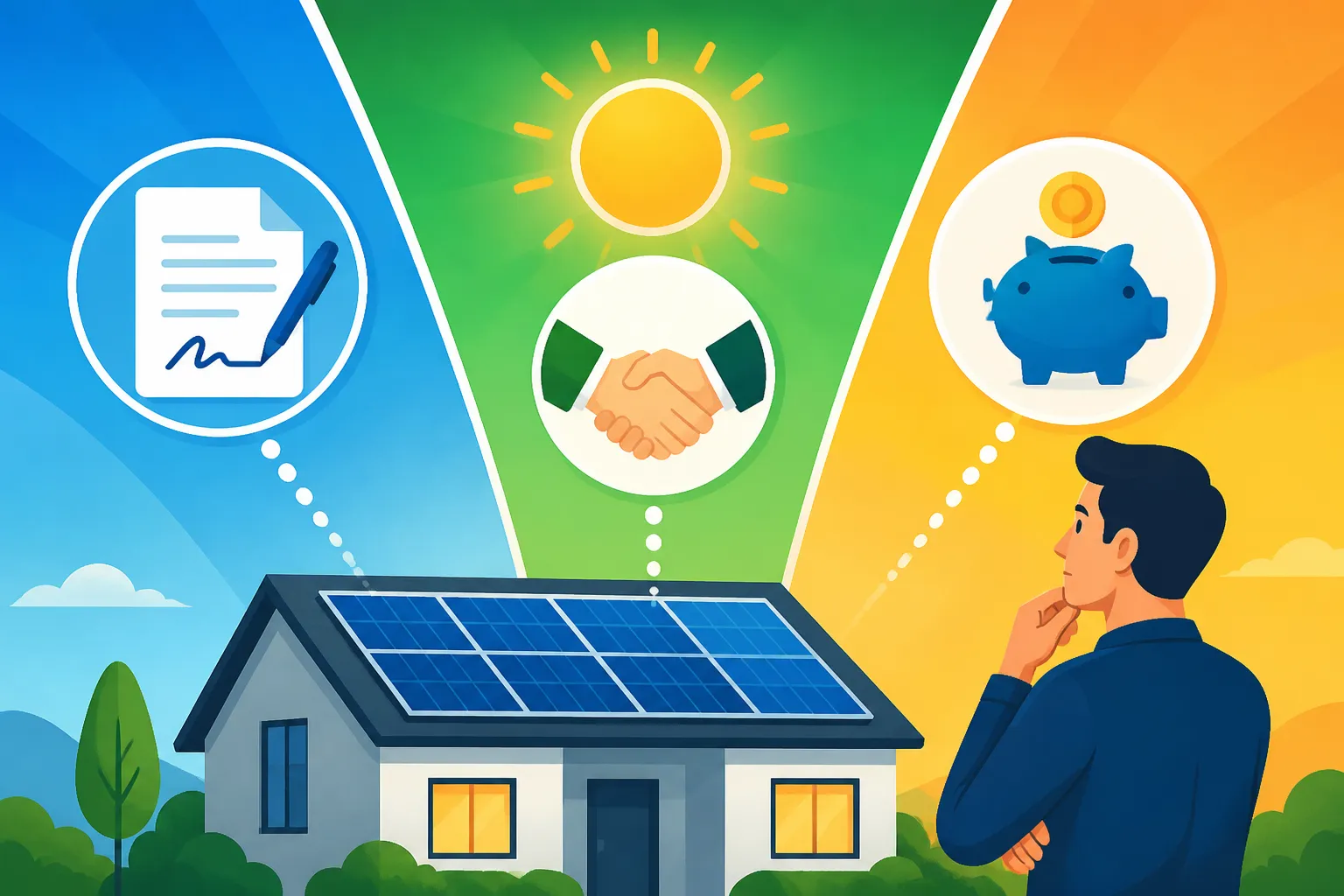
Before we dive deep, let's establish a high-level understanding of what each of these financing options means. Think of it this way:
- Solar Lease: You rent the solar panels from a solar company. They own the equipment, they install it, and you pay them a fixed monthly fee for using it. It's like renting an apartment; you get to live there, but you don't own the building.
- Power Purchase Agreement (PPA): Similar to a lease in that a third-party owns the system, but instead of paying a fixed monthly rent for the equipment, you pay for the electricity the panels produce at a set rate per kilowatt-hour (kWh). It’s like buying electricity directly from your own rooftop power plant, but someone else built and maintains the plant.
- Outright Purchase (Cash or Loan): You buy the solar panels and system components, becoming the full owner. This can be done with cash upfront or through a solar loan. This is like owning your home outright or with a mortgage; you have full equity and control.
Each option has distinct advantages and disadvantages, catering to different financial situations and homeowner preferences. The best choice for your neighbor in Phoenix might not be the best for you in rural Vermont, and that’s perfectly okay.
Deciphering the Solar Lease Agreement
A solar lease is often touted as a "no money down" way to go solar, and for many, that initial appeal is strong. It certainly removes the hefty upfront investment, which can be a significant barrier for some homeowners. However, it’s important to understand the full scope of what a lease entails beyond just the zero-down promise. You're essentially subscribing to solar energy, rather than investing in an asset.
How a Solar Lease Works in Practice
When you enter into a solar lease, a third-party solar company, known as the lessor, buys and installs the solar panel system on your property. They retain ownership of all the equipment – the panels, inverters, racking, and monitoring systems. In return for hosting their equipment, you pay them a predetermined monthly fee, much like a utility bill or rent. This fee is usually fixed or increases by a small percentage annually, known as an escalator, which can range from 1% to 3% per year. The lease agreement typically spans 20 to 25 years. During this time, the solar company is responsible for maintenance, repairs, and performance guarantees. You essentially get to enjoy the benefits of solar energy without the responsibilities of ownership.
For example, imagine you sign a lease for a 7 kW system. Instead of paying for the panels, you pay the solar company, let's say, $120 a month. This payment ensures you get to use the electricity generated by those panels, offsetting what you would have otherwise bought from your utility. If your utility bill was $200, and your panels generate enough power to bring it down to $50, your total monthly energy outlay becomes $120 (lease) + $50 (utility) = $170, representing a $30 savings. The catch, however, is that while you're saving on your utility bill, you’re still tied to that lease payment for two decades or more.
The Pros and Cons of Leasing Solar Panels
Leasing certainly has its upsides. The most obvious is the zero upfront cost, making solar accessible to those who can't afford a large investment or prefer not to tie up their capital. The maintenance and repairs are handled by the leasing company, which means you don't have to worry about a faulty inverter or a cleaning schedule. Plus, performance guarantees are often included, ensuring the system produces a certain amount of electricity or you receive compensation. This removes a lot of the headache for homeowners who just want to turn on the lights without thinking about the mechanics of solar.
However, the disadvantages are significant. Perhaps the biggest drawback is that you don't own the system, meaning you don't qualify for valuable financial incentives like the federal Solar Tax Credit 2026: What Happened to the Federal Credit. These credits and other Federal Solar Incentives That Still Exist in 2026 go directly to the leasing company, who, as the owner, claims them. This significantly reduces your overall long-term savings compared to owning. Additionally, lease agreements can be complex to transfer if you sell your home. A prospective buyer might be hesitant to take on a 20-year commitment, potentially complicating the sale or even requiring you to buy out the lease, which can be expensive. Many homeowners report that Selling a House With Solar Panels becomes more difficult with a lease than with an owned system.
Common Lease Terms and What to Look For
When reviewing a solar lease, there are several critical terms you need to scrutinize. First, look at the lease term length, typically 20 to 25 years. Understand that you are locked into this agreement for the duration. Second, pay close attention to the escalator clause. This is the percentage by which your monthly payment will increase each year. A 2.9% annual escalator, common with some providers like Sunrun, can significantly increase your payments over two decades, potentially eroding your savings. If your utility rates don't increase faster than your escalator, you might find yourself paying more for leased solar in later years than you would for grid electricity.
Also, examine the performance guarantee – what happens if the system underperforms? Will the company compensate you, or does it simply state that they'll maintain it? What are your options at the end of the lease term? Typically, you can renew the lease, have the panels removed (often at your cost), or purchase the system at its fair market value, which can still be substantial. Be wary of hidden fees, especially those related to early termination or system removal. Always consult with an independent financial advisor or a trusted platform like Modernize to ensure you understand every aspect of the contract before committing.
Exploring Power Purchase Agreements (PPAs)
Power Purchase Agreements, or PPAs, are another popular third-party ownership model, often confused with leases. While they share similarities, particularly the "no money down" aspect, their financial structure is quite different. A PPA often appeals to homeowners who want the environmental benefits of solar and some savings, without the responsibility of owning or maintaining the hardware.
The Mechanics of a Solar PPA
With a solar PPA, a developer, or a third-party provider, installs and maintains a solar energy system on your property at no upfront cost to you. Unlike a lease, where you pay a fixed monthly fee for the panels themselves, with a PPA, you agree to purchase the electricity generated by those panels at a predetermined rate per kilowatt-hour (kWh). This rate is typically lower than what your traditional utility company charges, providing immediate savings. The solar company remains the owner of the system, takes care of all maintenance, and claims any available tax credits or incentives. You essentially become a customer of the solar system on your roof, buying power from it.
Let's illustrate with an example: your utility charges $0.18/kWh for electricity. A PPA might offer you a rate of $0.13/kWh for the power your solar panels produce. If your panels generate 1,000 kWh in a month, you'd pay the PPA provider $130, instead of the $180 you'd pay your utility for that same amount of power. Any additional power you need beyond what your panels produce would still come from your utility at their standard rates. PPA terms usually range from 15 to 25 years, just like leases, and also often include an annual escalator.
Advantages and Disadvantages of PPAs
The primary benefit of a PPA, much like a lease, is the absence of upfront costs, making solar more accessible. You also enjoy predictable electricity rates for the term of the agreement, as your PPA rate is set (though it may escalate). The solar provider handles all maintenance and performance issues, giving you peace of mind. This means if a panel breaks or the inverter fails, it's their problem, not yours. Many homeowners find this hands-off approach very appealing, especially if they're not interested in the technicalities of solar system upkeep.
However, the downsides closely mirror those of a solar lease. Because you don't own the system, you forgo all federal and state incentives, including the significant federal tax credit. This means lower overall savings compared to ownership. PPAs also come with escalator clauses, which can erode your savings over time if the PPA rate increases faster than your utility's rates. If your PPA has a 2.9% annual increase and your utility's rates only rise by 1.5% annually, you could eventually pay more for solar-generated electricity than for grid power. Furthermore, just like leases, PPAs can complicate the sale of your home, as the new buyer must either assume the agreement or you'll need to buy out the contract, which can be a complex and expensive process.
PPA Rates and Escalator Clauses
The PPA rate is the price per kilowatt-hour you pay for the solar electricity generated. This rate is usually locked in for the initial period but will often increase annually due to an escalator clause. These escalators are typically between 1% and 3%, designed to account for inflation and operational costs for the solar provider. It's crucial to understand how this escalator will affect your payments over the long term. A quick calculation can show how even a seemingly small percentage can add up.
Consider a PPA with an initial rate of $0.13/kWh and a 2.5% annual escalator over 20 years. By year 10, your rate will be about $0.164/kWh, and by year 20, it will be around $0.21/kWh. If your utility rates in that same period don't rise as quickly, your savings could diminish significantly or even disappear. This is a critical factor when comparing a PPA to the option of buying your system. Always ask for a detailed projection of your PPA payments over the entire term, and compare it against historical utility rate increases in your area to get a realistic picture of your potential savings. Platforms like Modernize can help you compare various PPA offers and understand these intricate financial projections.
The Path to Ownership: Buying Your Solar System
For many homeowners, outright ownership of a solar system represents the gold standard of going solar. It provides maximum financial benefit, complete control, and often the greatest sense of satisfaction. While it requires an upfront investment, the long-term rewards are typically much more substantial than with third-party ownership models.
The Direct Purchase Model: How it Works
When you choose to buy your solar system, you are either paying for it with cash upfront or securing a solar loan. In either scenario, you become the legal owner of all the equipment from day one. This means you are responsible for the system's maintenance and performance, but you also reap all the financial benefits directly. The installation process is similar to a leased or PPA system in terms of design and permits; you'll still need to go through a Solar Installation Timeline: What to Expect, but the financial ownership is entirely yours.
Once the system is installed and operational, all the electricity it generates directly reduces your utility bill. If your system produces more electricity than you consume, you might even earn credits or payments from your utility through programs like Net Metering Explained: How It Works by State, depending on your local regulations. Over time, as electricity prices from your utility inevitably rise, your savings from generating your own power will grow, leading to a much better Solar ROI & 25-Year Savings Breakdown.
Financial Benefits and Incentives of Ownership
The biggest draw of owning your solar system is access to all available solar incentives. As the system owner, you are eligible for the federal Investment Tax Credit (ITC), which currently provides a 30% tax credit on the total cost of your solar system. This credit directly reduces your federal tax liability, representing a significant chunk of change. Beyond the federal credit, many states and even local municipalities offer additional incentives, such as state tax credits, property tax exemptions, or SRECs Explained: Selling Solar Renewable Energy Credits. These incentives are designed to make solar ownership more attractive and can dramatically lower your net cost.
Furthermore, owning your solar system can significantly increase your home's value. Studies have shown that homes with owned solar panels sell for a premium and often faster than comparable homes without solar. This is a tangible asset that adds to your property's appeal. You also benefit from long-term savings that are generally much higher than with leases or PPAs because you aren't making ongoing payments to a third-party provider and you capture all the utility bill reductions. Over the lifespan of the system, which can be 25-30 years, these savings can amount to tens of thousands of dollars.
Considerations for Cash Purchase vs. Solar Loans
If you decide to buy, you have two main avenues: paying with cash or taking out a solar loan.
A cash purchase offers the maximum savings and the fastest Solar Panel Payback Period Explained. You avoid all interest charges and loan fees, immediately capture the tax credit, and start seeing the full benefits of reduced electricity bills from day one. This is ideal if you have sufficient liquid capital and want the absolute best return on investment.
For those who don't have the cash readily available, a solar loan is an excellent alternative. These are specialized loans designed for solar installations, often with competitive interest rates and terms. While you'll pay interest, you still own the system and remain eligible for all incentives. The federal tax credit, for example, can be used to pay down a portion of your loan balance, effectively reducing your principal. It's crucial to compare different Solar Loans: Complete Guide from various lenders to find the best terms, as some loans come with hidden "dealer fees" that can inflate the total cost. You'll want to ensure your monthly loan payment, combined with any remaining utility bill, is still less than your old utility bill to ensure immediate savings. Many homeowners find that a combination of a modest down payment and a solar loan provides the best balance of affordability and long-term financial gain.
Direct Comparison: Lease vs. PPA vs. Buy
When you lay out all three options side-by-side, the distinctions become much clearer. It’s not about one being inherently "better" for everyone, but rather which one aligns best with your financial capacity, risk tolerance, and long-term goals as a homeowner.
Who Benefits Most from Each Option?
Let’s break down who typically finds each option most appealing:
-
Solar Lease: This option is often best for homeowners who:
- Cannot afford any upfront cost or a loan payment.
- Have little to no federal tax liability, making the federal tax credit less relevant to them (since they couldn't claim it anyway).
- Do not want the responsibility of maintenance or repairs.
- Are looking for predictable, albeit often smaller, monthly savings.
- May not plan to stay in their home for the very long term, though selling can still be complicated.
-
Power Purchase Agreement (PPA): Similar to a lease, PPAs appeal to those who:
- Prefer no upfront costs.
- Want to contribute to renewable energy without owning the system.
- Are seeking a fixed rate for their electricity, even with escalators.
- Don't have significant tax liability to benefit from incentives.
- Again, desire a hands-off approach to system maintenance.
-
Outright Purchase (Cash or Loan): This is typically the best fit for homeowners who:
- Have the financial means to pay cash or qualify for a competitive solar loan.
- Have a strong federal tax appetite to fully utilize the Investment Tax Credit.
- Are looking for the maximum long-term financial returns and highest savings.
- Want to increase their home's value and equity.
- Prefer complete ownership and control over their assets.
- Plan to stay in their home for the long haul to realize the full Solar Panel Payback Period Explained.
Impact on Home Value and Resale
This is where the differences between these options become particularly stark.
When you buy your solar system, it becomes a permanent upgrade to your home, much like a renovated kitchen or a new roof. Numerous studies have shown that owned solar panels typically Do Solar Panels Increase Home Value? The appraisal often reflects this addition, and homes with owned solar tend to sell faster and for more money. Buyers appreciate not having to worry about energy bills or taking on a separate contract. For instance, a report by Zillow found that homes with solar energy systems sold for an average of 4.1% more than comparable homes without.
In contrast, solar leases and PPAs can complicate selling your home. Since the solar equipment is owned by a third party, the new buyer must either assume the existing contract or you, as the seller, may need to buy out the remaining term. This can be a hurdle for potential buyers who might be hesitant to take on a long-term agreement that they didn't initiate. Some buyers might even view it as a liability rather than an asset, as they don't reap the full financial benefits or tax credits. While some leasing companies like Sunrun or Tesla Energy offer transfer assistance, the process can still add delays and complexities to the sale, potentially affecting your closing price or making your home less attractive than a property with an owned system.
Understanding Your Financial Commitment Over Time
The long-term financial commitment is another critical differentiator.
With a solar lease, your financial commitment is a fixed monthly payment (plus any annual escalator) to the solar company for the entire lease term, typically 20-25 years. This payment is separate from your utility bill, though the solar energy generated offsets a portion of that bill. Your total energy cost becomes your lease payment plus the reduced utility bill. The lease payments rarely stop, even if your power production drops due to maintenance issues; however, the leasing company is often responsible for addressing these issues.
A PPA involves paying for the electricity generated by the panels at a per-kWh rate. This rate also typically has an escalator, meaning your cost for solar electricity will increase over the 15-25 year term. Your total energy cost is the amount you pay the PPA provider for solar electricity, plus the amount you pay your utility for any additional electricity needed. Again, you're committed to buying power from the system owner, regardless of market changes, subject to the agreed-upon rates and escalators.
When you buy your system (cash or loan), your financial commitment is either a one-time payment or a series of loan payments. Once the loan is paid off, your primary financial commitment for electricity largely disappears, apart from a small grid connection fee or minimal utility charges if you still draw some power. You benefit from decades of free electricity generation. You also have full control over future upgrades or modifications, without needing permission from a third-party owner. This complete financial freedom from energy bills after the payback period is one of the most compelling reasons for ownership.
Here’s a helpful table summarizing the key differences:
| Feature | Solar Lease | Power Purchase Agreement (PPA) | Outright Purchase (Cash/Loan) |
|---|---|---|---|
| Ownership | Third-party company | Third-party company | Homeowner |
| Upfront Cost | Typically $0 | Typically $0 | Significant (Cash) or Monthly Payments (Loan) |
| Monthly Payments | Fixed monthly fee (with escalators) | Per-kWh rate for solar power used (with escalators) | Loan payments (if financed) or none (if cash) |
| Incentives Claimed By | Third-party company | Third-party company | Homeowner |
| Maintenance/Repairs | Handled by third-party | Handled by third-party | Homeowner's responsibility |
| Long-Term Savings | Moderate, dependent on escalator vs. utility | Moderate, dependent on escalator vs. utility | Highest, especially after payback period |
| Home Value Impact | Can complicate sale, potentially negative | Can complicate sale, potentially negative | Positive increase, easier resale |
| Control | Limited | Limited | Full control |
| Early Termination | Often expensive buyout or transfer fees | Often expensive buyout or transfer fees | Depends on loan terms (if financed), no termination for cash |
Navigating Incentives and Long-Term Savings
Understanding how each financing option interacts with solar incentives is paramount to calculating your actual long-term savings. This is often where homeowners make their biggest financial missteps.
How Each Option Interacts with Solar Incentives
When you purchase your solar system, either with cash or a loan, you are the legal owner. This means you are eligible for the robust federal Investment Tax Credit (ITC), which is currently 30% of the system's cost. So, if your system costs $30,000, you'd get a $9,000 credit on your federal taxes. This significantly reduces your overall investment. You also qualify for State Solar Incentives: Complete 2026 Guide, local rebates, and programs like SRECs, which can further sweeten the deal. These are direct financial benefits that accelerate your payback period and boost your overall return on investment.
However, with a solar lease or PPA, you are not the system owner. The third-party company that owns the system is the entity that claims the federal tax credit and all other available incentives. While they factor these savings into the lower monthly rates they offer you, you don't receive these direct financial benefits. This is a critical point that many homeowners overlook. You might be saving some money each month compared to your old utility bill, but the company providing the lease or PPA is often making out with the lion's share of the incentives. This significantly limits your long-term savings potential.
Real-World Savings Scenarios
Let's imagine a homeowner in Arizona with a $25,000 solar system before incentives.
-
Scenario 1: Outright Purchase (Loan)
- System Cost: $25,000
- Federal ITC (30%): $7,500
- Net Cost after ITC: $17,500
- Monthly loan payments might be around $150, but these payments are offsetting a utility bill that was previously $200-$250.
- After the loan is paid off (e.g., in 10-12 years), electricity is essentially free for the remaining 15-20 years of the panel's lifespan, leading to massive long-term savings, potentially $40,000-$60,000 over 25 years.
- This also includes any Utility Solar Rebates: How to Find Yours that might be available.
-
Scenario 2: Solar Lease
- Upfront Cost: $0
- Monthly Lease Payment: $120 (with a 2.9% annual escalator)
- Initial monthly utility bill reduction: from $200 to $50
- Total initial monthly energy outlay: $120 (lease) + $50 (utility) = $170
- Initial Monthly Savings: $200 – $170 = $30.
- Over 25 years, with the escalator, the cumulative lease payments can total over $50,000. Your overall savings will be the difference between what you would have paid your utility over 25 years and the sum of your lease payments plus remaining utility bills. This saving is often much smaller than with ownership, perhaps $10,000-$15,000 over 25 years, and highly dependent on how fast utility rates rise.
As you can see, while a lease provides some immediate savings, the long-term financial benefits are dwarfed by those of ownership. This is why financial experts and consumer advocates often recommend buying solar whenever feasible.
The Importance of Future Electricity Rates
Regardless of your chosen financing method, the future trajectory of electricity rates plays a huge role in your overall savings.
If you own your solar system, rising electricity rates mean greater savings for you. Every kilowatt-hour your panels produce is a kilowatt-hour you don't have to buy from the utility at an increasingly higher price. This acts as a hedge against inflation and volatile energy markets. Your "cost" of electricity from your panels is essentially fixed (or zero, once your loan is paid off), while the alternative cost (from the utility) continues to climb. This significantly shortens your Solar Panel Payback Period Explained.
With a solar lease or PPA, the impact of rising utility rates is a bit more nuanced. If your utility rates rise faster than your PPA or lease escalator, you will continue to save money. However, if your escalator increases at a higher rate than the utility's rates, your savings could diminish or even disappear over time. For example, if your utility historically raises rates by 1.5% annually, but your PPA has a 2.9% escalator, eventually, you'll be paying more per kWh from your solar panels than you would from the grid. This is a crucial calculation that a reputable solar provider, or a platform like Modernize, should help you perform before you commit to a long-term contract.
Key Factors for Making Your Decision
Choosing between a solar lease, PPA, or outright purchase is a highly personal decision. There’s no universal "best" option, as it depends entirely on your unique circumstances and priorities.
Your Financial Situation and Goals
This is arguably the most critical factor. Start by asking yourself:
- Do I have liquid cash available for a significant upfront investment? If yes, a cash purchase offers the fastest payback and highest ROI.
- Do I have good credit and qualify for a low-interest solar loan? If yes, a loan allows you to own the system, claim incentives, and still benefit from reduced monthly energy costs, often with no or low down payment.
- What is my federal tax liability? If you owe a substantial amount in federal taxes, you can fully leverage the federal ITC with an owned system. If you have minimal tax liability, this incentive is less beneficial to you, potentially making a lease or PPA more attractive if that's your only barrier to solar.
- What is my primary motivation for going solar? Is it maximum financial savings, environmental impact, energy independence, or simply reducing monthly energy bills with no fuss? Your goals will steer you toward the right option. For instance, if purely maximizing Are Solar Panels Worth It in 2026? is your goal, ownership is almost always the answer.
Don’t forget to consider your monthly budget. While a loan payment might be higher than a lease payment, it's an investment towards ownership and eventual energy freedom.
Long-Term Homeownership Plans
Your plans for how long you intend to live in your current home should heavily influence your decision.
- If you plan to stay in your home for 10-25+ years: Purchasing the system (cash or loan) is almost always the most financially advantageous choice. You’ll be around long enough to realize the full Solar Panel Payback Period Explained and enjoy many years of effectively free electricity. The increased home value will also benefit you directly when you eventually sell.
- If you anticipate moving within the next 5-7 years: The decision becomes trickier. While an owned system still adds value, the full financial benefits might not be realized before you move. However, selling a home with an owned system is generally far simpler than selling one with a lease or PPA, which requires transferring the contract to the new buyer or buying it out yourself. This can be a significant hassle and expense during an already stressful time. For those with short-term plans, a lease or PPA might seem attractive due to zero upfront costs, but the complexities of transfer often outweigh this initial benefit.
Geographic Considerations and Local Markets
The incentives and regulations surrounding solar vary significantly by state and even by utility.
- Strong Incentive States: If you live in a state with generous state-level tax credits, rebates, or high SREC values (like Massachusetts with its SMART program, or New Jersey with its SREC-II / SuSI Program), purchasing your system becomes even more financially rewarding. These additional incentives stack on top of the federal credit, making ownership a no-brainer.
- Net Metering Policies: States with robust net metering policies allow you to send excess solar electricity back to the grid and receive credits on your bill, further increasing your savings. States like California have transitioned to NEM 3.0 (Net Billing), which still offers credits but at a lower rate, making battery storage more valuable and shifting the ROI calculation. Understanding your local Net Metering Explained: How It Works by State is crucial.
- Electricity Rates: In areas with very high electricity rates, solar offers a quicker payback and greater savings, regardless of the financing option. However, high rates still make ownership more lucrative.
- Installer Market: The competitiveness of the solar market in your area can also impact pricing. In states like California or Florida, where solar is very popular, you might find more competitive pricing for purchased systems.
Always research your specific local incentives and utility policies. A trusted solar advisor from a company like Modernize can help you understand the specific benefits available in your zip code.
Avoiding Pitfalls and Misconceptions
The solar industry has grown tremendously, but with growth comes complexity, and sometimes, less-than-transparent practices. It's essential to be an informed consumer to avoid common traps.
The "Too Good to Be True" Deals
Beware of promises that sound too good to be true, especially those that push "free solar" or "zero-cost solar" too aggressively. While leases and PPAs genuinely offer no upfront payment, they are not "free" in the long run. You are still paying for the electricity or the equipment, and often at a higher cumulative cost than ownership. High-pressure sales tactics are a major red flag. If an installer tries to rush you into signing a contract on the first visit, without allowing you time to review the details, compare quotes, or understand the long-term implications, walk away.
Some companies might exaggerate savings figures or downplay the impact of escalator clauses on leases and PPAs. Always ask for a detailed, year-by-year financial projection for any option presented, and compare it against your historical utility bills. Remember, the company offering the lease or PPA benefits significantly from the incentives you miss out on, so their sales pitch will naturally lean towards those options. Always get multiple quotes from different installers, and ensure they are comparing apples to apples when it comes to system size, components, and financing terms.
What Happens When You Sell Your Home
One of the most common and frustrating issues homeowners face with leased or PPA systems is selling their home. As we discussed, these agreements are tied to the property, not just the original homeowner. When you sell, the buyer has to assume the remainder of the contract. This means they inherit your monthly payments or per-kWh rates. If the buyer isn't interested in taking on that commitment, you could be forced to buy out the remaining value of the system yourself, which can be tens of thousands of dollars. Imagine trying to close on your dream home, only to find out you need to fork over $20,000 to get rid of a solar contract. It's a deal-breaker for many.
For owned systems, selling your home is usually much smoother. The solar panels are an asset that adds value, and the new homeowner gains the benefits of lower energy bills immediately, without needing to take over a separate contract. While you still need to disclose the presence of solar panels, it's generally viewed as a positive feature that enhances marketability and price. Always consider your future plans, as this can be a major factor in the value and ease of selling your most significant asset.
Essential Questions to Ask Before Signing
Before you sign any solar contract, arm yourself with these critical questions:
-
For Purchases (Cash/Loan):
- What is the total system cost, including all equipment, labor, permits, and interconnection fees?
- What is the estimated federal tax credit amount, and are there any state or local incentives I qualify for?
- What is the estimated Solar Panel Payback Period Explained for my specific system and electricity usage?
- What warranties are included (equipment, performance, labor)?
- What are the terms of the loan (interest rate, APR, term length, any dealer fees or origination fees)?
- What happens if my production is lower than expected?
-
For Leases and PPAs:
- What is the exact monthly payment or per-kWh rate?
- What is the annual escalator percentage, and how will it impact my payments over the full term (get a year-by-year projection)?
- What is the total cost of the agreement over 20-25 years, including escalators?
- What are my options at the end of the lease/PPA term (renewal, removal, purchase)? What are the associated costs?
- What are the terms for transferring the contract if I sell my home? Are there fees? What if the new buyer doesn't want it?
- What happens if the system underperforms? Is there a performance guarantee, and what are the remedies?
- Who claims the federal and state incentives?
Don't be afraid to ask for clarification, take the contract home to review, and even seek legal advice if anything is unclear. Reputable solar companies, like those found through Modernize, will be transparent and happy to answer all your questions thoroughly. The more informed you are, the better decision you'll make for your home and your finances.
Disclaimer
The information provided in this guide is for general informational purposes only and does not constitute financial, tax, or legal advice. Solar incentives, regulations, and product offerings are subject to change. We strongly recommend consulting with a qualified solar professional, financial advisor, and tax professional to discuss your specific situation and to verify the accuracy of any information presented here.