Monocrystalline vs Polycrystalline Cost
Standing on your roof and looking at a pile of solar quotes can feel like trying to decode a foreign language. Many homeowners find themselves stuck between choosing monocrystalline panels, which look sleek but carry a premium price, and polycrystalline panels, which are cheaper but often seen as "older" tech. This guide solves that confusion by breaking down the real-world cost differences, performance tradeoffs, and long-term value of both options so you can stop overthinking and start saving.
Understanding the Visual and Technical Foundations
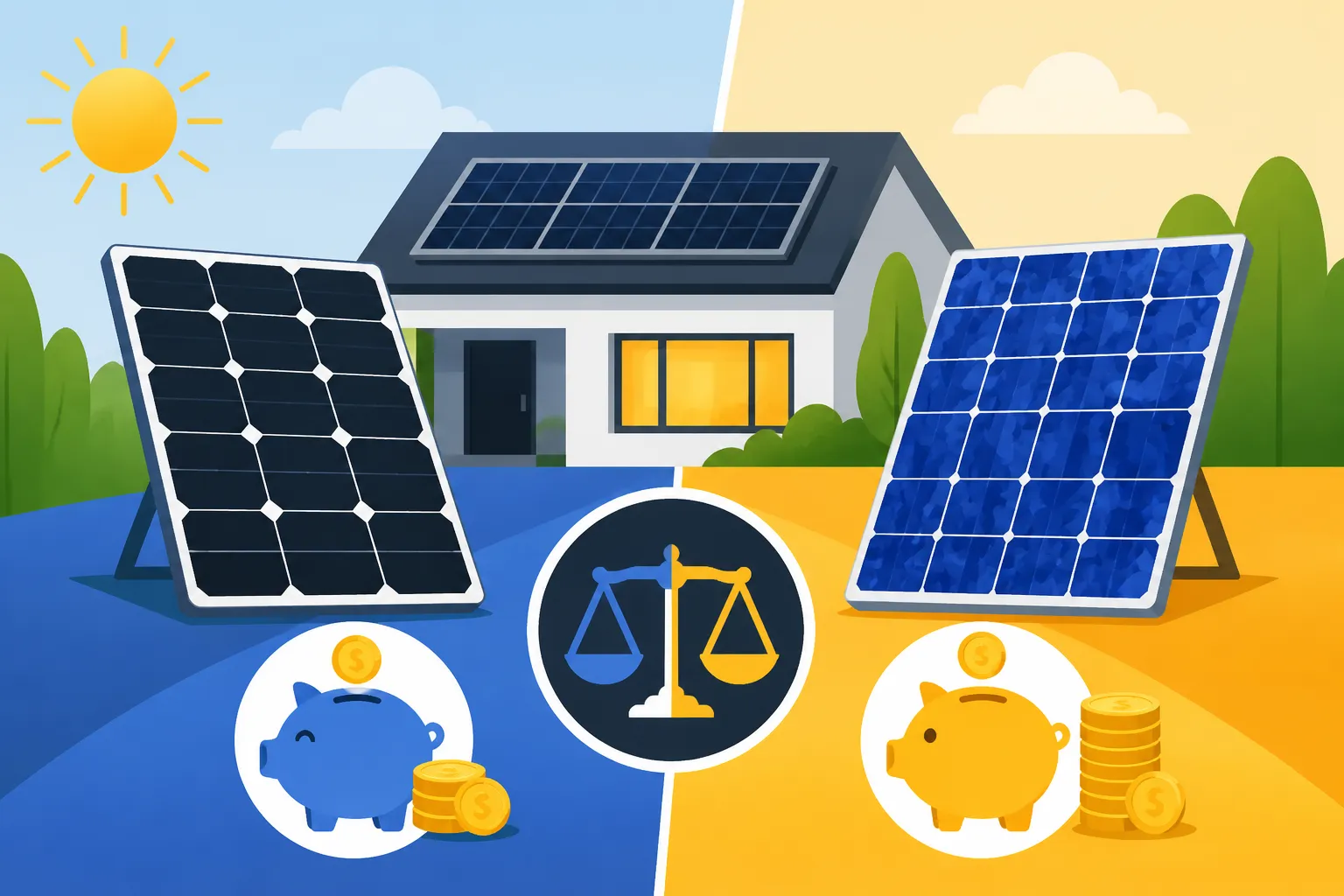
When you first start looking at solar panels, the most immediate difference you’ll notice isn't the price tag—it’s the color. Monocrystalline panels are famous for their uniform, dark, almost black appearance. Polycrystalline panels, on the other hand, have a distinct blue hue and a "marbled" look where you can actually see the individual silicon crystals. While this might seem like a purely aesthetic choice, it’s actually a direct result of how these panels are made, which ultimately dictates their price and efficiency.
Aesthetics and the HOA Factor
For many of us, how the panels look on our shingles matters just as much as how much power they produce. Monocrystalline panels are generally considered more attractive because their sleek black finish blends in better with modern roofing materials. If you live in a neighborhood with a strict Homeowners Association (HOA), you might find that monocrystalline is the only "socially acceptable" option. I’ve spoken to many homeowners who initially wanted the cheapest poly panels available, only to realize that the "blue-glare" look of polycrystalline didn't sit well with their neighbors or their own sense of curb appeal.
Beyond just the color, the shape of the cells is different. Monocrystalline cells are made from a single crystal of silicon, and the edges are often rounded, creating small diamond-shaped gaps between the cells. Polycrystalline cells are perfectly square because they are cast in blocks. This gives poly panels a more "patchwork" look. If you are worried about the resale value of your home, aesthetics play a role, and the market currently favors the clean, uniform look of monocrystalline.
Silicon Purity and Manufacturing Complexity
The reason monocrystalline panels cost more is rooted in the manufacturing process. To create a "mono" cell, manufacturers use the Czochralski process, where a seed crystal is dipped into a vat of molten silicon and slowly pulled out to form a single, continuous ingot. This process is energy-intensive and results in a lot of wasted silicon because the round ingots have to be shaved down into square-ish wafers. You’re essentially paying for that high-purity, labor-intensive process.
Polycrystalline manufacturing is much more "rough and ready." Instead of growing a single crystal, manufacturers melt many fragments of silicon together and pour them into a square mold. There is almost zero waste because the resulting block is simply sliced into square wafers. Because the process is faster and requires less precision, the upfront cost to produce these panels is lower. However, because the electrons have to move through many different crystal structures in a poly cell, they encounter more resistance, which is why these panels are naturally less efficient.
Breaking Down the Upfront Cost Comparison
The question everyone asks is: "How much am I actually going to save by going poly?" In the early 2010s, the price gap was massive. Today, that gap has narrowed significantly, but when you are looking at a system that costs twenty or thirty thousand dollars, even a small percentage difference adds up. Understanding the Solar Panel Cost Per Watt Explained is the first step in realizing why a "cheaper" panel isn't always a better deal.
Price Per Watt Breakdown in 2026
On average, you can expect to pay about $0.05 to $0.15 more per watt for monocrystalline panels compared to polycrystalline. For a standard 8 kW system, that could mean a difference of $400 to $1,200 in raw equipment costs. While that sounds like a lot of money, it’s important to remember that the panels themselves are only about 25% to 30% of your total invoice. You still have to pay for the inverter, the racking, the permits, and the labor, which usually remain the same regardless of which panel type you choose.
If you are working with a tight budget, using a service like Modernize can help you find installers who still carry polycrystalline stock. Many large-scale national installers have moved almost exclusively to monocrystalline because it’s easier to stock one type of high-efficiency panel. By using Modernize to compare local quotes, you might find a smaller, local contractor who has access to "legacy" poly panels at a steep discount, which can be a great win for someone with a massive roof and a desire for the lowest possible entry price.
System Size and Total Project Costs
One of the "hidden" costs of polycrystalline panels is that you need more of them to reach the same power output. Because they are less efficient, a poly panel might only be rated at 300 watts, while a mono panel of the exact same size might be rated at 400 watts. If your goal is to offset 100% of your electric bill, you might need 25 poly panels to do the work that 18 mono panels could handle.
This creates a ripple effect in your Average Solar Panel Cost in 2026. More panels mean more racking, more wiring, more labor hours on the roof, and potentially a larger footprint that requires a more complex permit. Sometimes, the "savings" you get from the cheaper poly panels are eaten up by the extra hardware needed to mount them. This is why it is so critical to look at the "all-in" price rather than just the cost of the individual modules.
The Role of Modernize in Cost Discovery
Navigating these quotes is exhausting. I’ve seen homeowners get three different quotes where the "cheapest" one actually used the most expensive panels, simply because that installer had better labor rates or lower overhead. This is where Modernize becomes a lifesaver. Instead of you spending hours calling different shops, Modernize connects you with pre-vetted professionals who can give you side-by-side comparisons.
When you use Modernize, you can specifically ask the pros about their "value" lines. Sometimes an installer has a "premium" mono package and a "standard" poly package. By seeing these options laid out clearly, you can decide if that extra $1,000 for the black-on-black monocrystalline look is worth it to you, or if you’d rather keep that cash in your pocket. Having that data upfront prevents the "sales pressure" of being told there is only one way to go solar.
| Feature | Monocrystalline | Polycrystalline |
|---|---|---|
| Typical Efficiency | 19% – 23% | 15% – 17% |
| Average Cost per Watt | $0.40 – $0.70 (Equipment Only) | $0.30 – $0.50 (Equipment Only) |
| Color/Appearance | Black / Uniform | Blue / Marbled |
| Space Required | Low (Highest power density) | High (Needs more roof space) |
| Heat Tolerance | High | Moderate |
| Durability | Excellent | Very Good |
Efficiency and Performance Under the Sun
Cost isn't just about what you pay today; it's about what the panels produce over the next 25 years. This is where the technical differences between mono and poly really start to matter. If you have a small roof, efficiency isn't a luxury—it's a necessity. If you can only fit 15 panels on your south-facing roof, you better make sure those 15 panels are working as hard as possible.
Power Output and Space Efficiency
Monocrystalline panels are the kings of space efficiency. Because the silicon is higher purity, the electrons have a much easier time moving through the cell. This means more of the sunlight hitting the panel is converted into usable electricity. If you are trying to figure out How Many Solar Panels Do I Need for My Home?, you’ll quickly find that mono panels allow you to meet your energy needs with a much smaller physical footprint.
For homeowners with massive ranch-style homes or several acres of land for a ground-mounted system, the space efficiency of monocrystalline might not be worth the premium. If space isn't an issue, you can simply "brute force" your energy production by installing 20% more polycrystalline panels. In this scenario, polycrystalline can actually provide a better ROI because you aren't paying the "efficiency premium" for space you have in abundance.
Temperature Coefficients and Performance
A lot of people don't realize that solar panels actually hate the heat. As a panel gets hotter, its ability to generate electricity drops. This is measured by something called the "temperature coefficient." Monocrystalline panels generally have a better (lower) temperature coefficient than polycrystalline. This means that on a scorching 100-degree day in Arizona, a monocrystalline panel will lose less of its rated power than a polycrystalline one.
If you live in a hot climate, the "savings" of poly panels can be deceptive. You might buy a poly system that looks cheaper on paper, but if it underperforms by 5% to 10% every summer because of the heat, you’re losing money on your utility bill offset every single month. When calculating How Much Can You Save With Solar Panels?, you have to factor in your local weather. In cooler climates like the Northeast or the Pacific Northwest, this difference is negligible, and poly panels might perform almost as well as mono.
Long-Term Financial Impact and ROI
When we talk about the "cost" of solar, we have to talk about the payback period. This is the point where the utility savings have finally covered the initial cost of the system. Whether you choose mono or poly will shift this timeline, sometimes in surprising ways. It’s not always the cheapest panel that pays for itself the fastest.
Payback Periods and System Longevity
Generally, monocrystalline systems have a slightly shorter payback period, even though they cost more upfront. This is because they produce more power consistently over time. If a mono system costs $15,000 and saves you $200 a month, it pays for itself faster than a poly system that costs $13,500 but only saves you $150 a month because of lower efficiency. You can dive deeper into this math in our guide on the Solar Panel Payback Period Explained.
However, there is a "sweet spot" for polycrystalline panels in states with high solar incentives. If your state offers massive upfront rebates, that initial $1,500 difference in equipment cost might be wiped out, making the poly system an incredible bargain. But for the average homeowner without massive state-level grants, the higher production of monocrystalline usually wins the ROI race by a year or two.
Degradation Rates and Lifetime Value
All solar panels lose a little bit of their "juice" every year. This is known as degradation. High-quality monocrystalline panels often have lower degradation rates, meaning they might still be producing 90% of their original power after 25 years. Some cheaper polycrystalline panels might drop to 80% or 85% in that same timeframe. When you look at a Solar ROI & 25-Year Savings Breakdown, that 5% to 10% difference in the "tail end" of the system's life can represent thousands of dollars in electricity you don't have to buy from the grid.
It’s also worth checking the Solar Panel Warranties Explained for any panels you are considering. Historically, monocrystalline manufacturers offer longer and more comprehensive "performance warranties" because they have more confidence in the long-term stability of the single-crystal silicon. If you plan on staying in your home for 30 years, that extra warranty protection is a form of insurance that is worth paying for.
Which One Is Right for Your Roof?
The "best" panel isn't a universal truth; it depends entirely on your specific situation. I’ve seen people regret buying mono panels because they overspent on efficiency they didn't need, and I’ve seen people regret poly panels because they ran out of roof space before they could cover their whole bill.
Large Roofs vs. Limited Space
This is the golden rule of solar: if your roof is small, go mono. If you have a tiny bungalow or a townhouse, you need every square inch to produce maximum power. Choosing poly panels on a small roof is like putting a four-cylinder engine in a heavy truck—it just won't have the "oomph" to do the job.
Conversely, if you have a massive barn or a sprawling suburban roof with no shading issues, polycrystalline panels are a fantastic way to save money. You can use the extra space to your advantage and get a system that produces the same amount of power as a mono system for a fraction of the cost. Using a tool like Modernize to find installers who specialize in large-scale residential installs can help you see if a high-volume poly installation makes sense for your property.
Environmental and Climate Considerations
We already touched on heat, but what about snow and clouds? In low-light conditions, such as the cloudy winters of Michigan or Washington, monocrystalline panels tend to perform slightly better. They are more sensitive to the photons that make it through the cloud cover.
If you’re wondering Do Solar Panels Lose Efficiency Over Time? in your specific climate, talk to local installers. They will tell you that in snowy regions, the smooth surface of monocrystalline panels sometimes helps snow slide off faster compared to some poly designs, though this varies by brand. If you’re in a "harsh" climate, spending the extra money for the durability and low-light performance of mono is generally the smarter move for your long-term sanity and savings.
Making the Final Decision
At the end of the day, the solar industry is moving toward monocrystalline as the standard. In fact, many of the Best Solar Panels of 2026 are exclusively monocrystalline because the technology has become so efficient and the manufacturing has scaled so well that the price gap is smaller than ever.
Assessing Installer Recommendations
When you sit down with an installer, they are probably going to push monocrystalline. Some of this is because it’s a better product, but some is because it’s simply what they have on the truck. Don't be afraid to ask: "What would the price difference be if we went with a standard-efficiency poly panel?" If they tell you the difference is only $300, it’s a no-brainer—go with the mono. If they tell you it’s $3,000, then you have a real decision to make.
When you’re learning How Do I Choose a Solar Installer?, look for transparency. A good pro will explain the "price per watt" of both options and show you a production simulation for your specific roof using both types of panels. If they refuse to quote poly, it might be because they know the labor of installing more panels will actually make the "cheaper" option more expensive for them to execute.
Using Modernize to Compare Modern Panel Options
The reality is that the "monocrystalline vs. polycrystalline" debate is slowly being replaced by the "N-Type vs. P-Type" debate or "TOPCon vs. HJT." The technology is moving fast. This is why using a platform like Modernize is so helpful. It allows you to cast a wide net and see what the most competitive companies in your area are offering.
By using Modernize, you can find the balance between "bleeding-edge" tech and "tried-and-true" value. You might find an installer who is clearing out last year’s high-end mono panels for the price of this year's poly panels. That kind of deal only happens when you compare multiple sources and stay informed about the market. Solar is a big investment, but by focusing on the total value rather than just the lowest sticker price, you'll end up with a system that keeps your lights on and your bank account full for decades to come.
Disclaimer
This guide is for informational purposes only. Solar pricing, incentives, and technology performance can vary significantly based on your geographic location, utility provider, and individual home characteristics. Always consult with a qualified solar professional and review your specific site conditions before making a financial commitment. State-level incentives mentioned are subject to change.