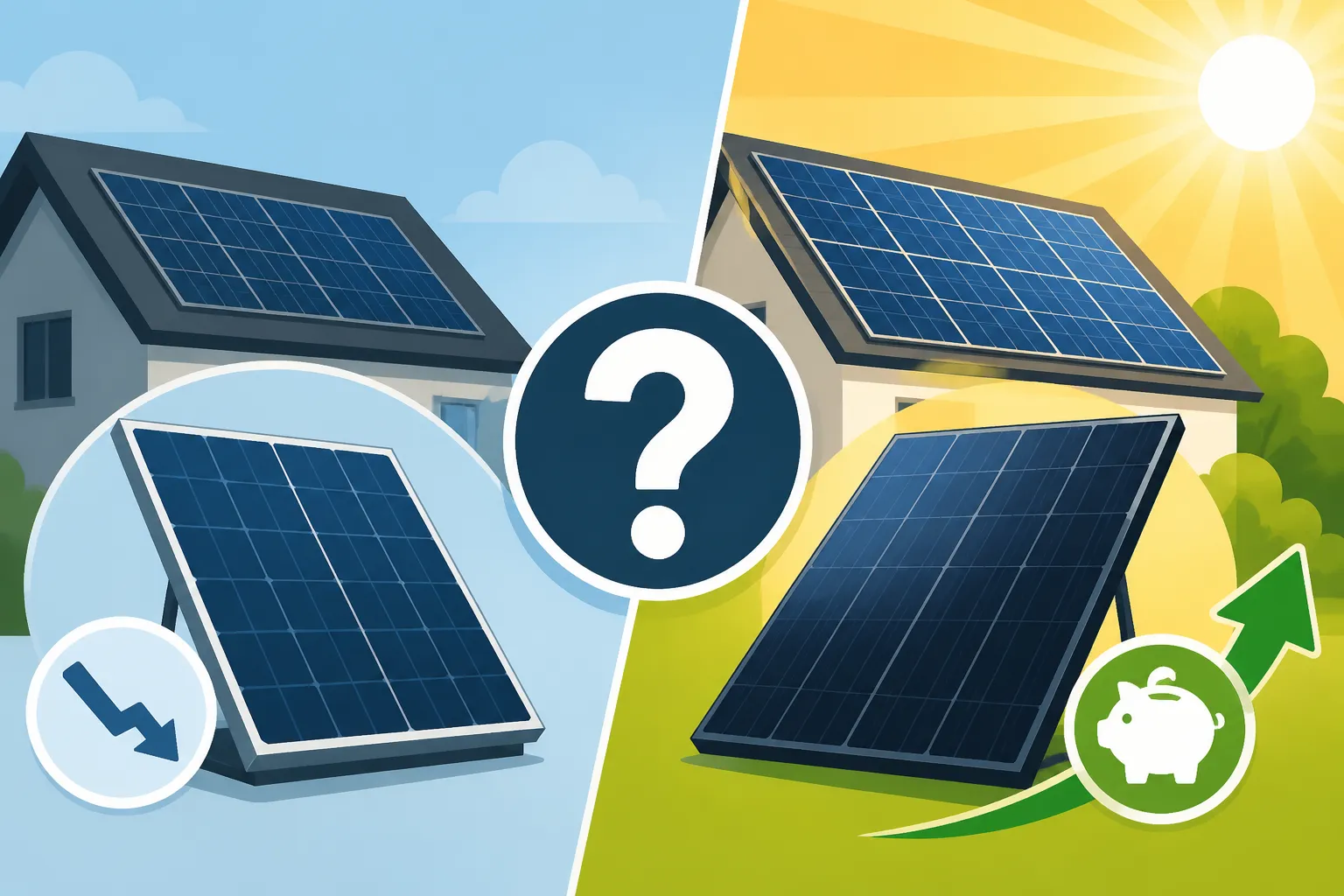
Do More Efficient Panels Save Money?
It’s incredibly common to feel a bit lost in the sea of solar panel specifications, especially when comparing efficiency ratings. Many homeowners assume that simply opting for the highest efficiency panels available will automatically translate into the biggest savings, but the reality is often more nuanced than a single percentage might suggest. This guide is here to untangle the complexities, helping you understand how panel efficiency truly impacts your long-term savings and whether paying a premium for those top-tier panels is genuinely worth it for your unique situation.
What Exactly Is Solar Panel Efficiency?
When we talk about solar panel efficiency, we're essentially referring to how effectively a solar panel converts sunlight into usable electricity. It's a critical metric, but it’s just one piece of the puzzle. A higher efficiency rating means that a panel can generate more power from the same amount of sunlight compared to a less efficient panel of the same physical size. This sounds straightforward, but its impact on your overall cost and savings needs a deeper look.
Decoding the Efficiency Percentage
The efficiency percentage you see advertised for a solar panel, like "22% efficiency," represents the maximum percentage of the sunlight (solar energy) hitting the panel that can be converted into electricity under standard testing conditions. These conditions—known as STC, or Standard Test Conditions—typically involve a panel temperature of 77°F (25°C) and a solar irradiance of 1,000 watts per square meter (which mimics peak midday sun). While these conditions are standardized for comparison, they don't always perfectly reflect real-world performance. For example, a 400-watt panel with 20% efficiency will produce 400 watts under STC, while a 400-watt panel with 22% efficiency will do the same, but the 22% efficient panel will be physically smaller.
This means that if you have two panels, both rated for 400 watts, the one with higher efficiency will simply take up less physical space to achieve that same power output. This distinction is crucial, especially for homeowners with limited roof area or specific aesthetic concerns. It's not necessarily about producing more power per panel, but producing the same amount of power from a smaller footprint. Understanding this fundamental aspect helps you move beyond the "higher number is always better" mindset and appreciate how efficiency translates into practical application.
Factors Influencing Panel Efficiency
Solar panel efficiency isn't just about the raw technology; it's affected by a range of factors both during manufacturing and once installed on your roof. At the core, the type of photovoltaic cell used makes a huge difference. Monocrystalline panels, for instance, are generally more efficient than polycrystalline panels due to their purer silicon structure and uniform crystal alignment, which allows electrons to flow more freely. You can learn more about the differences in efficiency and cost by checking out our guide on Monocrystalline vs Polycrystalline Solar Panels. Newer technologies like TOPCon and Heterojunction (HJT) cells are pushing efficiency boundaries even further, often reaching over 22% or even 23% in commercially available panels.
Beyond the cell technology, factors like temperature, shading, and even the angle and orientation of your roof can significantly impact how efficiently your panels perform in the real world. A panel's efficiency rating is typically given at 25°C, but panels on a hot roof can reach much higher temperatures, reducing their efficiency. Similarly, even partial shading from a nearby tree or chimney can drastically cut a panel's output, regardless of its peak efficiency rating. This is why a well-designed system, accounting for these environmental factors, is just as important as the panels themselves.
The Direct Link Between Efficiency, Cost, and Available Space
This is where the rubber meets the road for many homeowners. You've heard that more efficient panels cost more, but how much more, and when does that extra cost truly pay off? It boils down to a balancing act between your budget, the amount of roof space you have, and your energy production goals.
Higher Efficiency, Higher Upfront Cost
There's no getting around it: solar panels with higher efficiency ratings almost always come with a higher upfront price tag per watt. Think of it like buying a premium car model with advanced fuel efficiency features – it costs more initially than a standard model, even if both get you to the same destination. This additional cost stems from more advanced manufacturing processes, higher-grade materials, and cutting-edge research and development that go into pushing those efficiency numbers. You might see the cost per watt for a standard panel hover around $2.50 to $3.00, while a high-efficiency panel from a top-tier brand might push that closer to $3.50 or even $4.00 per watt. Our detailed article on Solar Panel Cost Per Watt Explained can give you a deeper dive into these numbers.
This premium can add thousands of dollars to your overall system cost, depending on the size of your installation. For instance, if you're looking at a 10 kW system, an extra $0.50 per watt for higher efficiency panels could mean an additional $5,000 on your total bill. So, the crucial question becomes: does that extra $5,000 translate into $5,000 (or more) in additional savings over the lifespan of your system, or could that money be better invested elsewhere, perhaps in a solar battery, or simply by opting for slightly less efficient but more affordable panels?
Making the Most of Limited Roof Space
Here's the primary scenario where higher efficiency panels truly shine and justify their extra cost: when you have limited roof space but high energy demands. Imagine you live in a charming bungalow in San Francisco with a smaller roof footprint, but your family's electricity consumption is quite high due to electric vehicles and a bustling household. A standard 350-watt panel might measure about 65 inches by 39 inches. A high-efficiency 400-watt panel from a brand like Maxeon (SunPower) or REC, on the other hand, might be nearly the same physical size but generate significantly more power. This difference allows you to fit more power generation capacity into the constrained area.
If your goal is to offset 100% of your electricity bill, but your roof simply can't accommodate enough lower-efficiency panels to achieve that, then investing in high-efficiency panels becomes a smart move. They allow you to maximize your energy production within those tight constraints, potentially reaching your energy independence goals without needing a larger, more expensive ground-mount system. This is a common situation for many urban homeowners or those with complex rooflines that limit usable space. You might want to refer to our guide on How Much Roof Space Do Solar Panels Need? for more insights into planning your layout.
Real-World Scenarios Where Higher Efficiency Shines (and Where It Doesn't)
Understanding the raw numbers is one thing, but seeing how efficiency plays out in actual home settings helps clarify its value proposition. It’s not a universal panacea, but rather a tool that can be incredibly effective in specific circumstances.
Maximizing Production in Small Spaces
Let's consider a practical example. Sarah lives in a cozy suburb of Boston with a south-facing roof that's perfect for solar, but it's not huge. Her electricity bill is consistently high, and she wants to generate as much power as possible to reduce her reliance on the grid. If she installs standard 350-watt panels, she might only be able to fit 15 panels, yielding 5.25 kW. But if she opts for 400-watt high-efficiency panels from a brand like Qcells or Jinko Solar that are roughly the same physical dimensions, she could still fit 15 panels, but now she's generating 6.0 kW. That extra 0.75 kW might be enough to cover a larger portion of her electricity use, making the higher upfront cost a worthwhile investment for achieving her goal within her existing roof constraints. This is especially true in states with strong net metering policies where every extra kWh generated can translate into significant savings.
For homes with complex roof designs, skylights, or chimneys that create shading challenges, high-efficiency panels can also be beneficial. By generating more power from each unshaded panel, you can compensate more effectively for the areas that are less productive. This strategic use allows you to squeeze the maximum possible energy out of your available, optimal sunlight areas, turning potential wasted space into productive energy generation.
The Law of Diminishing Returns
On the flip side, if you have ample roof space – perhaps a large, unobstructed south-facing roof in a sunny state like Arizona or Florida – the benefits of ultra-high efficiency panels diminish significantly. In these cases, you might be able to achieve your desired total system size (e.g., 10 kW) by simply installing more of the slightly larger, lower-efficiency panels at a much lower cost per watt. For example, if you need 10 kW of power, you could install 25 of the 400-watt high-efficiency panels, or you could install 29 of the 350-watt standard efficiency panels. If the 350-watt panels are significantly cheaper, and you have the room, the lower cost option will likely offer a better Solar ROI & 25-Year Savings Breakdown.
The extra premium for that marginal increase in efficiency (say, going from 20% to 22%) might not be recouped in additional energy savings, especially if you're not constrained by space. It's like buying a Formula 1 car for your daily commute to save a few seconds – it's impressive, but largely overkill for the purpose. Many homeowners find their "sweet spot" in the middle, opting for panels that offer a good balance of efficiency and cost-effectiveness, perhaps in the 19-21% range. These panels, often from reputable brands, provide solid performance without the top-tier price tag.
Beyond the Label: Other Factors Affecting Your Savings
While panel efficiency is certainly important, it's far from the only element determining how much money you'll save. A holistic view considers everything from the system's design to the local utility landscape. Ignoring these other factors can lead to disappointment, even with the most efficient panels money can buy.
System Design and Installation Quality
Even the most cutting-edge, high-efficiency panels will underperform if the system isn't designed and installed correctly. A poorly designed system might suffer from suboptimal panel orientation and tilt, excessive shading, or inadequate inverter sizing. For instance, if your panels are facing west but your peak energy use is in the morning, your overall savings might not be as high as expected, regardless of panel efficiency. Similarly, if you have significant shading from trees or adjacent buildings, the type of inverter technology – whether string inverters, microinverters (like those from Enphase), or power optimizers (like SolarEdge) – will have a far greater impact on your system's output than a percentage point or two in panel efficiency. This is because microinverters and optimizers allow each panel to operate independently, mitigating the impact of shading on the entire array.
The quality of installation also plays a critical role. Shoddy wiring, improper mounting, or overlooked details during the permitting and interconnection process can lead to long-term performance issues, safety hazards, and warranty voidances. It's not enough to just buy "good" panels; you need a "good" solar company to design and install your system. Always do your research and get multiple quotes from reputable installers, checking their certifications and customer reviews. A superior installation with moderately efficient panels will almost always outperform a poor installation with the most efficient panels.
Local Incentives and Electricity Rates
Your potential savings from solar are profoundly shaped by your local incentives and utility company's policies. For example, states with robust net metering programs, like some parts of New York or Maryland, allow you to send excess electricity back to the grid and get credited at or near the retail electricity rate. This makes every kilowatt-hour (kWh) your system produces extremely valuable, potentially making the investment in higher efficiency panels more worthwhile if it helps you reach full energy offset. Our comprehensive guide on Net Metering Explained: How It Works by State offers more detailed information.
However, in areas with less favorable policies, such as California under NEM 3.0, where export compensation rates are significantly lower than retail rates, the value of exporting excess energy is reduced. In such scenarios, adding a solar battery might offer greater value than simply maximizing panel efficiency, as it allows you to store and self-consume your power rather than exporting it for a lower credit. Furthermore, state-specific incentives like Solar Renewable Energy Credits (SRECs) or utility rebates can dramatically alter your total cost and payback period, often having a larger financial impact than a marginal increase in panel efficiency. These are all considerations that transcend the panel itself, directly influencing your Is Solar Worth It in 2026? question.
Finding Your Optimal Balance: Efficiency vs. Budget
It's clear that there's no single "best" answer for everyone. The ideal approach to solar panel efficiency involves a thoughtful assessment of your specific needs, site conditions, and financial priorities. This isn't just about picking a number; it's about crafting a solution that works for you.
Calculating Your Personal "Sweet Spot"
To find your personal efficiency sweet spot, start by understanding your average monthly or annual electricity consumption. This will tell you the target system size (in kW) you need to meet your energy goals. You can find useful calculators online, or a good solar installer can help determine this during a site assessment. Next, consider your available roof space. Is it ample and unobstructed, or is it limited and complex? If space is generous, you might lean towards more cost-effective, slightly less efficient panels. If space is tight, higher efficiency becomes a more attractive option. Our article How Many Solar Panels Do I Need for My Home? can help you begin this calculation.
Then, gather quotes from several reputable installers. Compare systems that use different efficiency tiers of panels. Pay close attention to the total system cost, the estimated annual energy production, and the proposed payback period for each option. Don't be afraid to ask installers to provide options with varying panel efficiencies. For example, ask for one quote with panels around 19% efficiency and another with panels closer to 21-22%. This comparative analysis will allow you to see the real-world cost difference and the corresponding increase in projected energy output, helping you determine if the extra investment in efficiency provides a tangible return for your situation.
The Role of Warranties and Durability
Beyond efficiency, the long-term performance and reliability of your solar panels are paramount. A highly efficient panel that fails prematurely or degrades rapidly won't save you money in the long run. This is where solar panel warranties become incredibly important. Most reputable manufacturers offer two main types of warranties: a product warranty (covering manufacturing defects and material flaws) and a performance warranty (guaranteeing a certain percentage of power output over time).
A strong product warranty, often 25 years, gives you peace of mind that your investment is protected. The performance warranty typically guarantees that panels will still produce 80-90% of their original rated power after 25 years. Brands like Maxeon (SunPower) and REC are known for their industry-leading warranties and low degradation rates. While you might find cheaper panels, they might come with shorter warranties or higher degradation rates, meaning their efficiency and output will drop faster over time. Our guide on Solar Panel Warranties Explained delves into what to look for. Sometimes, paying a little more for a panel with a superior warranty and proven durability can save you money by avoiding costly repairs or premature replacements down the line. You can even check general solar products or monitoring equipment on sites like Amazon to see user reviews on durability.
The Long-Term Perspective: Future-Proofing Your Investment
Solar is a long-term investment, typically lasting 25-30 years or more. Therefore, considering the long-term implications of your panel choice, including how well they maintain their performance and how they affect your home's value, is crucial for maximizing your savings and ensuring your system continues to deliver.
Degradation and Sustained Performance
No solar panel maintains its peak efficiency indefinitely. All panels experience a phenomenon called degradation, where their power output slowly decreases over time. The rate of this degradation varies by manufacturer and technology, but a typical high-quality panel might degrade by about 0.5% per year after the first year. This means that a panel rated at 400 watts today might produce around 350-360 watts after 25 years. Our article Do Solar Panels Lose Efficiency Over Time? provides more details.
When you're comparing panels, look at their guaranteed degradation rate. A panel with a lower degradation rate, even if its initial efficiency isn't the absolute highest, might actually outperform a slightly more efficient panel with a higher degradation rate over the full 25-year lifespan of your system. This sustained performance contributes directly to your total lifetime energy production and, by extension, your total savings. For instance, if you're comparing two panels that are nearly identical in initial efficiency, but one guarantees 87% output after 25 years and the other guarantees 80%, that difference will translate into thousands of extra kilowatt-hours generated over the system's lifetime, adding to your financial benefits.
Potential Resale Value Considerations
While the primary motivation for going solar is often to reduce electricity bills, the impact on your home's resale value is another important financial consideration. Studies consistently show that homes with owned solar panel systems sell for more and often sell faster than comparable homes without solar. The exact increase varies by location and system size, but it can be a significant boost to your property's value. When you sell a house with solar panels, future buyers often appreciate a well-performing, aesthetically pleasing system.
High-efficiency, well-regarded solar panels from established brands, coupled with a clean, professional installation, can contribute positively to your home's appeal. Buyers are often willing to pay a premium for a system that's known for its reliability and strong performance. Conversely, a system with older, less efficient, or poorly installed panels might not add as much value, or could even be seen as a liability if it requires significant upgrades or maintenance soon after purchase. Even small elements like ensuring your panels are clean and well-maintained with products you might find on Amazon can make a difference in how a system is perceived during a home showing. Ultimately, choosing panels that balance efficiency, cost, and quality is an investment not just in your energy future, but in your home's equity.
Disclaimer
The information provided in this guide is intended for general informational purposes only and does not constitute professional advice. Solar panel efficiency, costs, and savings can vary significantly based on location, specific system design, prevailing electricity rates, available incentives, and individual energy consumption patterns. It is highly recommended to consult with multiple qualified solar professionals to obtain personalized estimates and advice tailored to your specific circumstances before making any purchasing decisions.