Solar Panel Cost vs Other Home Upgrades
Every homeowner eventually hits that wall where the "to-do" list for the house exceeds the balance in the savings account. You are staring at a kitchen that feels trapped in 1994, but your monthly utility bill just hit an all-time high, making the idea of energy independence feel like a necessity rather than a luxury. This guide meticulously compares the cost and long-term value of home solar against traditional upgrades like kitchen remodels, roof replacements, and HVAC overhauls to help you decide where your next dollar is best spent.
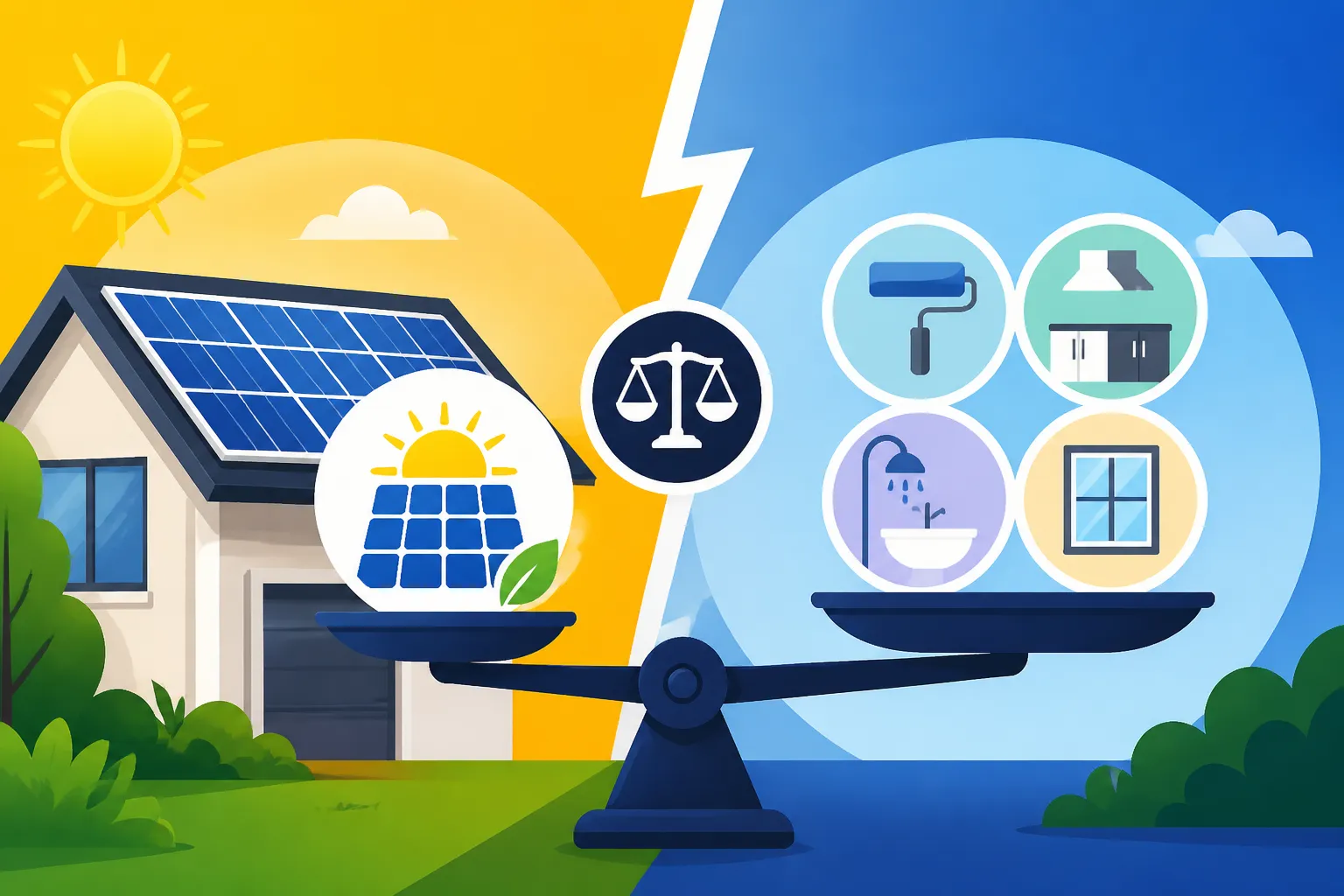
Understanding the Solar Investment vs. Traditional Renovations
When you decide to sink twenty or thirty thousand dollars into your home, you are usually looking for one of two things: increased comfort or increased equity. Traditional renovations, like finishing a basement or updating a master suite, are heavily weighted toward the "comfort" side of the scale. You get to enjoy the new tile and the soaking tub, but that money is essentially gone the moment the contractor packs up their tools. You might see a bump in home value, but it rarely covers the initial spent.
Solar panels operate on a completely different financial logic. They are perhaps the only home upgrade that functions as a revenue-generating asset. Instead of just sitting there and looking pretty, a solar array actively offsets an existing monthly liability—your electric bill. When we look at How Much Do Solar Panels Cost? 2026 Guide, we see that while the upfront price tag is comparable to a mid-range kitchen refresh, the solar panels eventually "buy" themselves back through savings. Using a service like Modernize can help you find local pros who understand this distinction, ensuring you aren't just buying equipment, but a long-term financial strategy.
Immediate Utility vs. Long-Term Financial Yield
The moment you finish a bathroom remodel, the utility is immediate. You have a nicer place to brush your teeth. However, from a financial perspective, that bathroom begins to depreciate. Grout discolors, fixtures go out of style, and eventually, it will need to be done again. Solar, conversely, has a "break-even" point. If your system costs $20,000 and saves you $2,000 a year in electricity, after ten years, the system has essentially become free. Every year after that is pure profit.
Think about a homeowner in a high-cost area like Westchester, New York, or San Diego, California. In these regions, electricity rates are staggering. A homeowner who chooses solar over a deck addition isn't just avoiding a bill; they are shielding themselves from future rate hikes. This is why the conversation around How Much Can You Save With Solar Panels? is so critical. You are trading a one-time aesthetic boost for a 25-year hedge against inflation.
Maintenance Costs Over the Lifecycle
Every home upgrade comes with a "tail"—the ongoing cost to keep it looking and functioning well. A new deck needs staining every two years. A new kitchen has appliances that will inevitably break. A new HVAC system requires filters, seasonal tune-ups, and eventual refrigerant recharges. These are hidden costs that eat away at the initial joy of the upgrade.
Solar panels are remarkably low-maintenance because they have no moving parts. Aside from the occasional cleaning if you live in a particularly dusty area or a region with heavy pollen, they just sit there. Most systems today come with robust monitoring software that tells you exactly how much power you’re making. If you’re worried about the upkeep, checking out Solar Panel Maintenance & Cleaning can demystify the process. Generally, you’ll find that the "tail" on solar is much shorter and cheaper than almost any other major home improvement.
Emotional Satisfaction vs. Practical Savings
We cannot ignore the "HGTV effect." There is a deep, psychological satisfaction that comes from walking into a home with a brand-new, open-concept kitchen. It changes how you feel about your space. Solar panels, being stuck on the roof, don't offer that same daily visual "wow" factor. You don't host a dinner party and sit around talking about your silicon wafers—well, most people don't.
However, the satisfaction of solar is felt when you open your email and see a utility bill for $12 instead of $350. That "bill-shock" relief is a different kind of emotional satisfaction. It’s the feeling of security. Especially for those nearing retirement or on a fixed income, the predictability of solar can be worth more than a new backsplash. It’s about choosing between looking rich and being wealthy.
Comparing ROI: Solar vs. Kitchen and Bathroom Remodels
The Remodeling Futures Program at Harvard University has consistently shown that major indoor remodels rarely return 100% of their cost at the time of sale. A major upscale kitchen remodel might only return 50-60% of its investment. If you spend $80,000, you might only add $45,000 to your home's asking price. That’s a "loss" of $35,000 in exchange for the pleasure of using the kitchen.
Solar energy, however, is often viewed by modern buyers as a "pre-paid utility." In markets with high electricity costs, a house with solar is significantly more attractive than the identical house next door without it. Buyers realize they can afford a slightly higher mortgage payment if their monthly overhead for electricity is near zero. This shift in buyer psychology is why Are Solar Panels Worth It in 2026? is the most common question we hear. The ROI isn't just about the resale; it's about the cash flow during your years of ownership.
The Recoupment Reality of Aesthetic Upgrades
Aesthetic upgrades are subjective. You might love the dark navy cabinets you installed, but a potential buyer might see them as a weekend of painting they’d rather avoid. This subjectivity lowers the "recoupment" value. Solar is objective. Kilowatt-hours are the same regardless of who owns the home. Power is a commodity, and producing it yourself has a fixed, calculable value.
When you use Modernize to compare quotes for these different projects, you’ll notice that the "sales pitch" for a kitchen is about lifestyle, while the pitch for solar is about mathematics. If you are looking at your home as an investment portfolio, the math almost always favors the energy production over the cosmetic change. This is especially true when you factor in the Solar Panel Payback Period Explained logic, which shows you exactly when you move from the "red" to the "green."
Energy Savings as a Second Income Stream
Most people think of home upgrades as "spending." Solar should be thought of as "saving." If you reduce your monthly expenses by $200, that is effectively the same as getting a $2,400 per year raise, tax-free. No other home upgrade offers this. A new bathroom doesn't put money back in your pocket every month; it actually costs you more in water if you install that fancy rain-shower head.
In states with aggressive green energy goals, you might even be able to sell the excess power back to the grid. While the days of high-profit "net metering" are changing in places like California, the underlying principle of offsetting your own usage remains the most powerful financial lever available to a homeowner. This is why understanding Net Metering Explained: How It Works by State is so vital before you sign any contracts.
Market Demand: What Buyers Value Most
The buyer of 2026 is tech-savvy and climate-conscious, but most importantly, they are budget-strained. With housing prices and interest rates remaining stubbornly high, the "cost to carry" a home is the number one concern. A home that comes with its own power plant is a massive selling point. We are seeing real estate listings lead with "Owned Solar" as a primary headline, often above "Granite Countertops."
In regions like Phoenix or Las Vegas, where air conditioning is a non-negotiable survival tool, solar isn't just a "nice to have"—it’s a competitive advantage. Buyers are looking at the Solar Panel Cost by State and realizing that if the previous owner already did the work of installing the system, they are walking into a house with lower operational costs from day one.
Solar vs. Critical Structural Upgrades (Roof, HVAC, Windows)
There is a category of home upgrades that aren't optional. When the roof leaks or the furnace dies, you have to act. Often, homeowners wonder if they should squeeze solar into these necessary projects. The answer is almost always yes, because of the labor and permitting overlaps. If you're already tearing up the roof, that is the most cost-effective time to install the mounting brackets for a solar array.
The synergy here is incredible. For example, if you are replacing your windows to save on heating, you might spend $15,000 to save 10% on your bill. If you spent that same $15,000 on solar, you might offset 60-70% of your bill. The "efficiency per dollar" of solar frequently outperforms the efficiency of insulation or window upgrades once you have reached a basic level of home sealing.
Synergy Between New Roofs and Solar Panels
If your roof is more than 15 years old, you should not put solar panels on it. Period. The cost to remove the panels, replace the shingles, and reinstall the panels later is a financial nightmare. However, doing them together allows you to treat the entire project as a single home envelope upgrade. In some cases, the logistics of a combined project can save you thousands in labor costs.
When you're evaluating this, refer to Do I Need a New Roof Before Solar? to see where your current roof sits in its lifecycle. Many installers will offer a package deal, and through platforms like Modernize, you can find contractors licensed in both roofing and solar, which simplifies the warranty process significantly. You don't want a roofer blaming a solar guy for a leak, or vice versa.
Efficiency Stacking: HVAC vs. Energy Production
A common debate is whether to buy a more efficient 20-SEER HVAC system or a standard 14-SEER system and use the savings for solar. Interestingly, the math often favors the latter. A super-high-efficiency HVAC system has a diminishing return on investment. The leap from "good" to "amazing" is very expensive. However, the leap from "no solar" to "some solar" provides a massive initial benefit.
By "stacking" your upgrades, you create a resilient home. If you have an electric heat pump and a solar array, you have effectively neutralized your heating and cooling costs. This is the gold standard of modern homeownership. For a deep dive into the numbers, looking at Solar Panel Cost for a 2,000 Sq Ft House can help you estimate how much power you’d need to cover a standard HVAC load.
Replacement Windows and the Marginal Utility of Insulation
Windows are often sold as the ultimate energy-saver, but the "payback period" on windows can sometimes be 40 to 50 years. They are extremely expensive for the amount of energy they actually save. While they certainly help with drafts and comfort, they don't produce anything. Solar panels have a much shorter payback, often between 6 and 10 years depending on your local incentives.
If your goal is purely financial, solar wins over windows every time. If your goal is to stop a draft that makes you shiver every night, windows are the priority. It’s about understanding the difference between "stopping the bleed" (efficiency) and "generating the cure" (solar). Most experts suggest doing basic attic insulation first (the cheapest "win"), then solar, and only then moving to expensive window replacements.
The Tangible Impact on Property Value
One of the biggest fears homeowners have is that solar panels will make their house harder to sell or that they won't get their money back. The data, however, suggests the opposite—as long as you own the panels. Leased panels can indeed complicate a sale, but owned systems are viewed as an asset. Studies from Zillow and Lawrence Berkeley National Laboratory have shown that homes with solar sell for an average of 4.1% more than comparable homes without it.
This "Green Premium" is becoming more standardized as appraisers get better at valuing solar. Instead of just guessing, they use "income-based valuation" methods, looking at how much money the panels save the owner over their remaining lifespan. This makes solar one of the few upgrades where the value addition is based on cold, hard data rather than the whims of a buyer's taste.
Appraisals and the Green Premium
When an appraiser walks into a home with a $30,000 kitchen, they compare it to other recently sold homes with nice kitchens. When they walk into a home with solar, they can actually look at the production logs. If those panels save $150 a month, that’s $1,800 a year. Over 20 years, that’s $36,000 in saved costs. That is a tangible number that an appraiser can defend to a bank.
For more on this, check out Do Solar Panels Increase Home Value? to see how different regions value these systems. In places like New Jersey or Massachusetts, the premium can be even higher because of local energy prices. It’s important to keep all your installation paperwork and production data in a "Home Energy Folder" to hand to an appraiser when the time comes to sell.
Tax Exemptions and Home Valuation Secrets
A "hidden" benefit of solar that many homeowners miss is the property tax exemption. In many states, even though the solar panels increase the value of your home, the government is prohibited from raising your property taxes based on that increase. If you add a bedroom, your taxes go up. If you add a solar array of the same value, your taxes stay the same.
This is a massive advantage over other upgrades. You get the benefit of a higher resale value without the annual penalty of higher taxes. You can find out if your state offers this by reading Solar Property Tax Exemptions by State. It’s one of those rare "win-win" scenarios in the tax code that favors the homeowner who goes green.
Regional Differences in Value Addition
The value added by solar isn't uniform across the country. In Florida, solar is almost expected in high-end new builds. In the Pacific Northwest, where hydro-power keeps rates lower, the premium might be smaller. You have to look at your local market. If your neighbors all have solar, not having it might actually make your home "sub-standard" and harder to sell.
Using a platform like Modernize to see what's trending in your zip code is a smart move. They can connect you with installers who know what local buyers are asking for. In the Northeast, for example, the focus might be on Solar Plus Battery Cost because of frequent storm-related outages, whereas in the Southwest, it’s all about raw production for AC.
Comparing the Financial Commitment
| Upgrade Type | Average Cost (2026) | Typical ROI (%) | Payback Period | Primary Benefit |
|---|---|---|---|---|
| Home Solar (8kW) | $20,000 – $28,000 | 100% – 150% | 6 – 10 Years | Monthly Savings & Equity |
| Kitchen Remodel | $25,000 – $65,000 | 50% – 70% | Never | Lifestyle & Aesthetics |
| Roof Replacement | $12,000 – $22,000 | 60% – 80% | Never | Structural Integrity |
| HVAC Upgrade | $8,000 – $15,000 | 40% – 60% | 15 – 20 Years | Comfort & Efficiency |
| Master Suite Add | $50,000 – $100,000 | 50% – 60% | Never | Resale Value & Space |
Financing and Incentives: The Hidden Differentiator
One reason solar often wins the "budget battle" is that the financing is frequently more attractive than a standard home improvement loan. Because solar is an energy-saving measure, there are federal, state, and local programs designed to make it affordable. You aren't just relying on your credit score; you are relying on the projected savings of the system to help justify the loan.
Furthermore, while the landscape for incentives changed recently, there are still numerous paths to lowering the "net cost" of your system. Unlike a kitchen remodel where you pay 100% of the sticker price, solar has rebates and credits that can lop off thousands of dollars before you even make your first payment. This makes the "real" cost of solar much lower than it appears on paper.
Why Solar Incentives Trump Remodeling Loans
Most banks view a kitchen remodel as a "lifestyle loan." They know that if you default, they can't exactly repossess the cabinets and sell them. Solar is different. There are specific "Solar Loans" where the panels themselves act as collateral, often leading to lower interest rates than a standard personal loan or a high-interest credit card.
If you are curious about the current landscape of financial help, look into Federal Solar Incentives That Still Exist in 2026. Even without the old 30% credit, there are performance-based incentives (PBIs) and state-specific grants that can significantly bridge the gap. Modernize often lists installers who are experts at navigating these "paperwork mazes" to ensure you get every dollar you're entitled to.
Impact of the Post-Federal Credit Landscape
A common misconception is that solar is no longer worth it because the major federal tax credits have evolved or expired. However, the cost of solar equipment has also plummeted. The "out of pocket" cost of an 8kW system today is often lower than it was five years ago even with the credit. Efficiency has gone up, and manufacturing has scaled.
If you're wondering about the "deadline" for savings, check out Is the Federal Solar Tax Credit Really Gone? for the latest updates on what's available. The reality is that the market has matured. Solar doesn't need "training wheels" from the government as much as it used to because the raw economics of solar vs. utility power have become so lopsided in favor of solar.
Cash Flow Comparison: Monthly Bills vs. Debt Service
This is the most important calculation for any homeowner. If your solar loan payment is $150 a month, but it eliminates a $200 electric bill, you are "cash flow positive" from month one. You have effectively "upgraded" your home and put $50 back in your pocket every month. No other home renovation can claim this.
Compare that to a kitchen remodel. If you finance $30,000 for a kitchen at 8% interest, your monthly payment might be $350. That is $350 out of your pocket every month with zero offset. Solar is the only upgrade that pays for its own financing. For a breakdown of how to structure these deals, Solar Loans: Complete Guide is an essential read.
Making the Final Decision for Your Home Strategy
At the end of the day, your home is your sanctuary, but it’s also likely your biggest financial asset. Choosing between "pretty" and "practical" is never easy. However, the most successful homeowners are those who find a way to do both by prioritizing projects that offer the fastest return. By installing solar first, you can use the monthly savings from your utility bill to eventually fund that kitchen remodel or basement finish.
Think of solar as the foundation of your home's financial health. Once your energy costs are under control, every other part of homeownership becomes easier. You have more breathing room in your monthly budget and a more valuable asset to leverage if you ever need a home equity line of credit. It’s about building a home that takes care of you, rather than a home that you constantly have to "pay" to live in.
Prioritizing Your Project Pipeline
If your roof is failing, that is priority number one. If your roof is fine, but your electric bills are crushing your spirit, solar is priority number two. The kitchen can wait. A new countertop is nice, but it doesn't solve a systemic financial drain like high utility costs. Start with the upgrades that reduce your "cost of living."
Check out How to Choose a Solar Installer to find someone who can give you an honest assessment of your home's potential. Using a service like Modernize allows you to "vibe check" different contractors to find someone who understands your long-term goals. Don't be afraid to ask for a "25-year outlook" on any project you consider.
The "Wait and See" Cost of Energy Inflation
Many homeowners want to "wait until solar gets cheaper." The problem with this logic is that while you wait, you are still paying the utility company. If you wait two years to save $1,000 on the cost of panels, but you paid $4,000 in electricity bills during those two years, you have actually "lost" $3,000. This is the "cost of delay."
Utility rates have historically risen faster than inflation in many parts of the country. By locking in your energy costs now, you are opting out of that cycle. To see if your local rates are particularly prone to this, read Are Solar Panels Worth It in 2026? for a regional breakdown of utility trends. The best time to plant a tree was twenty years ago; the second best time is today.
Integrating Aesthetic and Functional Goals
Finally, remember that solar has come a long way aesthetically. We now have "all-black" panels that look sleek and modern, and even solar shingles that blend in with traditional roofing materials. You don't have to sacrifice your home's curb appeal to get the benefits of energy production. You can have a beautiful home that is also an efficient machine.
Working with a designer or a high-end installer found through Modernize can help you place the panels in a way that respects your home's architecture. Sometimes, putting panels on a ground-mount system in the backyard or on a detached garage is the perfect compromise. There is always a way to make solar work for your specific vision of home.
Solar Panel Cost vs Other Home Upgrades Disclaimer
The information provided in this guide is for educational purposes only and does not constitute financial, legal, or professional tax advice. Solar costs, incentives, and home value increases vary significantly by location, property type, and individual financial situations. Always consult with a qualified tax professional and a licensed contractor before making major home investment decisions.