What’s the Average Cost of Solar Panels Per Month?
It's completely normal to feel overwhelmed when you start looking into solar panels and hear all sorts of numbers thrown around about "average monthly costs." The truth is, that average can be incredibly misleading because your personal situation, financing choices, and even where you live dramatically impact what you actually pay each month. This guide is here to untangle that confusion, break down the real factors at play, and give you a clear, realistic picture of what a monthly solar payment might look like for your home.
Understanding the "Average Cost Per Month" Myth
When people ask about the average monthly cost of solar panels, they're often looking for a simple, single number to budget around. Unfortunately, it's rarely that straightforward. The solar industry has many layers, and the "monthly cost" can refer to a few different things, leading to a lot of confusion for homeowners just like you. It’s important to peel back these layers to understand what you’re truly looking at.
Why Averages Are Misleading
Imagine trying to find the "average monthly car payment" without knowing if someone is buying a new luxury SUV with a long loan term or a used compact car outright. Solar is much the same. A simple national average doesn't account for the vast differences in energy consumption across households, the size of solar system needed, regional electricity rates, or the local incentives available. For instance, a home in sunny Arizona with high energy usage might need a larger system than a small home in the cloudy Pacific Northwest, and the financing terms and local tax credits will also vary wildly. Comparing your situation to a national average could either make solar seem impossibly expensive or unrealistically cheap.
Moreover, the total upfront cost of solar panels can vary significantly. For example, the going rate for solar panels can range from $2.70 to $3.50 per watt, which translates to a wide range for a typical 6 kW to 10 kW residential system. This foundational cost is the biggest driver of any monthly payment, and it's far from uniform across the country or even within a single state.
The "Net Savings" Confusion
Sometimes, when people talk about the "average monthly cost" of solar, what they really mean is their net monthly energy bill after going solar. This is where things get even more confusing because solar isn't just an expense; it's also a way to reduce or eliminate your existing electricity bill. For many homeowners, their new solar loan payment or lease payment might be lower than their old utility bill, leading to immediate monthly savings. In other cases, especially if you opted for a larger system or certain financing, your solar payment might be a bit higher, but you gain energy independence and protection from rising utility rates.
Consider the interplay of factors like Net Metering Explained: How It Works by State or specific state programs. In states with robust net metering policies, you might get full retail credit for excess energy sent back to the grid, dramatically reducing your utility bill and maximizing your net savings. Conversely, in regions with less favorable policies, or where net metering has been altered (like What Is NEM 3.0 California Net Billing?), the calculation of net savings becomes more complex and might necessitate a larger battery storage system to capture and utilize your generated power, which adds to the initial cost.
Factors Influencing Your Monthly Solar Costs
So, if there's no single "average," what does determine your monthly solar payment? It comes down to a few critical factors that are unique to your home and your financial choices. Understanding these elements will empower you to get a realistic estimate for your specific situation.
System Size and Energy Usage
The most fundamental factor is the size of your solar panel system, measured in kilowatts (kW). The larger your home and the more electricity you consume, the larger system you'll likely need to offset your usage, and a larger system naturally costs more. A home with high electricity bills—say, a 3,000 square foot house with central air conditioning running constantly in a hot climate like Florida—will require a substantially larger system than a modest 1,500 square foot home in a milder climate.
You'll need to look at your past 12 months of utility bills to get an accurate picture of your average monthly kilowatt-hour (kWh) usage. This information is crucial for any reputable solar installer to design a system that adequately meets your needs. Without this baseline, any cost estimate is just a guess. The total output of your system is directly correlated with how much you can expect to save on your electricity bill, directly influencing your net monthly expenses. If you size your system correctly, you can often significantly reduce or even eliminate your electricity bill, making your solar loan or lease payment your primary energy expenditure.
Equipment Choices and Installation Costs
Just like cars or appliances, not all solar panels and inverters are created equal. High-efficiency panels from premium brands like Maxeon (SunPower) or REC, for instance, might cost more per watt but can produce more electricity in less space, potentially reducing the total number of panels needed. Similarly, choosing microinverters (like those from Enphase) over a traditional string inverter (like those from SolarEdge) can add to the upfront cost but offer benefits like panel-level monitoring and better performance in shaded conditions. The choice of equipment significantly impacts the total Solar Panel Cost Per Watt Explained.
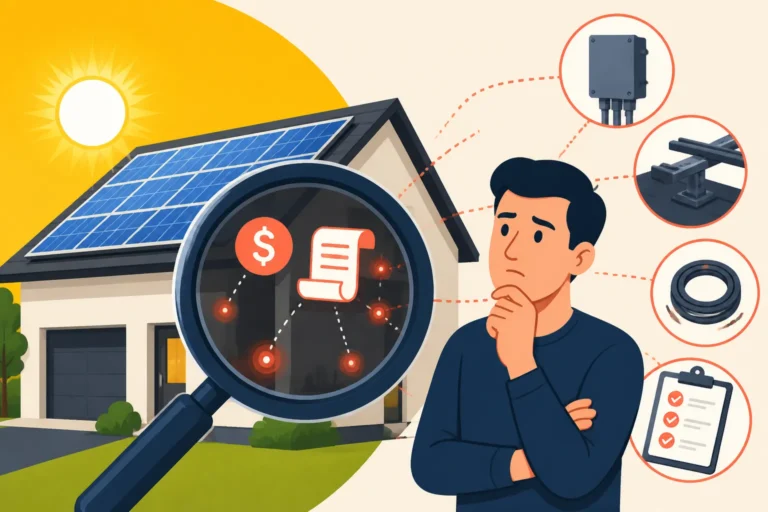
Beyond the panels themselves, installation costs include labor, permits, wiring, mounting hardware, and potentially upgrading your electrical panel. These costs can vary based on the complexity of your roof (pitch, material, accessibility), local labor rates, and regional permitting fees. For example, installing panels on a tricky tile roof in a city with strict building codes might be more expensive than on a simple asphalt shingle roof in a rural area. It’s why getting multiple quotes from different installers is so vital—it helps you compare not just panel prices but also the full scope of installation services and costs. Companies like Modernize can help homeowners connect with vetted local installers to get competitive bids, ensuring you see a range of options for both equipment and installation specifics.
Local Incentives and Net Metering Policies
This is where the financial puzzle really gets interesting, and where things have changed significantly in recent years. While the federal solar tax credit remains a powerful incentive, state and local programs, as well as utility rebates, can drastically reduce your overall solar investment. These incentives directly lower the total system cost, which in turn reduces the amount you need to finance, thereby lowering your monthly payments.
For example, states like New York offer a state tax credit and programs through NY-Sun that can significantly lower costs. Massachusetts has the SMART Program, and Illinois offers programs like Illinois Shines. These incentives can shave thousands off your upfront cost, which means a smaller loan principal and thus a lower monthly payment. Beyond upfront cost reduction, net metering policies are crucial. They dictate how much your utility credits you for excess energy your panels produce and send back to the grid. Favorable net metering can lead to lower or even zeroed-out utility bills, making your monthly solar payment the only energy bill you see.
However, as mentioned earlier, some states are seeing changes to these policies, such as the transition in California to NEM 3.0, which significantly alters the export compensation rate. This shift means that the financial benefit of sending excess energy back to the grid is reduced, often making solar batteries a more attractive, albeit pricier, addition to a new system to maximize self-consumption. Therefore, understanding State Solar Incentives: Complete 2026 Guide and your utility’s specific policies is absolutely essential when calculating potential monthly costs and savings.
Financing Options and Their Monthly Payments
How you choose to pay for your solar system is perhaps the single biggest determinant of your "average monthly cost." There are several common ways to go solar, each with its own financial implications, ownership structure, and monthly payment characteristics.
Solar Loans Explained
Purchasing your solar panels through a loan is one of the most popular ways to go solar for homeowners who want to own their system without paying cash upfront. With a solar loan, you essentially take out a personal loan or a secured loan against your home (like a home equity loan or PACE financing) to cover the cost of the system. You own the panels from day one, which means you qualify for all available incentives, including the federal tax credit. The monthly payment will depend on the loan amount, interest rate, and term length (e.g., 10, 15, or 20 years).
Many solar companies offer specific solar loans, often with attractive rates, though it's always wise to compare these with options from traditional banks or credit unions. Remember to inquire about Solar Dealer Fees Explained Hidden Loan Costs, as these can sometimes inflate the total loan amount and hide within the interest rate, leading to higher monthly payments than you might expect. A common strategy for many homeowners is to use the federal tax credit to pay down a significant portion of the loan principal in the first year, thereby reducing future monthly payments. The benefit here is clear: fixed monthly payments, ownership, and maximum long-term savings from your electricity generation. This financing option can be particularly appealing if you're looking to understand Solar Loans Complete Guide.
Power Purchase Agreements (PPAs) and Leases
For those who prefer not to own their solar system or don't want the upfront financial commitment, solar leases and Power Purchase Agreements (PPAs) are viable alternatives. These options involve a third-party company owning and maintaining the solar panels on your roof.
- Solar Lease: With a solar lease, you pay a fixed monthly fee to the solar company for the right to use the panels and the electricity they produce. This payment might be lower than your previous utility bill, leading to immediate savings. Lease terms typically run for 20-25 years, often with a slight annual escalator (e.g., 2-3%) in the monthly payment. You don't directly benefit from the federal tax credit or other ownership incentives, as the third-party owner claims them.
- Power Purchase Agreement (PPA): A PPA is similar to a lease, but instead of paying a fixed monthly fee for the panels, you pay a fixed rate per kilowatt-hour (kWh) for the electricity the panels produce. This rate is typically lower than your utility's rate, offering savings. Like leases, PPAs usually have annual rate escalators, and the third-party company handles maintenance and owns the incentives.
Both leases and PPAs offer the benefit of $0 down installation, making solar accessible without a large initial investment. However, it's crucial to understand the long-term costs, especially the escalator clauses, and how these agreements might impact your home's value or resale potential. For a deep dive into these choices, check out Solar Lease vs PPA vs Buy Which Is Best?
Cash Purchase: No Monthly Payments
The simplest way to go solar, financially speaking, is to pay for the system upfront with cash. While this requires a substantial initial investment, it eliminates any monthly solar payments entirely. After installation, your only ongoing costs would be a potentially reduced utility bill (depending on your energy usage and net metering rules) and minimal maintenance.
A cash purchase offers the highest return on investment over the long term because you capture all the savings from avoided utility bills and retain full ownership of the system and all associated incentives, including the federal tax credit. If you have the capital available, paying cash can lead to the fastest Solar Panel Payback Period Explained and maximizes your overall savings over the system's lifespan. This option might not be feasible for everyone, but for those who can swing it, it offers unparalleled financial freedom from energy bills.
Real-World Examples of Monthly Solar Costs by State
To give you a clearer picture, let's look at how monthly costs can play out in different parts of the country. These examples are illustrative, as individual situations will always vary, but they highlight the impact of regional factors. When considering these, remember that the goal is typically for your new total monthly energy expense (solar payment + reduced utility bill) to be lower than your old utility bill.
California's NEM 3.0 Impact
California has long been a leader in solar adoption, but its recent shift to Net Energy Metering 3.0 (NEM 3.0, also known as net billing) has significantly altered the financial landscape for new solar owners. Under NEM 3.0, the credit homeowners receive for sending excess solar power back to the grid is considerably lower than the retail electricity rate. This means that while solar panels still generate electricity, selling it back to the utility is less lucrative.
For a homeowner in, say, Sacramento, a solar-only system might still result in an average monthly loan payment, but the reduced export credits mean their net utility bill might not drop as dramatically as it would have under NEM 2.0. To maximize savings and minimize reliance on the grid, many California homeowners are now choosing to pair their solar panels with a battery storage system. While a battery adds to the initial installation cost—and thus increases the monthly loan payment—it allows homeowners to store their excess solar energy and use it when utility rates are highest (peak hours), effectively avoiding expensive purchases from the grid.
For a 7 kW system, the average upfront cost without a battery might be around $20,000-$24,000 (after incentives). With a loan at a reasonable interest rate, a monthly payment could be in the range of $150-$200. Add a battery like a Tesla Powerwall or Enphase IQ Battery, and your system cost might jump to $30,000-$40,000, pushing monthly payments to $250-$350 or more, depending on terms. However, the net savings from reduced utility bills could still make this a wise investment, especially given California's high electricity rates. It’s why understanding How Does California Net Billing NEM 3.0 Affect Savings? is critical.
Texas's Varying Buyback Rates
Texas is a unique market with a deregulated electricity system, leading to a patchwork of solar policies. Unlike some states with statewide net metering, Texas operates on a utility-by-utility or retail electric provider (REP) basis, offering what are often called "solar buyback programs" or "export credits." These can range from full retail rate buyback in some areas to much lower wholesale rates in others.
For a homeowner in Houston looking at a 8 kW system, the total upfront cost might be around $22,000-$28,000 before considering any specific REP incentives. If they finance this with a 15-year loan, their monthly payment could be roughly $180-$230. The critical difference here is how much their utility bill is reduced. If their REP, like Green Mountain Energy or Rhythm, offers a favorable buyback rate, their monthly utility charge could drop significantly, leading to substantial net monthly savings. However, if their REP only offers a low, avoided-cost rate, their utility bill might still be noticeable, making the overall monthly energy expense (solar payment + utility bill) feel higher. This means that understanding Does Texas Have Net Metering? or, more accurately, how solar buyback programs work, is crucial for financial planning.
Northeastern States with Strong Incentives
States in the Northeast, despite having less direct sunlight than the Sun Belt, often boast some of the most robust solar incentive programs, which can dramatically lower the effective monthly cost for homeowners. New Jersey, for example, has its SREC-II / SuSI program, while Massachusetts offers the SMART Program. These programs, combined with the federal tax credit and state-specific tax credits, can make solar highly affordable.
Consider a homeowner in New Jersey installing a 6 kW system. The average upfront cost might be $18,000-$22,000. After leveraging the federal tax credit and factoring in the value of Solar Renewable Energy Credits (SRECs) generated through the SuSI program, the net cost of ownership can be significantly reduced. If this homeowner finances their system, their monthly loan payment might be in the $140-$180 range. Crucially, the income generated from selling SRECs (which can vary, but has been substantial in New Jersey) can offset a portion of this monthly loan payment, making the effective cost even lower. This, coupled with reduced utility bills due to strong net metering, makes solar incredibly appealing. For more detail, you can explore New Jersey SREC-II SuSI Program Guide to see how these credits impact financial outcomes.
These examples illustrate that while there's no single "average monthly cost," by understanding the interplay of system size, equipment choices, financing, and local incentives, you can arrive at a realistic monthly figure tailored to your specific situation.
How to Get an Accurate Monthly Solar Cost Estimate
Given the complexity, how do you get a personalized, accurate estimate for your home? It's not about finding a magic number, but rather engaging in a thoughtful process of evaluation and comparison.
Reviewing Your Energy Usage
The absolute first step in getting an accurate solar cost estimate is to understand your current electricity consumption. You need to gather your utility bills for the past 12 to 24 months. Look for the kilowatt-hour (kWh) usage, not just the dollar amount, as electricity rates can fluctuate seasonally. Most utility companies make this data easily accessible online.
Having this data allows solar professionals to design a system that precisely matches your energy needs. Without it, any quote is just an educated guess. A well-designed system aims to offset 80-100% of your current usage, maximizing your savings. If your energy usage habits have recently changed (e.g., new EV, working from home more), be sure to mention this to the installer so they can factor it into their calculations. Knowing your precise usage helps determine How Many Solar Panels Do I Need for My Home? and, by extension, the total system cost.
Getting Multiple Quotes from Reputable Installers
This is perhaps the single most important action you can take. Contact at least three to five different solar installers in your area. Reputable companies will offer a free consultation, which typically includes a site assessment, an analysis of your energy bills, and a detailed proposal for a system tailored to your home. This proposal should include the total system cost, projected energy production, expected savings, and financing options.
When comparing quotes, don't just look at the bottom line. Pay attention to:
- Cost per watt: This is a good metric for comparing the overall value of different systems.
- Equipment brand and warranty: Are they offering reliable, high-quality panels and inverters with good warranties? For example, knowing Solar Panel Warranties Explained will help you understand what's covered.
- Production guarantee: Do they guarantee a certain level of energy production?
- Financing details: Understand the interest rates, loan terms, and any hidden fees associated with loans, leases, or PPAs.
- Installer reputation: Check reviews, ask for references, and verify their licensing and certifications.
Platforms like Modernize can be incredibly helpful here, as they connect you with pre-vetted installers, streamlining the process of getting multiple, competitive bids from companies that serve your local area. This competition ensures you get a fair price and a system that truly meets your needs.
Leveraging Local and Federal Incentives
Once you have your quotes, you'll need to factor in all applicable incentives to understand your true out-of-pocket cost and, consequently, your real monthly payment. The federal solar tax credit (also known as the Investment Tax Credit, or ITC) allows you to deduct a significant percentage of the cost of your solar system from your federal taxes. This credit directly reduces the amount you'll need to finance, leading to lower monthly loan payments.
Beyond the federal credit, research state, local, and utility-specific incentives. These can include state tax credits, cash rebates, property tax exemptions (which prevent your property taxes from increasing due to the added value of solar), or performance-based incentives (PBIs) that pay you for the electricity your system generates. An experienced local installer will be knowledgeable about all these programs and can help you apply for them. Make sure these incentives are clearly itemized in your quotes so you can see their impact on your total cost. Understanding the full landscape of incentives, like Federal Solar Incentives That Still Exist in 2026, can make a significant difference in your final monthly cost.
Table: Comparing Common Solar Financing Options
To help visualize the financial implications, here's a general comparison of common solar financing options. Remember, these are averages, and your specific costs will vary.
| Financing Option | Typical Monthly Payment Range* | Ownership | Pros | Cons | Best For… |
|---|---|---|---|---|---|
| Cash Purchase | $0 | Homeowner | Highest ROI, full incentives, no interest, maximum savings. | High upfront cost. | Homeowners with sufficient savings, seeking max ROI. |
| Solar Loan | $100 – $350 | Homeowner | Ownership, federal tax credit, potential for net monthly savings. | Monthly payment obligation, interest charges, potentially higher total cost if dealer fees are high. | Homeowners who want ownership & incentives, but prefer to spread costs. |
| Solar Lease | $80 – $280 | Third-Party Co. | $0 down, fixed monthly payment, no maintenance, immediate savings. | No ownership, no federal tax credit, potential for annual escalators, can complicate home sale. | Homeowners who want $0 down and hands-off approach, less concerned with long-term ROI. |
| PPA | Variable (per kWh) | Third-Party Co. | $0 down, pay only for energy used, no maintenance, immediate savings. | No ownership, no federal tax credit, rate escalators, can complicate home sale, savings tied to production. | Similar to lease, good for those with variable energy usage. |
*These ranges are estimates for an average residential system (6-10 kW) and can vary wildly based on system size, local electricity rates, incentives, loan terms, and current market conditions.
Final Thoughts on Your Monthly Solar Cost
The journey to understanding your average monthly solar panel cost is less about finding a single number and more about understanding the variables that shape it. It’s a personal financial decision, influenced by your home, your energy habits, and your comfort level with different financial products. What's clear is that going solar is a significant investment that promises long-term savings and increased energy independence.
By diligently reviewing your energy usage, exploring all available incentives, and most importantly, securing detailed quotes from several reputable solar installers, you can confidently calculate what your monthly commitment will truly look like. Don't be afraid to ask questions, compare every detail, and choose the path that makes the most sense for your household's financial well-being and environmental goals.
Disclaimer
The information provided in this guide is intended for general informational purposes only and does not constitute financial, legal, or professional advice. Solar costs and incentives are subject to change, and individual results will vary. Always consult with qualified solar professionals, financial advisors, and tax experts to determine the best options for your specific circumstances.