Is Solar Cheaper Than Paying for Electricity?
Watching your monthly utility bill climb while your paycheck stays the same is a special kind of stress. You try turning off the lights and adjusting the thermostat, but the rates keep rising regardless of your habits. This guide dives deep into the math of home solar to determine if it is truly cheaper than staying on the grid.
The Financial Tug-of-War: Utility Rates vs. Solar Investment
The core of the "is it cheaper" question lies in a simple comparison: are you better off renting your power from a utility company or owning the equipment that generates it? For decades, we have been conditioned to accept the monthly utility bill as an unavoidable life tax. However, the reality of the energy market is that utility rates are not just high; they are volatile. When you pay a utility company, you are paying for the generation of electricity, the maintenance of miles of aging transmission lines, and the corporate overhead of a massive monopoly.
When you transition to home solar, you are essentially "pre-purchasing" 25 to 30 years of electricity at a fixed price. While the upfront cost looks intimidating, it is a finite number. Unlike your utility company, which will likely raise its rates by 3% to 5% every single year, your solar panels don't send you an inflation notice. To get a clear picture of how these numbers play out for your specific roof, using a service like Modernize can help you connect with professionals who can model these long-term savings.
Understanding Rising Utility Costs
To understand why solar is often cheaper, we have to look at the "hidden" trajectory of electricity prices. Most homeowners look at their current bill and compare it to a solar quote, but that is a flawed comparison. You aren't just comparing today’s solar price to today’s utility price; you are comparing it to the cumulative cost of thirty years of utility bills. Utility companies are currently facing massive expenses related to grid modernization and climate-related infrastructure repairs, and those costs are passed directly to you.
Furthermore, many regions are seeing a shift in how they charge for power. Time-of-Use (TOU) rates mean that the electricity you use to run your air conditioner in the afternoon is significantly more expensive than the power you use at night. Solar panels produce the most energy during those peak, expensive hours. By generating your own power when the utility wants to charge you the most, the math swings heavily in favor of solar. You can learn more about how much these rates impact your bottom line in our guide on How Much Can You Save With Solar Panels?.
The Upfront Cost of Going Solar
The biggest hurdle to solar being "cheaper" is the initial price tag. Even with falling hardware prices, a full residential system is a significant investment. In 2026, the Average Solar Panel Cost in 2026 remains a point of concern for many families. This cost includes the panels themselves, the racking, the wiring, the labor, and the increasingly important battery storage systems.
However, looking at the sticker price in isolation is like looking at the total cost of a 30-year mortgage and deciding it’s cheaper to rent forever. You have to amortize that cost over the life of the system. When you break down the How Much Do Solar Panels Cost? 2026 Guide, you often find that the "levelized cost of energy" (LCOE) from a home solar system is significantly lower than the per-kilowatt-hour rate offered by your local power provider.
Net Metering and How It Tips the Scales
Net metering is the "secret sauce" that has historically made solar cheaper than utility power. It is a billing mechanism that allows you to store the energy you produce in the power grid. When your panels produce more than you need during a sunny afternoon, the meter spins backward, and you earn credits. At night, when the sun goes down, you use those credits to pull power from the grid for free.
Without net metering, solar becomes a bit more complicated. You would essentially have to use every drop of energy the moment it’s produced, or it would go to waste. This is why understanding Net Metering Explained: How It Works by State is vital for any homeowner. In states with "1-to-1" net metering, your solar panels act as a massive savings account, making it almost certain that solar will be cheaper than your utility bill over time.
How Net Metering Works
The landscape of net metering has shifted recently. Many states have moved away from traditional net metering toward "net billing" or "NEM 3.0" structures. In these newer systems, the utility company might not give you a full credit for the energy you send back to them. Instead, they might credit you at a lower "wholesale" rate while still charging you the full "retail" rate when you buy power from them.
This shift has changed the math, making it more important than ever to size your system correctly. If you live in a state with less favorable net metering rules, you may need to focus more on "self-consumption." This often means timing your heavy appliance usage to match peak sun hours. It’s a bit more work, but it’s a strategy that ensures solar remains the more affordable option. Tools like Modernize are excellent for finding installers who specialize in these complex system designs.
The Impact of Export Rates and Battery Storage
Because export rates—the price the utility pays you for your excess solar—have dropped in many areas, the "cheaper than electricity" argument now often relies on battery storage. If the utility is only going to give you 5 cents for your excess solar power but charges you 25 cents to buy it back at night, it makes more sense to keep that power in a home battery.
Adding a battery increases the initial cost, but it also increases your independence and protects your savings. By storing your midday sun and using it during the evening, you are effectively "arbitraging" the utility rates. This keeps your monthly payments lower than they would ever be if you were relying solely on the grid. We explore this dynamic deeply in our discussion on Is Solar Worth It in 2026 for Most Homeowners?.
Breaking Down the Return on Investment
To definitively answer if solar is cheaper, we have to look at the Return on Investment (ROI). For most homeowners, solar is not an expense; it is an asset. Unlike a new kitchen or a finished basement, which might add value but won't pay your bills, solar panels actively generate "revenue" in the form of avoided costs. Every dollar you don't send to the utility company is a dollar of profit generated by your roof.
Most residential systems in the United States currently reach a "break-even" point where the cumulative savings have completely paid off the cost of the system. Once you pass that point, your electricity is essentially free for the remaining life of the panels. If you plan to stay in your home for more than seven to ten years, solar is almost universally cheaper than paying for electricity.
The Payback Period Explained
The Solar Panel Payback Period Explained is the most important metric for determining if solar is a good deal for you. It factors in the total cost of the system, minus any incentives or tax credits, divided by your annual electricity savings. In high-cost electricity states like California, Massachusetts, or New Jersey, the payback period can be surprisingly short.
If your utility rates are 30 cents per kilowatt-hour, your panels are working much harder to save you money than they would in a state with 10-cent power. For many, a seven-year payback period on a system warranted for 25 years represents an incredible financial win. It’s essentially eighteen years of free power.
Long-term Savings Over 25 Years
When you look at the 25-year horizon, the numbers become staggering. A typical home might spend $50,000 to $80,000 on electricity over two and a half decades, especially when you factor in a conservative 3% annual rate hike. A solar system that costs $20,000 to $30,000 upfront (or through a loan) is clearly the more affordable path.
The peace of mind that comes with knowing your "fuel cost" for the next quarter-century is $0 is hard to quantify. It protects you against geopolitical energy spikes, utility mismanagement, and inflation. Even if solar were slightly more expensive on a month-to-month basis (which is rare), the long-term protection it offers makes it the superior financial choice for most.
| Comparison Metric | Traditional Utility Power | Home Solar System (Owned) |
|---|---|---|
| Monthly Cost | Increases 3-5% annually | Fixed (if financed) or $0 (if cash) |
| 25-Year Total Cost | $60,000 – $100,000+ | $18,000 – $35,000 |
| Asset Value | $0 (Pure Expense) | Increases Home Resale Value |
| Environmental Impact | High (Grid Dependent) | Low (Renewable) |
| Energy Independence | None | High (Especially with Battery) |
Financing vs. Cash: Which Makes Solar Cheaper?
How you pay for solar dramatically changes whether it’s "cheaper" than your current bill on day one. If you pay cash, you have no monthly payment, and your utility bill drops immediately—this is the fastest way to see savings. However, most people don't have $20,000 sitting under a mattress. This is where financing comes into play.
Modern solar financing is designed to make the monthly loan payment lower than, or equal to, your current average utility bill. This creates a "bill swap" scenario. Instead of paying the utility company for power you'll never own, you pay a loan for an asset you will eventually own. Once the loan is paid off, your cost of energy drops to near zero.
The Reality of Solar Loans and Interest
When evaluating Solar Loans: Complete Guide, you have to be careful with interest rates and "dealer fees." In 2026, interest rates have a significant impact on the total cost of the system. If you take out a 20-year loan at a high interest rate, you will pay much more for your solar than a cash buyer would.
However, even with interest, the "solar vs. utility" math usually still favors solar because utility rates are a "forever" cost that never stops increasing. A loan has an end date; a utility bill is a life sentence. When exploring loan options, using Modernize to compare multiple quotes can help you spot which installers are offering the best financing terms without hidden fees.
Leasing and PPAs: Are They Actually Saving You Money?
For some, the "no-money-down" appeal of a lease or Power Purchase Agreement (PPA) is tempting. In these scenarios, a third party owns the panels on your roof, and you simply buy the power from them at a lower rate than the utility charges. While this is often "cheaper" than the utility on a monthly basis, it is rarely the cheapest way to go solar.
Because you don't own the system, you don't get the tax credits or the long-term "free power" phase after a loan is paid off. You are essentially just switching from one utility company to a smaller, rooftop-based utility company. It’s still usually a better deal than the grid, but as we detail in Solar Lease vs PPA vs Buy: Which Is Best?, ownership is the path to the greatest savings.
Factors That Can Make Solar More Expensive
While solar is generally the cheaper option, it is not a guaranteed win for everyone. There are specific "gotchas" that can eat into your savings or even make the system a net loss if you aren't careful. The most common issue is the state of your roof. If your roof needs to be replaced in three years, but you put solar on it today, you will have to pay thousands of dollars to have the panels removed and reinstalled later.
There are also "adders" that can drive up the cost. If your home has an ancient electrical panel that needs an upgrade to handle solar, or if your roof requires structural reinforcement, your upfront costs will climb. These are necessary expenses, but they must be factored into the "is it cheaper" equation. You should always review Roof Considerations for Solar Panels before signing a contract.
Maintenance and Inverter Replacements
Solar panels themselves are incredibly durable, but they aren't totally maintenance-free. Over 25 years, you will likely need to replace your inverter at least once. String inverters typically have a 10 to 12-year lifespan, while microinverters might last longer but are more expensive upfront.
Additionally, if you live in a particularly dusty area or a place with lots of pollen, you may need to pay for professional cleaning once or twice a year to maintain peak efficiency. While these costs are small compared to the thousands you save on electricity, they are real. We recommend checking Solar Panel Maintenance & Cleaning to get a realistic idea of these long-term upkeep costs.
High-Pressure Sales and Overpriced Systems
Unfortunately, the solar industry has its share of "cowboys" who charge far above market rates. If you pay $5.00 per watt for a system that should cost $3.00 per watt, it will take twice as long for that system to pay for itself. In this scenario, solar might actually be more expensive than your utility bill for the first 15 years.
This is why getting multiple quotes is non-negotiable. Using a platform like Modernize ensures you are talking to reputable, vetted professionals who are competing for your business. When installers compete, the prices come down, and the "cheaper than electricity" promise becomes a reality.
Regional Realities: Where Solar Wins the Cost Battle
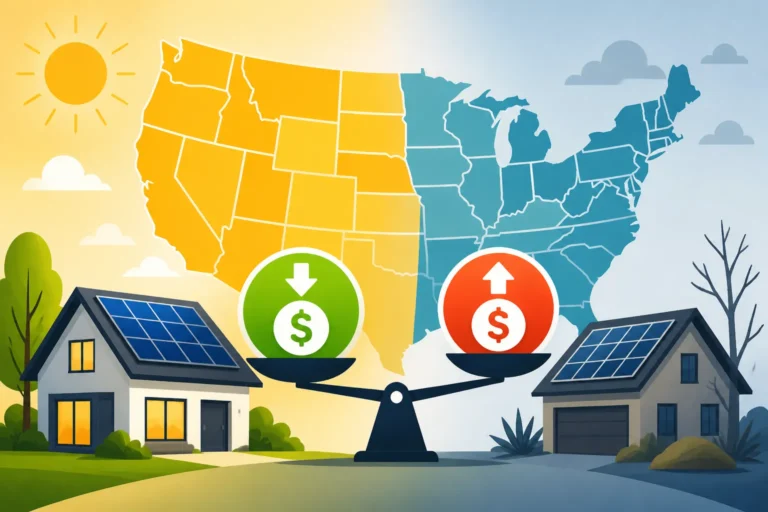
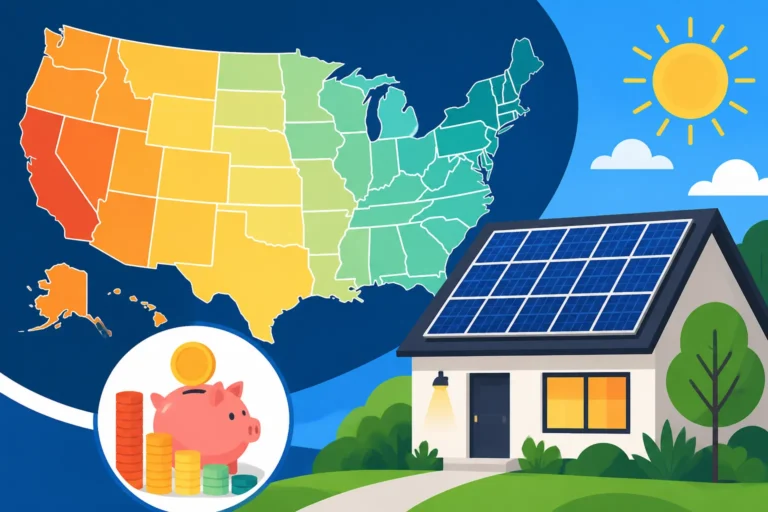
Geography is the final piece of the puzzle. Solar is not a one-size-fits-all solution. The price of electricity varies wildly across the country, as does the amount of sunshine and the availability of state-level incentives. In Washington state, where hydroelectric power keeps rates relatively low, the "solar is cheaper" argument is harder to make than in Hawaii, where electricity is among the most expensive in the nation.
You must look at Solar Panel Cost by State to see how your local market behaves. Some states offer additional rebates, performance-based incentives, or property tax exemptions that can shave thousands off the total cost. These local perks often represent the difference between a "good" investment and a "great" one.
High-Rate States vs. Low-Rate States
In states like New York, California, and Connecticut, the utility companies have made the choice for you. Their rates are so high that almost any solar system—even one with modest production—will be cheaper than the grid. In these areas, solar is essentially a "must-have" for any homeowner looking to stabilize their finances.
In contrast, if you live in a state with 10-cent-per-kWh electricity and no net metering, the math is much tighter. You would need a very efficient system, a perfect south-facing roof, and likely some federal tax credits to make the numbers work. However, even in low-rate states, the "peace of mind" factor of energy independence often tips the scales for homeowners.
The Power of Local Incentives
Beyond the federal level, local utilities sometimes offer "solar rebates" that aren't widely advertised. These can range from a few hundred dollars to several thousand. Some municipalities also offer "PACE" financing, which allows you to pay for your solar through your property tax bill.
When you combine a federal credit with a state rebate and a local property tax exemption, the "net cost" of your solar system can drop by 40% or more. At that point, there is no question: solar is dramatically cheaper than paying for electricity. To find the most current list of these local perks, your best bet is to speak with a local expert who knows the specific incentive landscape in your zip code.
State Solar Incentives Disclaimer
This guide is intended for informational purposes only. Solar incentives, net metering policies, and utility rates are subject to change by state legislatures, public utility commissions, and individual utility providers. While we strive to provide the most up-to-date information, you should always consult with a qualified tax professional and a local solar expert to confirm the specific financial benefits available in your area. Your actual savings will depend on your home's orientation, local weather patterns, and specific energy consumption habits.