How Does California Net Billing (NEM 3.0) Affect Savings?
California homeowners are currently facing a frustrating crossroads where skyrocketing utility rates from PG&E, SCE, and SDG&E are clashing with the complexities of the new Net Billing Tariff. If you feel like the rug was pulled out from under you with the transition to NEM 3.0, you are not alone. This guide breaks down exactly how the new rules affect your monthly savings and explains why your solar strategy must evolve to stay profitable.
Understanding the Shift from NEM 2.0 to NEM 3.0
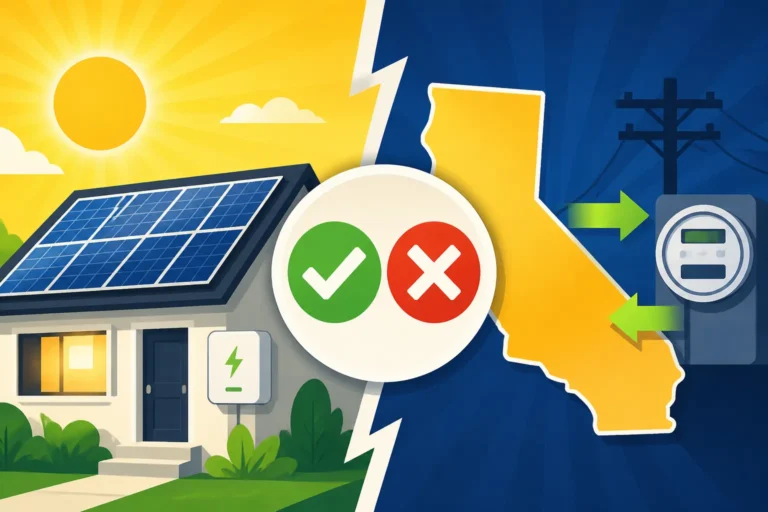
For over a decade, California was the gold standard for solar savings because of retail-rate net metering. If you lived in a place like Riverside or Sacramento, you could send a kilowatt-hour (kWh) of excess energy to the grid and get a credit for roughly the same price the utility charged you. It was a simple "one-for-one" swap that made the math easy for families trying to lower their overhead. However, the move to the Net Billing Tariff has fundamentally changed that equation by decoupling the value of the energy you produce from the price you pay to buy it.
The biggest hurdle for most people to grasp is that the utility no longer views your excess solar power as being worth the retail rate. Instead, they use a highly complex structure to determine what that energy is worth to the grid at any given moment. This shift was designed to encourage homeowners to install batteries and reduce the strain on the grid during peak evening hours, but for the average homeowner in the Central Valley or the Bay Area, it initially felt like a massive penalty for going green.
To understand the current landscape, you really have to look at California NEM 2.0 vs NEM 3.0 Explained to see the stark difference in credit values. While NEM 2.0 customers are largely grandfathered in for 20 years, new solar adopters are entering a world where the timing of their energy production is just as important as the amount of energy they produce. It is no longer enough to just cover your roof in panels; you have to think about when those panels are working and where that power is going.
The Death of Retail Rate Net Metering
Under the old rules, your electric meter essentially ran backward at the same speed it ran forward. If you were paying $0.45 per kWh during a hot July afternoon in Fresno, you were also earning $0.45 for every kWh your system pushed back to the grid. This allowed homeowners to "bank" credits during the sunny daylight hours and use them for free at night. It was a predictable system that allowed for a very fast return on investment.
With NEM 3.0, that one-for-one exchange is gone. The credit you receive for exporting power is now based on the "Avoided Cost" to the utility. On average, this means you are getting roughly 75% to 80% less for your exported energy than you did under NEM 2.0. Instead of 40 or 50 cents, you might be looking at an average of 5 to 8 cents per kWh. This is a massive blow to the "solar-only" model that worked so well for so many years.
This change is why so many people are asking Does California Have Net Metering in 2026? and searching for ways to bridge the gap. The reality is that the grid has changed. During the day, California often has an oversupply of solar energy, which drives the value down. The utilities argued that paying retail rates for that excess was a "cost shift" to non-solar customers, and the CPUC agreed. Now, the burden of managing that energy has shifted directly to you, the homeowner.
How the Avoided Cost Calculator Works
The math behind your new solar bill is dictated by something called the Avoided Cost Calculator (ACC). This is a massive spreadsheet used by state regulators that determines the value of electricity for every single hour of the year for the next 30 years. It takes into account things like greenhouse gas prices, transmission costs, and grid reliability. For a homeowner in San Diego or Los Angeles, it means your export credit changes constantly.
Most of the time, the ACC values are very low because the sun is shining across the entire state and everyone's solar panels are maxed out. However, there are "window" periods—specifically in the early evening during August and September—where the credit value can actually skyrocket because the grid is desperate for power as people turn on their air conditioning while the sun goes down. If you can push power to the grid during those specific hours, you can actually make a decent return, but you can't do that without a storage system.
Understanding this mechanism is vital because it changes the "avoided cost" of your electricity. To get the full picture of this pricing structure, you should check out Avoided-Cost Rate & Export Credits Explained. It explains why a kWh produced at 1:00 PM is worth almost nothing, while a kWh produced (or discharged from a battery) at 7:00 PM is the "gold" that makes your system pay for itself.
The Impact on Monthly Savings and Payback Periods
The most direct consequence of NEM 3.0 is the extension of the solar payback period. In the glory days of NEM 2.0, a well-designed system in a high-cost area like San Francisco or San Diego could pay for itself in 5 to 7 years. Because you were offsetting high retail rates with high export credits, the math was incredibly favorable. Today, if you install a solar-only system without a battery, that payback period can stretch out to 12 years or more, which is a hard pill for many families to swallow.
However, the "savings" part of the conversation hasn't vanished—it has just evolved. Even though export credits are lower, the price of utility power in California is rising at an alarming rate. With PG&E and others implementing double-digit rate hikes, the "avoided cost" of buying power from them is still very high. Every kWh you produce and consume immediately inside your home saves you the full retail price, which is still a huge win.
When calculating your long-term ROI, you have to look at the Solar Payback Period in California for the most current data. The goal now is not to sell power to the utility; the goal is to "self-consume" as much as possible. By keeping your energy at home, you are essentially "selling" it to yourself at the retail rate, which is the only way to keep those monthly savings in the triple digits.
Why Your Payback Period Might Be Longer Now
If you look at the Average Solar Cost in California (2026), you'll see that equipment prices have stabilized, but the "utility math" has gotten harder. Because your daytime exports are worth so much less, you aren't chipping away at your initial investment as quickly during the hours when your system is most productive. This is especially true for households where everyone is at work or school during the day and the house is "silent" while the sun is out.
If you don't have a way to store that mid-day energy, it gets "dumped" onto the grid for a few pennies, and then you have to buy it back at 6:00 PM for 50 cents or more. This "buy high, sell low" dynamic is exactly what the utilities want, and it is what drags out your payback period. To combat this, you have to be much more strategic about system sizing and energy habits than homeowners were five years ago.
Despite the longer timeline, many still find that Is Solar Worth It in California in 2026? is a resounding "yes," but only if you look at it as a 25-year hedge against inflation rather than a 5-year get-rich-quick scheme. The peace of mind that comes from knowing your power bill won't double again in the next decade is a value that doesn't always show up perfectly on a spreadsheet, but it definitely shows up in your bank account over time.
The Vital Role of Solar Batteries in NEM 3.0
In the NEM 3.0 era, a battery is no longer a luxury for backup power during a wildfire or a grid outage—it is the primary engine of your financial savings. By pairing your panels with a storage system, you can capture all that "cheap" daytime energy that the utility doesn't want to pay you for. Instead of exporting it for 5 cents, you save it in the battery and use it after the sun goes down when rates are at their highest.
This strategy is known as "load shifting" or "self-consumption." For a family in the Inland Empire or the Central Valley where AC usage is non-negotiable, a battery can be the difference between a $20 bill and a $200 bill. When you look at California Solar Incentives in 2026, you'll see that many of the remaining programs are actually geared toward storage rather than just generation.
If you are considering this path, you should definitely research Is the Tesla Powerwall 3 Worth It? or look at other high-capacity options like the Enphase IQ Battery. These systems are designed to communicate with the grid's Avoided Cost Calculator to ensure you are discharging power at the most financially beneficial times. It takes the guesswork out of the process and ensures you are clawing back as much value as possible from the utility.
Maximizing ROI Under the Net Billing Tariff
To get the most out of a solar investment, California homeowners have to stop thinking like passive consumers and start thinking like "prosumers." This means being mindful of when your heavy appliances are running and how your home interacts with the grid. If you can align your lifestyle with the rhythm of the sun, you can still see incredible returns, even under the Net Billing Tariff rules.
Another key factor is looking at your home as a whole ecosystem. This includes considering electric vehicle (EV) charging and heat pump technology. Since you are already producing "low-value" excess energy during the day, using that energy to fuel your car or pre-cool your home is far more valuable than exporting it. You are essentially turning your solar panels into a private gas station and HVAC fuel source.
Strategic planning also involves staying informed about the California Net Metering Rules in 2026 as they continue to be refined by the CPUC. There are often small adjustments to the ACC or new "adders" for low-income households that can move the needle on your ROI. Being proactive and working with an installer who understands the nuances of your specific utility territory is essential.
Self-Consumption Strategies for California Homeowners
The most effective way to save money now is to "offset" your highest-cost hours. Most California utilities use Time-of-Use (TOU) rates, where power is most expensive between 4:00 PM and 9:00 PM. If you have a battery, you should be running your home entirely off that stored energy during those hours. Even without a battery, you can practice "pre-cooling" your home at 2:00 PM while your solar production is high, so your AC doesn't have to work as hard when the sun goes down and rates spike.
Other simple shifts include running your dishwasher, laundry, and pool pumps during the middle of the day. If you are an EV owner, charging your car at noon while your panels are cranking is significantly better for your wallet than charging at night. These behavioral changes might seem small, but they can shave years off your payback period by ensuring you never "sell" a single kWh to the utility for a low price if you can help it.
Electrification and the Shift to Time-of-Use Rates
California is moving toward total electrification, and NEM 3.0 is a big part of that push. By making daytime power "cheap" and evening power "expensive," the state is forcing a shift in how we use energy. If you are moving away from gas appliances to heat pumps and induction stoves, your total electricity demand will go up, but your ability to save with solar also increases because you have more "internal" demand to soak up your solar production.
It’s worth noting that if you are currently on a legacy rate, you should understand What Happens to Net Metering When I Sell My House? because those benefits often don't transfer fully to the new owner, or they might be truncated. For new buyers, entering a home that is already set up for high self-consumption is a huge selling point. The more "electric-ready" your home is, the better your solar system will perform financially under the net billing structure.
| Feature | NEM 2.0 (Legacy) | NEM 3.0 (Net Billing Tariff) |
|---|---|---|
| Export Credit Value | Retail Rate (~$0.30 – $0.50) | Avoided Cost (~$0.05 – $0.08) |
| Payback Period (Solar Only) | 5 – 7 Years | 10 – 14 Years |
| Payback Period (Solar + Battery) | 7 – 9 Years | 7 – 9 Years |
| Battery Necessity | Optional (for backup) | Essential (for ROI) |
| Grid Connection Fee | Minimal | Standard (~$15/month) |
| Best Strategy | Export as much as possible | Consume as much as possible |
Frequently Asked Questions About California Solar in 2026
Can You Still Save Money with Solar in California?
Yes, but the "how" has changed. You can no longer rely on the utility to be your "free" battery. To save money today, you must prioritize storage. When you look at the Is Solar Worth It in California in 2026? analysis, it becomes clear that while the initial investment is higher (due to the battery), the long-term protection against utility rate hikes is more valuable than ever. Rates in California are currently some of the highest in the nation, and they aren't going down. Solar is your only "escape hatch" from those costs.
What Happens if You Buy a Home with an Existing System?
If the home was permitted under NEM 1.0 or NEM 2.0, those benefits typically stay with the "meter" for the remainder of the 20-year term from the original PTO (Permission to Operate) date. This is a massive asset when buying or selling a home. However, if you add more than 1 kW or 10% to the system's capacity, you might be forced to transition to NEM 3.0. Always verify the status of the system before closing, as the difference in monthly bills can be hundreds of dollars.
Disclaimer
The information provided in this guide is for educational purposes only and does not constitute financial, legal, or tax advice. Solar policies, utility rates, and incentive programs in California are subject to frequent changes by the CPUC and individual utility providers. Always consult with a qualified solar professional and a tax advisor to understand the specific implications for your home and financial situation.