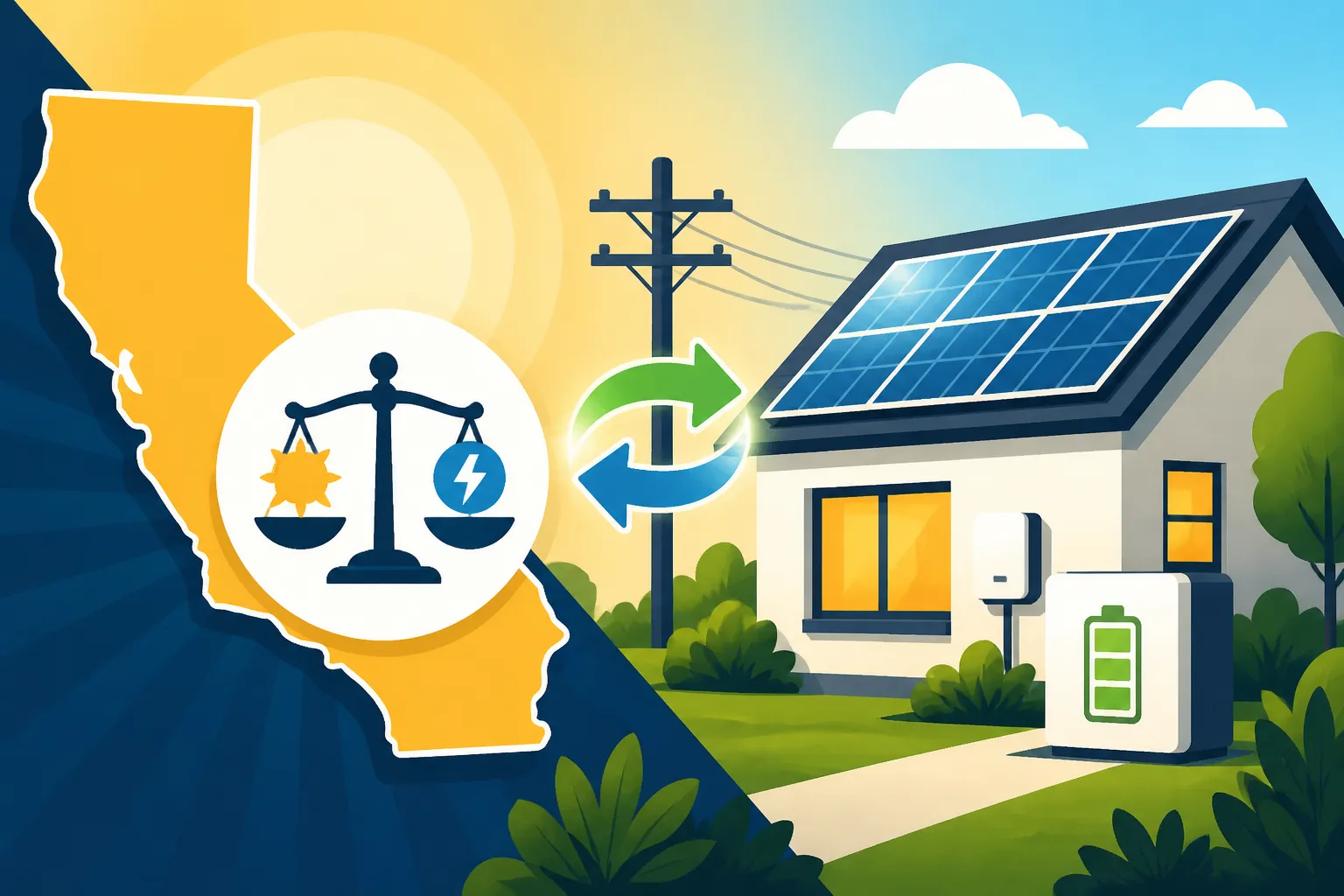
California Net Metering Rules in 2026
If you have been staring at your California utility bill lately and feeling a sense of dread, you are not alone. The landscape of home energy in the Golden State has shifted dramatically, leaving many homeowners wondering if the "solar dream" is still alive or if the new regulations have made it a luxury of the past. This guide breaks down the complex California net metering rules in 2026, specifically focusing on the Solar Billing Plan, to help you navigate these changes and reclaim control over your monthly expenses.
Understanding the Shift From NEM 2.0 to the Solar Billing Plan
For years, California was the poster child for solar adoption thanks to a policy known as Net Energy Metering (NEM). Under the old NEM 2.0 rules, if your panels produced more electricity than you needed during the day, you could send that excess back to the grid and receive a credit on your bill roughly equal to the retail price of power. It was a one-to-one swap that made the math for solar incredibly simple and the payback periods very short. However, as we move through 2026, that era has officially ended for new applicants, replaced by what the California Public Utilities Commission (CPUC) calls the Solar Billing Plan, or NEM 3.0.
The transition was driven by a desire from utilities to address the "cost-shift," arguing that solar owners weren't paying their fair share for grid maintenance. Whether you agree with that logic or not, the result is a system where the value of the energy you export to the grid has dropped by about 75%. This change has fundamentally altered how you should think about your system's design. If you are still on a legacy system, you might be wondering California NEM 2.0 vs NEM 3.0 Explained to see how much longer your current benefits will last before you are eventually moved to the new structure.
Grandfathering is a major point of confusion for many. If you submitted a complete interconnection application before the April 2023 deadline, you are likely locked into NEM 2.0 for 20 years from your original What Is Permission to Operate (PTO)? date. For everyone else entering the market in 2026, the Solar Billing Plan is the only path forward. It is not a death sentence for solar savings, but it does mean that the "set it and forget it" approach of the past no longer works. You now have to be much more strategic about when you use your energy and how much of it you actually let escape back to the utility company.
How Net Billing Works in California Today
The core of the 2026 rules is the Avoided Cost Calculator (ACC). Instead of getting retail rates for your excess power, the utility now pays you based on the "avoided cost"—essentially what it would have cost them to buy that same electricity elsewhere at that exact moment. This value fluctuates wildly depending on the time of day, the day of the week, and even the month. During the middle of a sunny Tuesday in April, the grid is flooded with solar power, so the export rate is almost zero. Conversely, on a hot September evening when the sun is setting but everyone is blasting their air conditioning, the export rate can skyrocket.
This is why understanding What Is NEM 3.0 (California Net Billing)? is so critical for modern homeowners. You are no longer just a passive consumer; you are a micro-generator participating in a complex market. The utility tracks your imports and exports in real-time. At the end of the month, they look at your "net" position. While you still have an annual true-up period, the way those credits are valued makes it much harder to "zero out" a bill simply by over-producing during the day. The math is geared toward encouraging you to keep your energy behind the meter.
To make sense of these fluctuating rates, many people are turning to tools like Modernize to find contractors who specialize in high-tech monitoring and smart energy management. These professionals can show you heat maps of when your specific utility—whether it's PG&E, SCE, or SDGE—values energy the most. In 2026, the highest export credits usually occur during a few key "window hours" in the late summer. If you can't discharge energy during those specific times, your Average Solar Cost in California (2026) might feel like a heavier burden than it should be because your credits aren't offsetting your nighttime usage effectively.
| Feature | NEM 2.0 (Legacy) | Solar Billing Plan (NEM 3.0) |
|---|---|---|
| Export Credit Rate | Retail Rate (~30c/kWh) | Avoided Cost Rate (~8c/kWh avg) |
| Payback Period | 5 to 7 Years | 7 to 10 Years (with battery) |
| Battery Requirement | Optional | Essential for ROI |
| Monthly Charges | Minimal non-bypassable charges | Higher fixed infrastructure fees |
| Grid Reliance | High (Grid acts as a free battery) | Low (Self-consumption is the goal) |
Maximizing ROI Under the 2026 Rules
If the export rates are so low, you might be asking: Is Solar Worth It in California in 2026? The answer is a resounding yes, but only if you change your hardware configuration. In the old days, we told people to cover every square inch of their roof with panels to maximize production. In 2026, that strategy can actually backfire. If you produce a massive surplus that you can't use or store, you are essentially giving free power to the utility for pennies on the dollar. The new goal is "self-consumption"—using every drop of energy you produce right in your own home.
This shift has made energy storage the absolute star of the show. You simply cannot talk about California solar anymore without talking about batteries. By adding a storage system, you can capture that "cheap" mid-day solar energy and save it for the evening when utility rates are at their peak. This prevents you from having to buy expensive power from the grid at 6:00 PM and allows you to avoid exporting your power when it’s worth the least. When you look at the Solar Plus Battery Cost, it is undeniably higher upfront, but the long-term savings are significantly better than a solar-only system under the current rules.
Beyond just hardware, you need to look at the available California Solar Incentives in 2026 to help offset these costs. While the federal tax credit remains a cornerstone, California has introduced specific equity programs and battery incentives for those in high-fire-threat districts or low-income areas. Using a service like Modernize can help you connect with installers who are well-versed in these niche rebates, ensuring you aren't leaving money on the table. They can also help you model How Much Does Solar Cost in California After NEM 3.0? based on your specific roof orientation and shade profile, which is more important now than ever before because every kilowatt-hour of self-consumption is worth three to four times more than an exported one.
Critical 2026 Deadlines and Compliance
Navigating the bureaucracy of the CPUC and the big three investor-owned utilities can feel like a full-time job. In 2026, the rules around Permission to Operate (PTO) have become stricter. Utilities are looking for specific smart-inverter settings that allow them to manage grid stability. If your system isn't commissioned with the correct software configurations, you could face delays in getting your system turned on, or worse, you could be billed under the wrong rate schedule. It is vital to work with a reputable professional who doesn't just slap panels on the roof but handles the entire administrative headache from start to finish.
Another major development for 2026 involves Virtual Net Metering (VNEM) and the requirements for multi-family properties. If you live in a condo or an apartment complex, the rules for how solar energy is shared among tenants have undergone significant changes. The "Solar Billing Plan" logic now applies to these shared systems as well, which has made some developers hesitant. However, new legislation is constantly being proposed to make Solar Incentives for Renters & Condos more accessible, so it is worth staying updated on the latest local ordinances in cities like Los Angeles, San Francisco, or San Diego.
Finally, keep in mind that the Avoided Cost Calculator values are updated annually. This means the "math" for your solar system could shift slightly every year. While this sounds intimidating, it usually works in favor of those who have batteries. As the grid becomes more stressed by heatwaves and electrification, the "avoided cost" during peak hours tends to rise, making your stored energy even more valuable. If you are still on the fence, Do I Really Need a Solar Battery? is a question you should answer sooner rather than later, as the hardware is the only real hedge you have against future utility rate hikes and policy shifts. Platforms like Modernize provide a great starting point to see what others in your neighborhood are doing to stay ahead of these regulatory curveballs.
California Solar Rules Disclaimer
This guide is provided for informational purposes only and does not constitute legal, financial, or tax advice. Net metering rules, utility rate structures, and state incentives in California are subject to frequent change by the California Public Utilities Commission (CPUC) and individual utility providers. Always consult with a qualified solar professional and a tax advisor to confirm the current regulations and potential savings specific to your home and location before making any investment decisions.