Does Massachusetts Have Net Metering in 2026?
If you have been watching your Eversource or National Grid bill climb higher every month in Boston or Worcester, you are probably feeling that familiar sense of dread. You want to go solar to fight back, but the rumors about changing state policies and "caps" can make anyone hesitate. This guide clarifies exactly how net metering works in Massachusetts for 2026 so you can stop guessing and start saving.
The Current State of Net Metering in Massachusetts
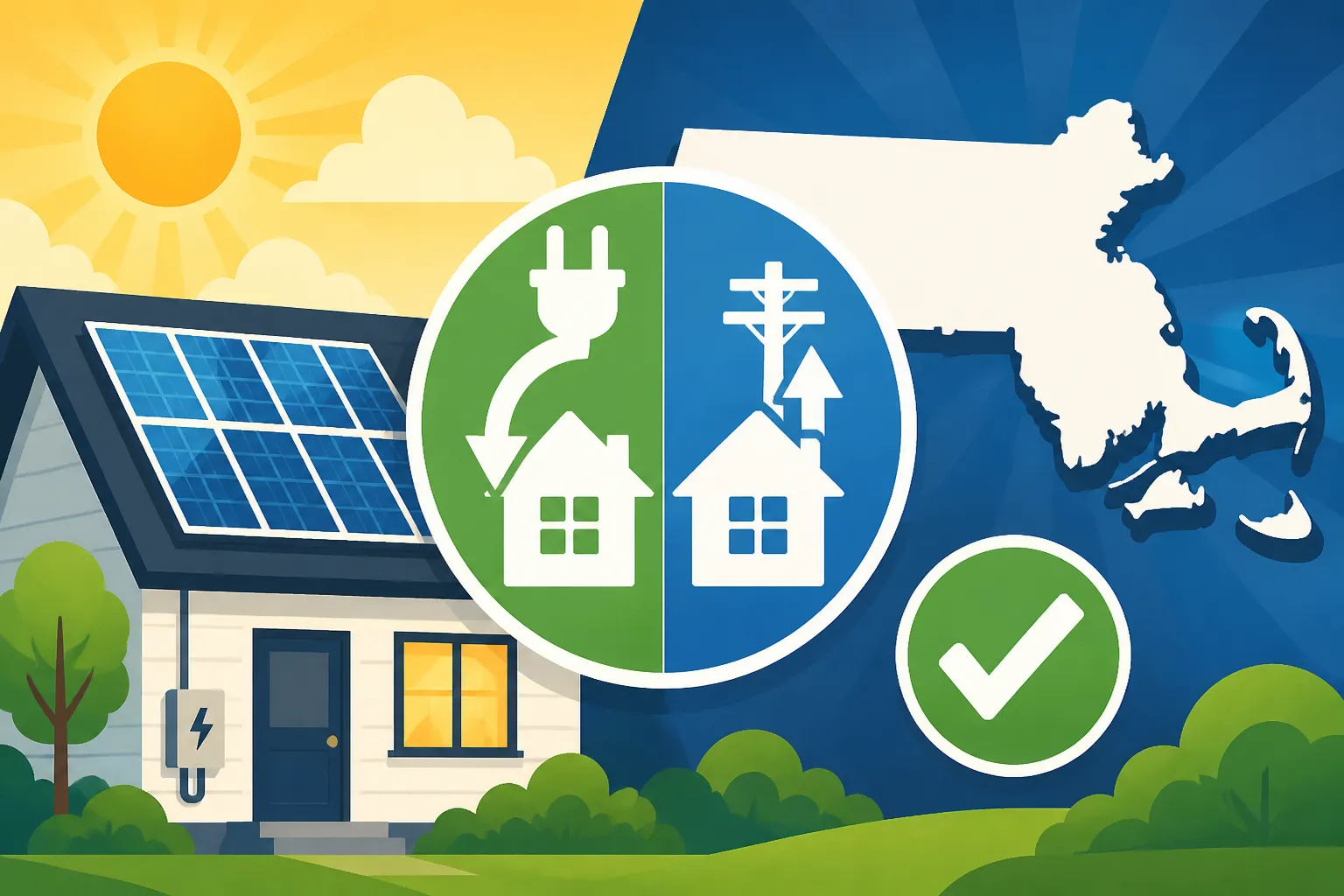
The short answer is a resounding yes: Massachusetts still has net metering, and it remains one of the strongest programs in the country. However, if you are looking for a simple "one-to-one" credit system, you need to understand that the rules have become a bit more nuanced than they were five years ago. Net metering is the mechanism that allows your electric meter to essentially spin backward when your solar panels are producing more energy than your home is consuming. Instead of that excess power just disappearing into the grid for free, the utility company is required to give you a credit on your bill.
The Bay State continues to use net metering as the backbone of its solar policy. For a homeowner in Springfield or a small business in Lowell, this means that the surplus electricity your system generates during those long June days can be used to offset the high costs of running your heat pump or electric furnace in the dead of January. The state's commitment to reaching net-zero emissions by 2050 has ensured that these programs aren't just surviving; they are being integrated into a more complex energy landscape.
One of the most common frustrations I hear from homeowners is the confusion between "retail rate" credits and "avoided cost" credits. In Massachusetts, most residential systems under a certain size still qualify for credits that are very close to the full retail rate. This is a huge win because it means every kilowatt-hour (kWh) you send back is worth nearly as much as the ones you buy. To get a better sense of the financial weight of this, it is worth checking out Net Metering Explained: How It Works by State to see how Massachusetts stacks up against its neighbors.
Retail Rate Credits vs. Net Billing
In 2026, the distinction between retail rate net metering and "net billing" has become more prominent. For most residential customers with systems smaller than 10 kilowatts (kW) on a single-phase circuit (which covers the vast majority of suburban homes), you are typically receiving credits at the full retail rate. This includes the supply, transmission, and transition charges. However, as systems get larger or move into the commercial space, the "Class II" and "Class III" rules kick in, which might reduce the credit value slightly by excluding certain delivery charges.
This nuance is exactly why people often ask Are Solar Panels Worth It in 2026? when they see their neighbors getting slightly different credit values. If you are in an area served by a municipal light plant (MLP) rather than a major investor-owned utility like National Grid, your rules might be entirely different. MLPs are not always required to offer the same net metering terms as the big players, though many do offer their own version of a rebate or incentive to stay competitive.
Utility-Specific Nuances: National Grid, Eversource, and Unitil
While the state sets the overarching rules, the day-to-day experience of net metering depends heavily on who sends you your bill. National Grid and Eversource handle the lion's share of the state, and in 2026, their portals for tracking net metering credits have become much more sophisticated. You can now see a line-by-line breakdown of your "banked" credits. If you generate $200 worth of excess power in July, that $200 sits in your account like a gift card that never expires, waiting to be applied to your future bills.
Unitil customers in the north-central part of the state also have access to net metering, but because their service territory is smaller, the "caps" on how much total solar can be on their grid can sometimes be reached faster. This leads to the "interconnection" waitlists that frustrate so many people. Before you get too deep into the process, understanding What Is Permission to Operate (PTO)? is crucial because that is the official moment your utility acknowledges your right to start net metering.
Navigating the Massachusetts SMART Program and Net Metering
You cannot talk about solar in Massachusetts without mentioning the SMART (Solar Massachusetts Renewable Target) program. SMART and net metering are like a pair of high-performance running shoes; they work together to get you to the finish line of a $0 electric bill. While net metering handles the "trading" of electricity, SMART provides a direct monthly payment (or bill credit) based on every kWh your system produces, regardless of whether you use it or send it back to the grid.
The SMART program is structured in "blocks." As more people sign up, the incentive rate for the next block decreases. In 2026, we are in the later blocks, meaning the per-kWh incentive is lower than it was in 2020, but the equipment is also more efficient and often cheaper. It is a balancing act. For a detailed breakdown of how these specific payments look today, refer to the Massachusetts SMART Program Explained guide.
How SMART Credits Work with Your Bill
The way SMART interacts with your net metering credit can be a bit of a head-scratcher. Essentially, your utility looks at your total production. If you are a National Grid customer, you might see a "SMART Incentive" credit applied directly to your bill, which reduces the total amount you owe. If that credit plus your net metering credits exceed your monthly usage, your bill will literally show a negative balance. It is a beautiful thing to see a bill that says "Do Not Pay: -$45.00."
Many homeowners worry that if they install a system today, they are "too late" for the best SMART rates. While the rates have indeed stepped down, the state has added "adders" for things like battery storage. This makes Massachusetts Solar Incentives in 2026 still some of the best in the country. If you include a battery, your SMART incentive rate actually increases, which helps offset the cost of the hardware.
The 2026 Outlook for Incentive Blocks
By 2026, the SMART program has matured significantly. Some regions of the state—particularly those served by Eversource in Eastern MA—have seen their blocks fill up faster than others. When a block fills, there is often a brief period of uncertainty while the Department of Energy Resources (DOER) opens the next one. This "hurry up and wait" cycle is a common pain point for installers and homeowners alike.
If you are planning an installation in 2026, your installer should be able to tell you exactly which block you will fall into. This transparency is vital because it affects your Solar Panel Payback Period Explained. If you are in a lower incentive block, your system might take seven years to pay for itself instead of six, but given that the panels are warranted for 25 years, the long-term ROI remains incredibly strong.
Common Challenges: Caps, Waitlists, and System Sizes
Even though net metering is alive and well, it isn't always smooth sailing. Massachusetts has "net metering caps," which are limits on the total capacity of solar that can be connected to the grid under the net metering program. These caps are divided into "Private" and "Public" categories. For a homeowner in a place like Newton or Quincy, the "Private" cap is the one that matters. Historically, these caps have filled up, causing the state legislature to have to jump in and raise them.
In 2026, most small residential systems (10 kW or less) are actually exempt from these caps. This is a huge relief for the average homeowner because it means you don't have to worry about the state "running out" of room for your system. However, if you have a massive estate or a small farm and want a 25 kW system, you might find yourself hitting a cap and having to wait for a legislative update. Understanding How Many Solar Panels Do I Need for My Home? is the first step in seeing which category you fall into.
Understanding System Size Limits
The "10 kW exempt" rule is the gold standard for Massachusetts homeowners. If your system is 10 kW DC or smaller, you are essentially fast-tracked for net metering. In 2026, with higher-efficiency panels, you can fit a lot of power into a 10 kW footprint. We are seeing panels that produce 450W or more, meaning you only need about 22 panels to hit that 10 kW mark. If you're wondering about the footprint, How Much Do Solar Panels Cost? 2026 Guide provides a good look at how these system sizes translate to real-world dollars and cents.
If you decide to go larger than 10 kW, you are no longer exempt from the caps. You have to apply for "Cap Allocation" through a system called MassACA. It sounds like a lot of bureaucracy, and frankly, it is. This is where a veteran installer earns their keep by navigating the paperwork to ensure your credits are secured before the panels even touch your roof.
The Net Metering Cap Headache
For those who do fall under the cap rules, the frustration of "waiting for the cap to move" is real. In some utility territories, the caps have been hit multiple times over the last decade. While the state has a history of raising them to meet climate goals, there can be months of limbo where new large systems aren't getting their full credit value.
If you find yourself in this situation, you might look into other options like Community Solar: How It Works & Who Qualifies. Community solar allows you to subscribe to a large off-site array, giving you many of the same bill-credit benefits without having to worry about the specific net metering caps on your own roof. It is a popular alternative for renters or people with heavily shaded Victorian homes in neighborhoods like Jamaica Plain.
| Utility Provider | Residential Net Metering Type | SMART Program Participant? | 10 kW Cap Exemption? |
|---|---|---|---|
| National Grid | Full Retail Rate (typically) | Yes | Yes |
| Eversource | Full Retail Rate (typically) | Yes | Yes |
| Unitil | Full Retail Rate (typically) | Yes | Yes |
| Municipal Light Plants | Varies by Town | Often No | Varies |
Maximizing Your Savings: Batteries and Efficiency
In 2026, the conversation about net metering has shifted slightly toward "self-consumption." Because utilities are looking for ways to manage the grid more effectively, they are increasingly encouraging homeowners to store their own power rather than sending it all back. This is where Solar Battery Incentives in 2026 become essential. By adding a battery like a Tesla Powerwall or an Enphase IQ Battery, you can store your excess mid-day production and use it during the "peak" evening hours when the grid is most stressed.
In Massachusetts, adding a battery doesn't just give you backup power for the next Nor'easter; it actually qualifies you for additional payments through programs like ConnectedSolutions. This program pays you for allowing the utility to briefly tap into your battery during heatwaves to prevent blackouts. When you combine net metering credits, SMART payments, and ConnectedSolutions revenue, the financial case for solar is actually more diverse and resilient than it was in the past.
Why Adding a Battery Changes the Game
Without a battery, you are 100% reliant on the net metering policy staying exactly as it is. With a battery, you have a layer of protection. If the state were to ever move toward a less favorable "net billing" model (like California did with NEM 3.0), having a battery allows you to use your own power rather than selling it to the utility for a lower price.
Furthermore, the peace of mind during a Massachusetts winter cannot be overstated. When the ice builds up on the lines in the Berkshires or on the Cape, and the power goes out, your solar-plus-battery system keeps your fridge running and your internet on. It turns a potential emergency into a minor inconvenience. This added value is a big reason why many are asking Is It Better to Buy or Lease Solar Panels? As the financing for battery-inclusive systems has become much more accessible.
Final Thoughts on the 2026 Massachusetts Solar Landscape
The transition to clean energy in Massachusetts is not just a trend; it is a structural shift in how we live. While the rules for net metering in 2026 require a bit more reading than they used to, the core benefit remains: the sun can pay your electric bill. Whether you are in a triple-decker in Dorchester or a ranch in Framingham, the combination of net metering and the SMART program creates a financial engine that is hard to beat.
Don't let the fear of "missing out" on older incentives stop you. The technology in 2026 is more reliable, the installers are more experienced, and the state's legal protections for solar owners are stronger than ever. Take the time to get multiple quotes, ask about the SMART block status in your specific zip code, and make sure your system is sized correctly for your actual needs. The journey to energy independence in the Bay State is still very much open for business.
Disclaimer
The information provided in this guide is for educational purposes only and does not constitute financial, legal, or tax advice. Solar policies, including net metering rules and SMART program incentives, are subject to change by state regulators and utility companies. Always consult with a qualified solar professional and a tax advisor to understand the specific incentives and regulations applicable to your situation in 2026.