Is It Better to Buy or Lease Solar Panels?
Deciding to go solar is a huge step toward energy independence and often significant savings, but for many homeowners, the biggest hurdle isn't whether to go solar, it's how to go solar. You're probably grappling with the age-old question: "Is it better to buy or lease solar panels?" It’s a completely valid concern, as the financial implications and long-term benefits can vary dramatically depending on the path you choose. This guide will meticulously break down the pros and cons of buying versus leasing, helping you understand which option aligns best with your financial goals and lifestyle.
Understanding Solar Ownership: The "Buy" Option
When you buy a solar panel system, whether with cash or a loan, you become the sole owner of the equipment. This means you’re responsible for the system from day one, but it also means you reap all the financial rewards and benefits. It’s like owning your home versus renting – you build equity and have full control over your asset.
The Financial Perks of Owning Your System
The most significant advantage of buying your solar panels outright or financing them through a loan is access to all available financial incentives. The federal government, for example, offers a substantial tax credit – currently 30% under the Investment Tax Credit (ITC) – for homeowners who purchase and install new solar energy systems. This isn't just a deduction; it's a dollar-for-dollar reduction in the amount of income tax you owe. Imagine getting a third of your entire system cost back as a credit on your taxes! This credit alone can drastically reduce your Solar Panel Payback Period Explained.
Beyond the federal tax credit, many states and local utilities offer additional incentives like state tax credits, rebates, and Solar Renewable Energy Credits (SRECs). With SRECs, you actually earn credits for the clean energy your system produces, which you can then sell on a market. These programs can add up to thousands of dollars in savings or income over the lifespan of your system. You can explore a comprehensive list of these benefits in guides like Federal Solar Incentives That Still Exist in 2026 and State Solar Incentives: Complete 2026 Guide. By owning, you unlock every single one of these financial opportunities.
Control, Flexibility, and Property Value
Owning your solar system gives you complete autonomy. You choose the specific panels, inverters, and batteries that fit your needs and preferences. Want the latest high-efficiency panels from Maxeon or a robust Tesla Powerwall for energy storage? It's your call. This level of control ensures your system is perfectly tailored to your energy consumption and aesthetic desires. You also control the maintenance schedule and any future upgrades. Should you decide to add more panels or a battery later, you have the flexibility to do so without navigating a third-party contract.
Furthermore, owning solar panels is a proven way to increase your home's value. Studies consistently show that homes with owned solar systems sell faster and for more money than comparable homes without solar. This added value isn't just theoretical; it's a tangible asset that contributes to your overall property equity. When you're ready to sell, the system is yours to transfer, adding significant appeal to potential buyers who appreciate lower energy bills and a greener lifestyle. The impact on your home's value is definitely something to consider, and you can learn more in our article about whether Do Solar Panels Increase Home Value?.
The Upfront Costs and Financing Considerations
Let's be real, the upfront cost of purchasing a solar system can be a bit intimidating. A typical residential solar system can range anywhere from $15,000 to $30,000 or more before incentives, depending on its size and complexity. This figure, though substantial, is often mitigated by the aforementioned tax credits and rebates. However, not everyone has that kind of cash readily available. This is where solar loans come into play.
Many homeowners opt for solar loans, treating their solar investment like a home improvement project or even a second mortgage. These loans can come from various sources, including national banks, credit unions, or specialized solar financing companies. While a loan means monthly payments, these payments are often offset by the savings on your electricity bill, sometimes even resulting in a net positive cash flow from day one. It's crucial to understand the terms of any loan, including interest rates, loan durations, and potential dealer fees. A detailed look at how these work can be found in our Solar Loans: Complete Guide. Companies like Modernize can help connect you with reputable solar installers who offer various financing options, making the process of exploring loans a bit smoother.
Understanding Solar Leases and Power Purchase Agreements (PPAs)
If the idea of a large upfront cost or navigating complex incentives feels overwhelming, solar leases and Power Purchase Agreements (PPAs) present an alternative. These options allow you to go solar with little to no upfront cost, transferring the ownership and maintenance responsibilities to a third-party provider.
How Solar Leases Work
A solar lease is essentially like renting your solar panels. A third-party company, often a solar provider like Sunrun or Vivint Solar, installs and maintains the system on your roof. In return, you pay them a fixed monthly fee, much like a regular utility bill. The lease agreement typically lasts for 20 to 25 years. During this period, you benefit from the electricity generated by the panels, usually at a rate lower than what your utility company charges.
The biggest draw of a solar lease is the minimal to zero upfront cost. This makes solar accessible to a broader range of homeowners who might not have the cash or credit score for a loan. The solar company also takes care of all maintenance, monitoring, and repairs. If a panel breaks or the inverter needs replacing, it's their responsibility, not yours. This "hands-off" approach can be appealing for those who prefer convenience and predictability in their energy expenses. However, the federal tax credit and other ownership-based incentives typically go to the solar company, as they are the legal owner of the system.
The Ins and Outs of Power Purchase Agreements (PPAs)
Power Purchase Agreements (PPAs) are very similar to leases but with a slight twist in how you pay. Instead of a fixed monthly lease payment, with a PPA, you agree to purchase the electricity generated by the solar panels at a predetermined rate per kilowatt-hour (kWh). This rate is typically lower than your local utility's electricity rate, guaranteeing you savings. The solar provider still owns, installs, and maintains the system, assuming all the associated risks and responsibilities.
PPAs also boast zero upfront costs and predictable electricity rates. The rate you pay for solar electricity might be fixed for the duration of the contract, or it might have a small annual escalator (e.g., 2-3%) built in. This escalator is usually designed to be less than historical utility rate increases, ensuring continued savings over time. Just like leases, the solar provider claims the tax credits and other incentives, as they are the system owner. For many, a PPA provides a straightforward way to go solar and save on electricity without the financial complexities of ownership. You can dive deeper into this financing option with our article, What Is a Solar PPA and How Does It Work?.
The Trade-offs: Lower Upfront Costs vs. Long-Term Value
While leases and PPAs offer undeniable benefits like no upfront cost and no maintenance worries, they come with trade-offs. The primary one is that you don't receive any of the valuable financial incentives like the federal tax credit or SRECs. These benefits go to the solar company. This means your long-term savings might not be as significant as they would be with an owned system.
Another consideration is the impact on home value. While an owned solar system typically adds value, a leased system can complicate the sale of your home. Potential buyers might be hesitant to take on a long-term lease agreement, and transferring the lease can sometimes be a lengthy process requiring credit checks and new contracts. Some buyers may even see it as a liability rather than an asset. This is a critical point to discuss with your installer and review in your lease agreement, especially if you anticipate moving within the lease term. Our piece on Selling a House With Solar Panels offers more insights into this scenario.
Key Factors to Consider When Deciding
Choosing between buying and leasing solar panels isn't a one-size-fits-all decision. Several personal and financial factors should weigh heavily on your choice. Thinking through these points will help you determine the best path for your specific situation.
Financial Situation and Goals
Your current financial standing and what you hope to achieve with solar are paramount. If you have the capital available, either in savings or through access to favorable loan terms, purchasing your system generally offers the best long-term return on investment. The ability to claim the federal tax credit, coupled with any state or local incentives, can dramatically reduce the net cost of the system and shorten your Solar Panel Payback Period Explained. Over 20-25 years, an owned system typically generates significantly more savings compared to a leased one, as you eventually pay off the system and enjoy free electricity for the remainder of its lifespan.
On the other hand, if a large upfront investment is simply not feasible or if you prefer to keep your cash for other purposes, a lease or PPA can be an excellent entry point into solar. You'll still save money on your monthly electricity bills from day one, without the financial strain of ownership. It's about balancing immediate accessibility with maximum long-term financial gain. It's also worth investigating if a "$0 Down Solar: How It Really Works" option could still lead to ownership benefits with a smart loan.
Moving Plans and Home Value Impact
Your future living situation plays a significant role in this decision. If you plan to stay in your home for many years – say, 10 to 15 years or more – the benefits of owning a solar system truly shine. You'll have ample time to realize the full financial benefits, including paying off your loan and enjoying years of free or heavily reduced electricity. Plus, the added property value will likely be a boon when you eventually decide to sell.
However, if you foresee moving in the next 3 to 7 years, the situation becomes more nuanced. Transferring a solar lease or PPA to a new homeowner can sometimes be complex and may even deter potential buyers. Some buyers might prefer a clean slate without a long-term energy contract attached. While many lease providers have processes for transferring agreements, it’s rarely as straightforward as selling a home with an owned system that simply conveys with the property. This is a crucial point that companies like Modernize can help you understand by connecting you with experienced solar professionals who can explain the nuances in your local market.
State and Local Incentives
The availability and generosity of state and local incentives can heavily influence whether buying or leasing is more advantageous. Some states offer robust programs for homeowners who purchase their systems, such as significant state tax credits, attractive net metering policies, or strong SREC markets. Net metering, for instance, allows you to send excess solar electricity back to the grid for credits on your bill, which can make a huge difference in your overall savings. You can learn more about how this works in our guide Net Metering Explained: How It Works by State.
In regions with particularly strong financial incentives for owners, the argument for purchasing becomes even more compelling. Conversely, in areas where incentives for owners are less robust, or where utility rates are exceptionally high, the consistent, predictable savings offered by a lease or PPA might hold more appeal, even if you forgo certain ownership benefits. It's essential to research what's available in your specific area; what makes sense in California, with its NEM 3.0 rules, might be different than in New York, which offers a 25% state tax credit.
Making the Right Choice for Your Home
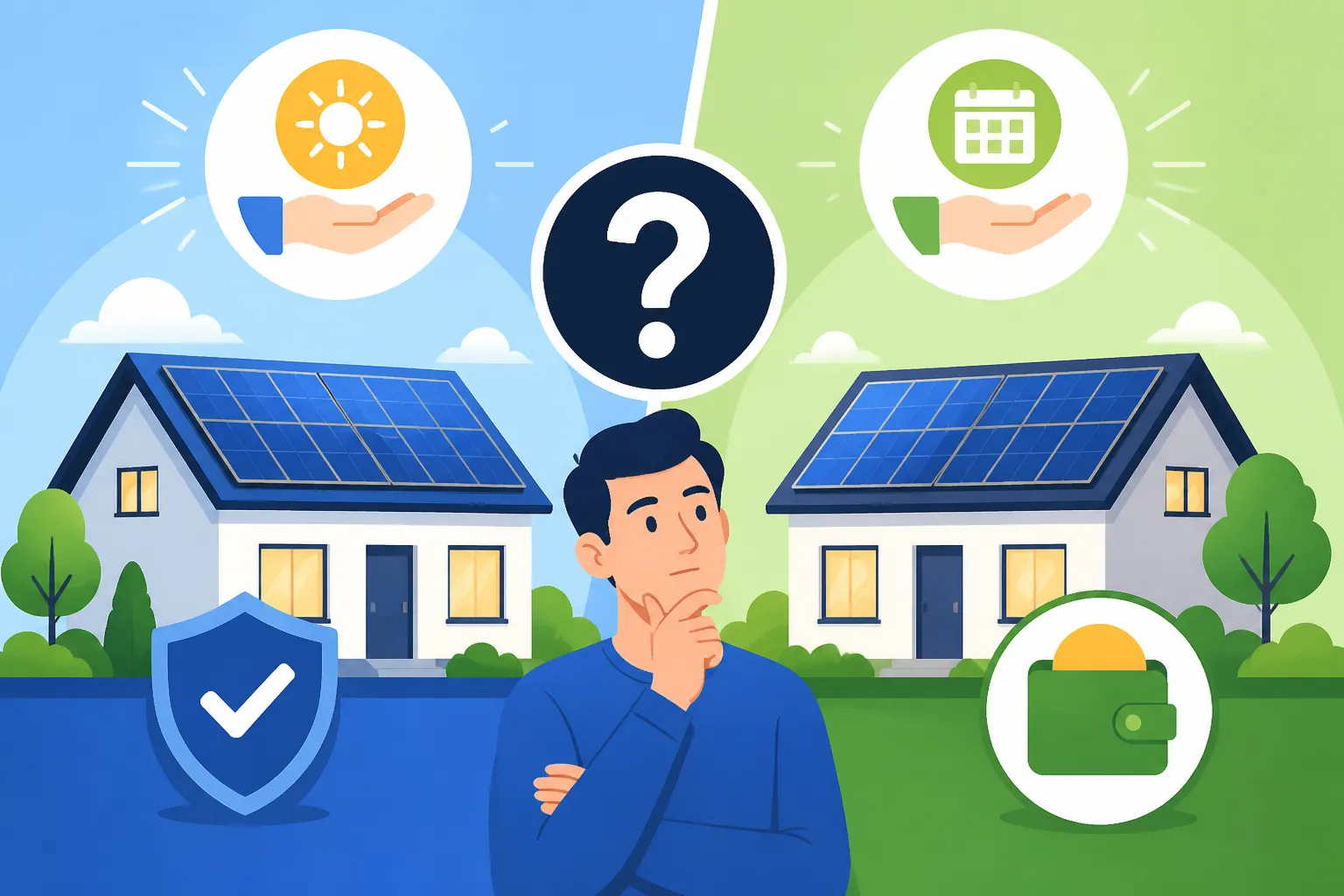
Ultimately, the choice between buying and leasing solar panels boils down to a personal decision based on your financial capacity, long-term goals, and comfort level with ownership responsibilities. There isn't a universally "better" option, but rather a better fit for you.
A Side-by-Side Comparison
To help clarify the differences, let's lay out a quick comparison of the key aspects of buying versus leasing/PPA:
| Feature | Buying (Cash or Loan) | Leasing / PPA |
|---|---|---|
| Upfront Cost | High (but reduced by incentives) or loan payments | Low to $0 |
| Ownership | You own the system | Solar company owns the system |
| Financial Incentives | You receive all federal, state, and local incentives | Solar company receives incentives |
| Electricity Bill | Significantly reduced, potentially $0 after payoff | Fixed monthly payment or per-kWh rate, usually lower than utility |
| Maintenance | Your responsibility (or covered by warranty) | Solar company's responsibility |
| Property Value | Typically increases home value, easier to sell | Can complicate home sale, potential buyer hesitation |
| Long-Term Savings | Potentially higher | Predictable, but potentially lower than ownership |
| Flexibility | Full control over upgrades, system changes | Limited, subject to contract terms |
This table highlights the fundamental differences, making it easier to see where your priorities might align.
When Buying Makes More Sense
Purchasing your solar panels, either with cash or a solar loan, is generally the most financially advantageous option for homeowners who:
- Have the financial means: You have sufficient savings to pay cash, or you qualify for a low-interest solar loan. The article Cash vs Financing Solar: Which Saves More? delves into these specifics.
- Plan to stay in their home long-term: If you envision living in your home for 10-15 years or more, you'll maximize your return on investment and enjoy years of free electricity after the system is paid off.
- Want to maximize savings and incentives: You're keen on claiming the federal tax credit, state incentives, and potentially selling SRECs. For most homeowners, this is the path to truly optimize financial benefits.
- Desire complete control: You want to choose your equipment, monitor performance, and have the freedom to make upgrades or changes as you see fit.
- Are comfortable with maintenance: You're okay with the idea that you're responsible for the system, though modern solar panels are incredibly durable and low-maintenance.
In essence, if you're looking for the deepest long-term financial benefits and value ownership, buying is almost always the superior choice.
When Leasing Might Be a Good Fit
Solar leases or PPAs are often a good solution for homeowners who:
- Are looking for zero or low upfront cost: This is the primary driver for many. If you want to go solar without a significant initial investment, leases and PPAs fit the bill perfectly.
- Prefer predictability and hands-off convenience: You appreciate knowing your monthly payment or electricity rate and having the solar company handle all maintenance, repairs, and performance monitoring.
- Don't plan on claiming tax credits or incentives: You're either not eligible for the federal tax credit (e.g., if you have minimal tax liability) or simply prefer to forgo the hassle, letting the solar company take those benefits.
- Are uncertain about long-term residency: If you might move in the next 5-10 years, a lease or PPA can offer energy savings during your stay, though you'll need to navigate the transfer process when you sell your home.
- Have a roof that's perfect for solar but a tight budget: Sometimes, the opportunity to save money on electricity immediately, even if it's not the maximum possible, is enough.
Ultimately, whether you buy or lease, the core benefit of solar is reducing your reliance on traditional utility companies and contributing to a cleaner environment. To truly gauge if going solar is worth it, regardless of the financing path, you might find our article Are Solar Panels Worth It in 2026? insightful. Companies like Modernize can connect you with qualified local installers who can walk you through both purchase and lease options, providing quotes tailored to your home and financial situation, helping you compare apples to apples.
Disclaimer
The information provided in this article is for general informational purposes only and does not constitute financial, legal, or professional advice. Solar incentives, regulations, and market conditions can change rapidly. It is crucial to consult with qualified solar professionals, financial advisors, and tax experts to understand the specific implications for your individual circumstances. Always conduct thorough due diligence before making any solar investment decisions.