Does New Jersey Have Net Metering in 2026?
Waking up to a three-hundred-dollar electric bill from JCP&L or PSE&G can feel like a gut punch, especially when you are trying to budget in a high-cost state like New Jersey. This guide cuts through the regulatory noise to explain exactly how net metering works, helping you understand if your utility will still pay you full value for your sunshine.
The Current State of Net Metering in New Jersey
If you have been scouring the internet for answers, you have probably seen a lot of scary headlines about net metering disappearing in states like California. It is enough to make any homeowner in the Garden State hesitate. However, I have some genuinely good news for you: New Jersey remains one of the strongest bastions for traditional net metering in the entire country. While other states have moved toward "net billing" structures that slash the value of the energy you send back to the grid, New Jersey has maintained a policy that treats your solar panels like a savings account rather than a hobby.
In 2026, the New Jersey Board of Public Utilities (BPU) continues to mandate that investor-owned utilities provide 1:1 net metering for residential customers. This means that for every kilowatt-hour (kWh) of solar energy your system produces and sends into the grid, you receive a credit equal to the full retail rate of electricity. You are essentially running your meter backward at the same price the utility charges you to buy power. This is a critical distinction because it preserves the financial logic of going solar. To see how this compares to other regions, you might want to look at Net Metering vs Net Billing: What's the Difference? to appreciate just how lucky we are in Jersey.
The stability of this program is largely due to New Jersey’s aggressive Energy Master Plan. The state is aiming for 100% clean energy by 2035, and they realize they cannot get there if they pull the rug out from under homeowners. If you are sitting in a kitchen in Toms River or a living room in Montclair wondering if the window of opportunity has closed, rest assured that the fundamental mechanism that makes solar profitable is still very much alive and well here.
How Net Metering Works for Garden State Homeowners
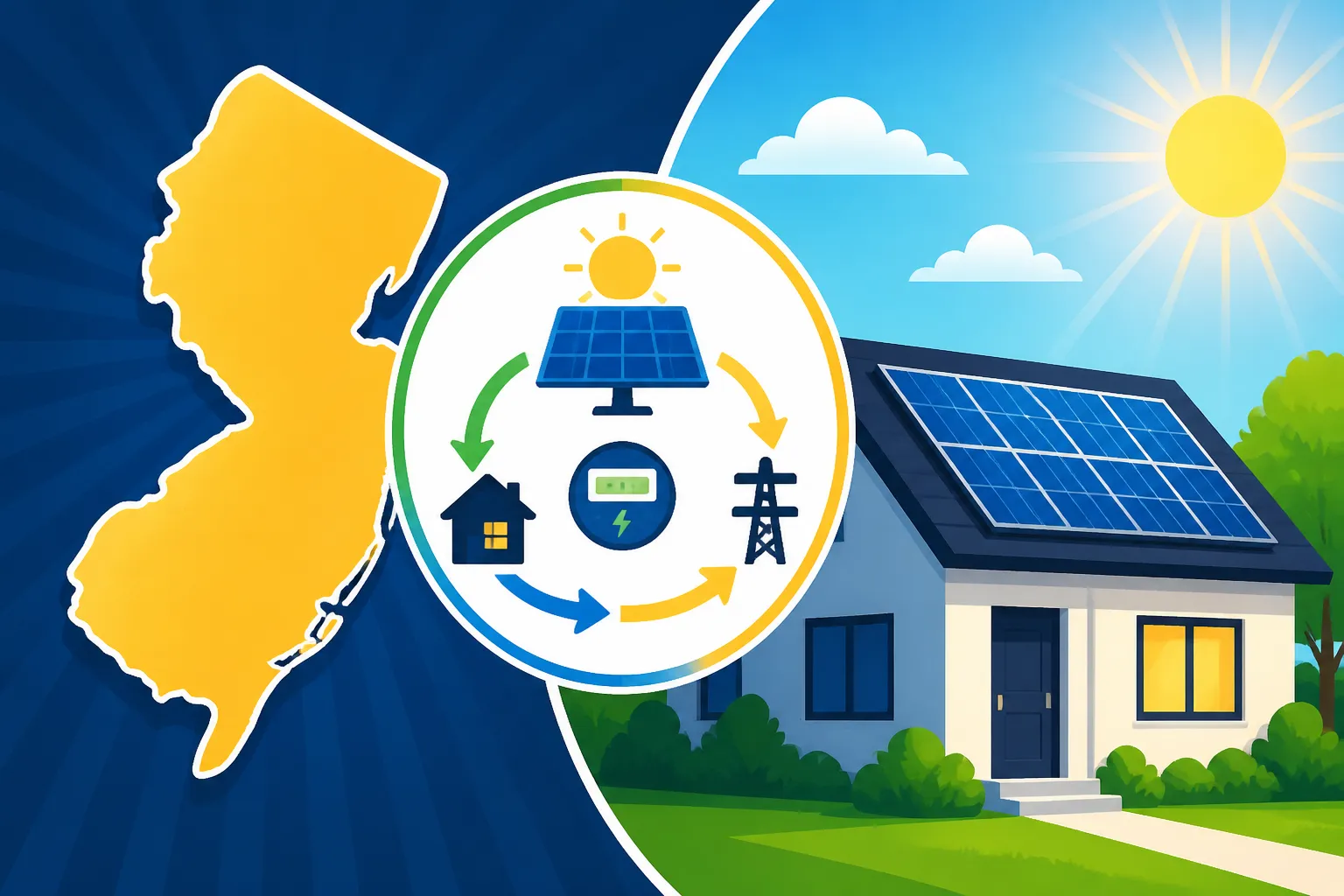
Understanding the mechanics of net metering is the first step to losing that "utility bill anxiety." When you install solar, your utility company (whether it is Atlantic City Electric, PSE&G, JCP&L, or Rockland Electric) will swap out your old electrical meter for a bi-directional one. This new meter is a smart little device that tracks energy moving in two directions: from the grid into your home when the sun is down, and from your panels into the grid when the sun is shining bright.
Imagine a Tuesday afternoon in July. You are at work, the AC is set to a modest 75 degrees, and your roof is absolutely soaking up the sun. Your panels are producing way more electricity than your house needs at that moment. Under New Jersey’s 2026 rules, that excess power flows out to the street and helps power your neighbor’s refrigerator. In exchange, your meter "ticks" backward. By the time you get home and start the dishwasher and the TV, you might have banked 10 or 15 kWh of credit. You use those credits to offset the power you draw later that night.
This 1:1 exchange is what allows for a much shorter Solar Panel Payback Period Explained. Without it, you would be forced to buy expensive batteries just to avoid "wasting" your solar energy. In New Jersey, the grid acts as your "virtual battery," storing the value of your excess afternoon production for use at night or during a rainy week in November. It is a seamless process that requires zero effort from you once the system is turned on.
The Annual True-Up Process
One of the most common questions I get from neighbors is: "What happens if I produce more than I use over the whole year?" This leads us to the "Annual True-Up," a process that is often misunderstood. In New Jersey, your net metering credits roll over from month to month. If you have a very sunny March and April, you might build up a massive "bank" of credits that you then burn through during a humid August when your AC is running 24/7.
At the end of your "anniversary year" (usually 12 months after your system was turned on), the utility looks at the balance. If you still have excess credits left over, they don't just disappear. The utility is required to pay you for them. However—and this is a big "however"—they do not pay you the full retail rate for this year-end excess. Instead, they pay you the "avoided cost of power," which is essentially the wholesale rate.
This is why your installer shouldn't over-size your system to 150% of your needs; you want to aim for roughly 100% coverage. If you are curious about the broader financial picture, checking out New Jersey Solar Incentives in 2026 will give you a better idea of how these year-end payments fit into your overall ROI.
Why New Jersey’s Policy is Better Than Most
To truly appreciate Does New Jersey Have Net Metering in 2026?, you have to look at what is happening across the border. In California, the shift to a new policy has drastically changed the math for homeowners. By understanding What Is NEM 3.0 (California Net Billing)?, you can see a "ghost of Christmas future" that New Jersey has luckily avoided for now. While California homeowners now get significantly less for the energy they export, New Jerseyans are still getting the "gold standard" of solar compensation.
This 1:1 retail parity is the reason why solar companies are still so active in the state. It makes the conversation simple: if you pay $0.20 per kWh to the utility, your solar energy is worth $0.20 per kWh. There are no complicated "export filters" or "time-of-use" penalties that gut your savings. This simplicity is a major reason why many still ask, Are Solar Panels Worth It in 2026? and the answer in New Jersey remains a resounding yes.
Furthermore, New Jersey’s net metering rules are protected by state law, which provides a layer of security that "voluntary" utility programs in other states lack. In places like Texas, net metering is often left up to the individual retail electric provider, leading to a confusing mess of plans. You can read more about that in Does Texas Have Net Metering in 2026? to see how much more stable our local environment is.
Full Retail Credit vs. Net Billing
The debate between full retail credit and net billing is essentially a fight over who gets the "extra" value of solar. Under net billing, the utility argues that they shouldn't have to pay you for the "delivery" portion of the bill since you are using their wires to send the energy. In New Jersey, the BPU has consistently ruled in favor of the consumer, stating that the environmental and grid-stabilization benefits of home solar outweigh those technical arguments.
Because you receive the full retail credit, your "delivery charges" and "system improvement charges" are also offset by your production. On a month where you produce as much as you consume, your bill could be as low as the basic monthly connection fee, which is usually around $5 to $15 depending on the utility. This is the "holy grail" of solar ownership.
| Feature | New Jersey Net Metering | Typical "Net Billing" State |
|---|---|---|
| Compensation Rate | Full Retail (1:1) | Wholesale/Avoided Cost (~25-40% of retail) |
| Credit Rollover | Monthly until annual true-up | Often expires monthly or carries low value |
| Grid Usage Fees | Usually covered by credits | Often added as non-bypassable charges |
| Battery Necessity | Optional (for backup) | Highly Recommended (for ROI) |
| Payback Period | Average 5-7 Years | Average 10-14 Years |
Locking in Your Status
One of the nuances of New Jersey Net Metering Rules in 2026 is the concept of "grandfathering." While the current rules are fantastic, utility companies are constantly lobbying to change them. Historically, when these rules change, people who already have systems installed are "grandfathered" into the old, better rules for a set period—often 10 to 20 years.
This creates a sense of urgency. By getting your Permission to Operate (PTO) under the current 2026 rules, you are essentially signing a contract that ensures your energy remains valuable even if the state decides to move to a less favorable model for new installers in 2028 or 2030. It is a form of financial insurance against future policy shifts.
Navigating the SuSI Program and SREC-II
It is important to remember that net metering is only half of the "income" equation for Jersey solar owners. While net metering lowers your bill, the Successor Solar Incentive (SuSI) program—specifically the ADI (Administratively Determined Incentive) part of it—provides you with actual income or additional credits based on how much you produce. This was designed to replace the old SREC program that many veteran solar owners remember.
In 2026, the SuSI program is still the primary vehicle for state-level solar incentives. For every megawatt-hour (MWh) your system produces, you earn one SREC-II (or "S-REC"). These have a fixed price set by the state, providing a predictable stream of income for 15 years. This predictability is a breath of fresh air compared to the old market where prices used to swing wildly. If you want the full breakdown of how to sign up, I highly recommend reading the New Jersey SREC-II / SuSI Program Guide.
The synergy between the SuSI program and net metering is what makes New Jersey a top-five solar state. You are saving money on your bill via net metering, and you are earning a "performance-based" incentive via SuSI. It is a double-win that helps offset the fact that we don't have as much sun as Arizona or Florida.
Understanding the ADI Program
The ADI program is part of the SuSI umbrella specifically for residential and small commercial systems. The state sets a "fixed" price for these credits to ensure homeowners know exactly what their return will be. As of 2026, these incentives are still robust, though the state does occasionally adjust the "block" prices as more people go solar.
If you are looking at a quote and seeing terms like "TRECs" or "SRECs," make sure your installer is specifically talking about the current 2026 ADI values. The process of registering for these can be a bit of a bureaucratic headache, involving a lot of paperwork with the New Jersey Clean Energy Program (NJCEP). Most reputable installers will handle this for you, but you should always verify that your application has been submitted so you don't miss out on those first few months of credits.
Why SREC-II Matters for Your ROI
Without the SuSI program, solar in New Jersey would still be good, but it wouldn't be the "slam dunk" it currently is. When you combine the savings from New Jersey Net Metering Rules in 2026 with the checks you get from SREC-II, you can often see a total return on investment that beats the stock market.
Think about it this way: your utility bill is an expense that is guaranteed to rise 2-4% every year. By locking in your energy costs through net metering and creating a new revenue stream through SuSI, you are effectively "shorting" the utility company. It is one of the few home improvements that actually pays you back in cash every month.
Qualifying for Net Metering in New Jersey
Not every solar setup automatically qualifies for these generous 2026 rules. There are some specific "hoops" you have to jump through to make sure your system is eligible for 1:1 net metering. First and foremost, your system must be sized appropriately. New Jersey law generally prevents you from installing a system that is designed to produce more than 100% of your historic annual electricity usage.
If you just moved into a new house and don't have a year of bills yet, the utility will usually allow an estimate based on the square footage and the number of residents. They are trying to prevent people from turning their suburban backyards into "mini power plants" that overwhelm the local grid. This is a common point of friction during the design phase, so be prepared to show your Solar Panel Cost for a 2,000 Sq Ft House estimates to your installer to ensure the math adds up for the utility's inspectors.
Understanding Your Utility's Specific Role
While the state sets the broad rules, each utility has its own quirks when it comes to the "interconnection" process. This is the technical step where they approve your system to be plugged into their grid.
- PSE&G: Generally very efficient with solar applications but has some specific "technical review" requirements for larger residential systems.
- JCP&L: Known for being a bit slower on the paperwork side; homeowners here should expect the PTO process to take 4-8 weeks.
- Atlantic City Electric: They have been proactive with grid upgrades, but some coastal areas may have "hosting capacity" limits.
Before you sign a contract, it is a smart move to ask Does My Utility Offer a Solar Rebate? because occasionally, local programs pop up that offer even more than the state-mandated net metering.
Residential vs. Commercial Rules
If you are a business owner in New Jersey, the 2026 net metering rules are slightly different. While small businesses often qualify for similar terms as residential owners, larger commercial installations might fall under the "Competitive Solar Incentive" (CSI) program. This guide is focused on homeowners, but if you have a mixed-use property, it is vital to clarify which bucket you fall into, as it can drastically change your Solar ROI & 25-Year Savings Breakdown.
Future Outlook: Will Net Metering Last in New Jersey?
I often tell people that the best time to go solar was five years ago, but the second best time is today. Why? Because the "retail parity" we enjoy in 2026 is always under threat. Utility companies across the country are spending millions on lobbying to convince regulators that net metering is "unfair" to non-solar customers. While New Jersey’s BPU has been very consumer-friendly, they are also looking at long-term grid stability.
We are seeing a move toward "Grid Modernization" which might eventually include more "Time-of-Use" (TOU) rates. Under TOU, electricity is more expensive at 6:00 PM than it is at 2:00 PM. Currently, NJ net metering is simple 1:1 regardless of time. However, if the state moves toward TOU in the late 2020s, having a battery would become much more important.
Why Locking In Now is Key
The beauty of the landscape is that the rules are "fixed" for those who enter the system now. If you are worried about Is Net Metering Going Away?, the best defense is to get your system installed and inspected while the 1:1 rules are still the law of the land. Historically, New Jersey has respected the "contract" with existing solar owners, meaning you likely won't be forced onto a worse plan later.
The Role of Batteries in a Net Metering State
In states with bad net metering, batteries are a financial necessity. In New Jersey, they are a luxury—but a very useful one. Since the grid is your "virtual battery" for financial purposes, you don't need a Tesla Powerwall to save money. However, with the increasing frequency of "Nor'easters" and summer storms knocking out power in the Garden State, many are choosing to add storage anyway.
If you do add a battery, you can still participate in net metering. You simply store what you need for emergencies and export the rest. It is the best of both worlds: financial ROI from the grid and physical security from the battery.
New Jersey Solar Net Metering Disclaimer
This guide is intended for informational purposes and reflects the solar policy landscape in New Jersey as of early 2026. Net metering rules, utility regulations, and state incentive programs like SuSI/ADI are subject to change by the New Jersey Board of Public Utilities (BPU) or through state legislative action. Always consult with a qualified tax professional and a certified solar installer to confirm your eligibility for specific credits and to receive a site-specific financial analysis. Your actual savings will depend on your utility provider, roof orientation, local shading, and energy consumption patterns.