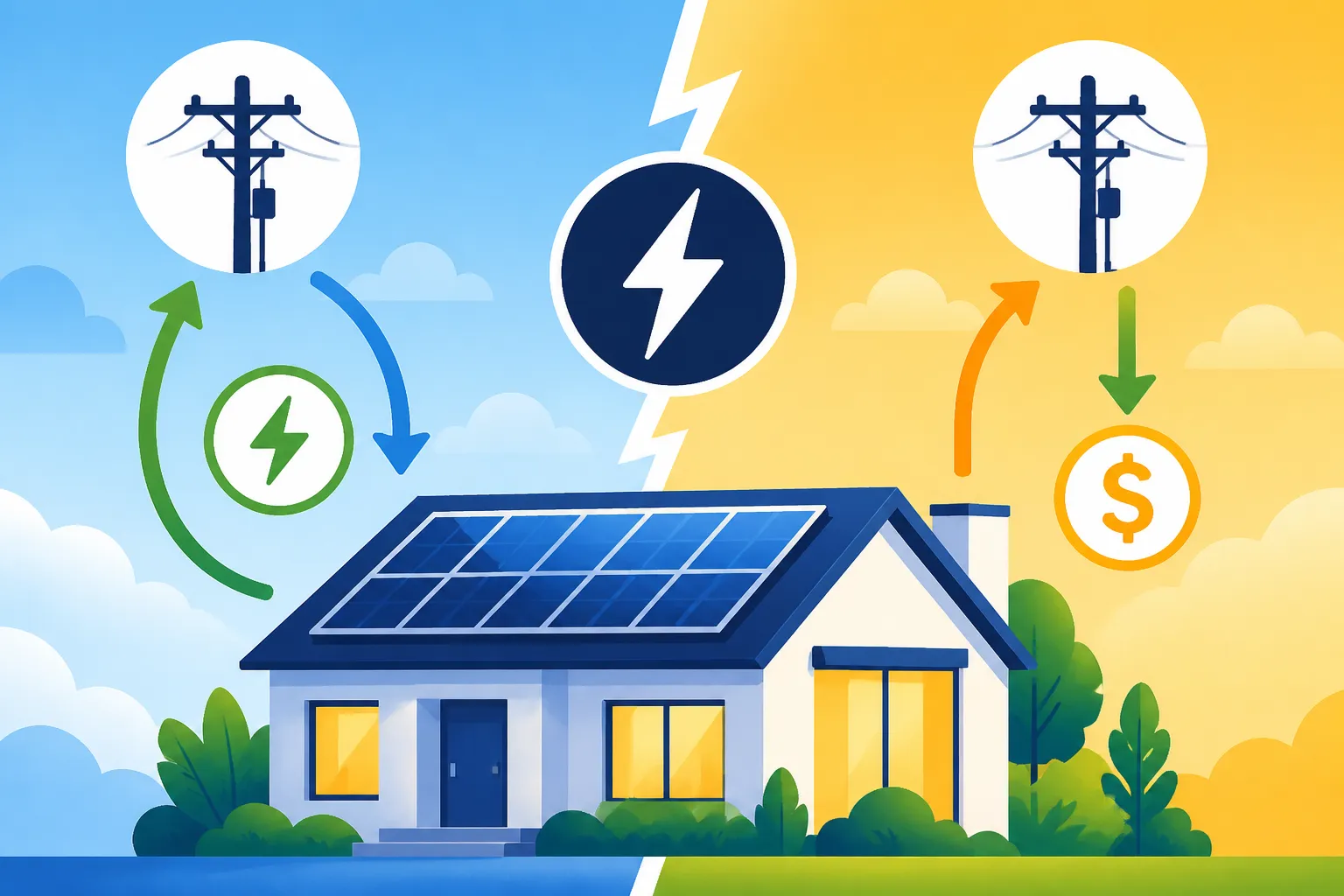
Net Metering vs Net Billing: What’s the Difference?
It's incredibly frustrating when you're trying to make an informed decision about something as significant as going solar, only to be met with confusing jargon and conflicting information. You hear about saving money, but then you also hear about changes to how utilities credit you for your solar power, leaving you wondering if it's still a good deal. This guide is here to cut through the confusion, clearly explaining the fundamental differences between net metering and net billing, and how these policies truly impact your wallet and your solar journey.
Understanding Net Metering: The Gold Standard for Solar Savings
For years, net metering has been the golden ticket for homeowners looking to maximize their solar savings. It's the policy that most folks imagine when they think about sending excess solar power back to the grid. It's straightforward, fair, and has been a huge driver for residential solar adoption across the country.
How Traditional Net Metering Works
Traditional net metering, often referred to as "full retail net metering," is a wonderfully simple concept. When your solar panels produce more electricity than your home is currently using, that excess power doesn't just disappear into thin air. Instead, it gets sent back to your local utility grid. The magic of net metering is that your utility essentially "buys" that power from you at the same retail rate you would pay to them for electricity. Think of it like a bank account for your electricity. When you overproduce, you deposit credits. When you underproduce (like at night or on cloudy days), you draw from those credits.
At the end of your billing cycle, your utility tallies up the electricity you pulled from the grid versus the electricity you sent back. If you sent more than you used, you might even see a credit roll over to the next month, or in some cases, receive a payout, though that's less common for residential systems. This one-to-one exchange rate is what makes it so appealing. It's as if the electricity flowing out of your house is just as valuable as the electricity flowing in, allowing you to effectively zero out your electricity bill over the course of a year, assuming your system is sized correctly. This direct offset is a key reason why understanding Net Metering Explained: How It Works by State is so crucial for potential solar owners.
States and Utilities Still Offering Full Retail Net Metering
While the landscape is constantly evolving, many states and individual utility companies still offer some form of full retail net metering. States like New Hampshire, Rhode Island, and parts of New York, for example, have historically maintained strong net metering policies, allowing residents to reap significant benefits from their solar investments. Even in states where full retail net metering is under review or has faced changes, certain utilities might still operate under older, more favorable terms, at least for existing customers.
However, it's a dynamic situation. Utilities often argue that full retail net metering shifts costs to non-solar customers, leading to debates and policy adjustments. This often leads to a gradual transition away from the most generous versions of net metering. This makes it incredibly important to check the current rules in your specific area. What was true last year might not be true today, and what applies in one county might be different in the next. Keeping an eye on state-specific guides, like those for New York Solar Incentives in 2026, can help you stay informed about the latest policies impacting your potential savings.
The Financial Impact of Net Metering on Your Bills
The financial impact of full retail net metering is, quite simply, transformative. By getting full credit for every kilowatt-hour (kWh) you send back to the grid, you drastically reduce your reliance on your utility company. Imagine your average monthly electric bill: with net metering, your goal is to reduce that to just the fixed connection fees, or even lower. Any surplus generation essentially becomes a credit that offsets future consumption.
Consider a sunny spring day when your panels are pumping out power, and you're at work, so your home's energy use is minimal. All that excess power gets sent out, and your meter spins backward, accumulating credits. Then, in the evening, when you come home and fire up the AC, you draw from those accumulated credits before your utility charges you for new electricity. At the end of the year, often called a "true-up" period, your utility performs a final accounting. Many homeowners with well-sized systems find their annual electricity costs plummet, sometimes by 80-100%, leading to substantial long-term savings and a quicker Solar Panel Payback Period Explained. This direct financial benefit is a major reason why solar has become so popular, offering a clear path to energy independence and predictable energy costs for decades to come.
Demystifying Net Billing: A Newer Approach to Solar Credits
As solar adoption grew, utilities and regulators began to re-evaluate traditional net metering. The result? A new policy, or rather, a different way of crediting solar homeowners, known as net billing or net energy billing. This approach aims to address concerns about grid costs and fairness, but it often means a less lucrative deal for solar owners compared to its predecessor.
How Net Billing (Net Energy Billing) Operates
Net billing operates on a slightly more complex, and often less generous, premise than traditional net metering. Under a net billing scheme, you still send your excess solar electricity back to the grid, which is great! However, the key difference is the rate at which you are credited for that exported power. Instead of receiving the full retail rate (what you pay to buy electricity), you receive a lower "export rate" or "avoided-cost rate." This export rate is typically much lower than the retail rate you pay to the utility for electricity you consume.
Let's break this down with an example. You might pay $0.25 per kWh to buy electricity from your utility. But under net billing, when your solar panels export power, the utility might only credit you $0.05 or $0.08 per kWh. This means that for every unit of electricity you send out, you're getting a significantly lower value than what you pay to draw a unit back in. This disparity means your ability to offset your bill one-for-one is gone. Instead, you're essentially selling your surplus at a wholesale rate and buying your needed power at a retail rate. This fundamental change is why many solar advocates consider net billing a step down for consumer savings.
The California NEM 3.0 Example
California, a state historically at the forefront of solar adoption, provides one of the most significant examples of the shift to net billing with its Net Energy Metering 3.0 (NEM 3.0) policy. Prior to December 15, 2022, California offered NEM 2.0, which was a robust form of net metering, providing near-retail rate credits for exported solar. However, NEM 3.0 drastically altered this landscape. The new policy, which took effect for new solar installations starting April 15, 2023, significantly reduced the export compensation rates, often by 75% or more compared to retail rates, particularly during certain times of the day.
Under What Is NEM 3.0 (California Net Billing)?, the value of exported solar electricity is tied to the "Avoided Cost Calculator," which reflects the wholesale value of energy. This means that for a homeowner in Southern California Edison (SCE) territory, for instance, exporting power during midday might only yield a few cents per kWh, while they still pay upwards of $0.30-$0.50 per kWh to pull power from the grid during peak evening hours. This dramatic shift has made solar-plus-battery storage systems far more attractive, and often essential, for maximizing savings, as homeowners can store their excess midday generation to use during expensive evening hours, rather than selling it back cheaply. It's a stark contrast to California NEM 2.0 vs NEM 3.0 Explained and has fundamentally changed the financial equation for solar in the Golden State.
Financial Implications and Reduced Savings
The financial implications of net billing are profound and generally mean reduced savings for solar homeowners compared to traditional net metering. Because your exported energy is credited at a much lower rate, it takes much longer to offset the electricity you do pull from the grid. This extends the payback period of your solar investment and can decrease your overall lifetime savings.
For example, if you have a system that historically would have generated enough credits under full net metering to nearly eliminate your bill, under net billing, you might still have a significant portion of your bill remaining. This is especially true if you don't have a battery. The most cost-effective strategy under net billing becomes maximizing your "self-consumption" – meaning you use as much of the solar power your panels generate instantly in your home as possible, rather than exporting it for a meager credit. This often involves shifting energy-intensive activities, like running dishwashers or charging electric vehicles, to midday hours when your solar production is highest. The reduction in export value means that while solar is still a smart investment, its financial returns are often diminished, making it even more important to explore all available State Solar Incentives: Complete 2026 Guide and Solar Battery Incentives in 2026 to bolster your savings.
Key Differences: Net Metering vs. Net Billing at a Glance
Navigating the world of solar can feel like deciphering a secret code, especially when it comes to how you get credited for your power. Understanding the core distinctions between net metering and net billing isn't just academic; it directly impacts your bank account and how you approach your solar system design.
Export Credit Valuation
This is the absolute heart of the matter, the single most critical difference between these two policies. Under net metering, the electricity you export to the grid is valued at the full retail rate. This means if your utility charges you $0.18 per kilowatt-hour (kWh) to buy power from them, they will credit you $0.18 per kWh for the power you send back. It's a true one-for-one exchange, which makes offsetting your entire bill much more achievable. You're effectively using the grid as a giant, free battery that stores your excess power at retail value.
In contrast, net billing assigns a lower, wholesale or "avoided-cost" rate to your exported electricity. That same $0.18 per kWh retail rate might translate to an export credit of only $0.03 to $0.08 per kWh under net billing. This disparity is why net billing significantly reduces the financial benefit of sending power back to the grid. You're selling low and buying high, which obviously impacts your overall savings. This difference alone dictates much of the strategy for designing and operating a solar system.
Impact on Payback Period and ROI
Given the difference in how exported power is valued, it's no surprise that the financial returns for solar systems diverge significantly between net metering and net billing environments. Under full retail net metering, the strong credits you receive for exports mean your electricity bill can be drastically reduced, often to just a few dollars in connection fees. This accelerates your Solar Panel Payback Period Explained and boosts your overall Return on Investment (ROI) over the system's lifespan. Homeowners in net metering states often see payback periods in the 6-10 year range, making solar an incredibly attractive financial proposition.
With net billing, the reduced value of exported power directly translates to longer payback periods and a lower overall ROI. Since you're not getting full credit for your excess generation, it takes more time for the cumulative savings to cover the initial investment cost. To mitigate this, homeowners in net billing regions often consider adding a solar battery. A battery allows you to store your excess solar power (which would otherwise be exported cheaply) and use it later when grid electricity rates are high, or when your panels aren't producing. While batteries add to the upfront cost, they can significantly improve the economics under net billing by increasing your self-consumption and reducing reliance on the grid during expensive periods. This shifts the calculation for whether Is Solar Worth It in 2026 for you.
System Design Considerations
The regulatory framework heavily influences how a solar system is designed to achieve optimal savings. In a net metering environment, the primary goal is often to size the system to offset as much of your annual electricity consumption as possible, sometimes aiming for 100% or even slightly more, knowing that any excess will be credited at retail rates. Since every kWh exported is valuable, there's less immediate pressure to consume all your power instantly or invest in battery storage, though batteries can still offer benefits like backup power.
Under net billing, the design strategy pivots significantly towards maximizing self-consumption. Because exporting power provides minimal financial benefit, the goal becomes using your solar power directly as it's generated, or storing it for later use with a battery. This can mean sizing the system more conservatively to closely match your daytime usage, or, more commonly, incorporating battery storage to hold onto excess power. For instance, if you're in a state with net billing, an installer might recommend a smaller system to prevent significant overproduction, or strongly advise adding a battery like a Tesla Powerwall or Enphase IQ Battery to ensure you're getting the most value out of every electron your panels produce. The question of How Many Solar Panels Do I Need for My Home becomes more nuanced, factoring in consumption patterns and battery integration.
Here's a quick comparison table to help visualize these differences:
| Feature | Net Metering (Full Retail) | Net Billing (Net Energy Billing) |
|---|---|---|
| Export Value | Full retail rate (same as what you pay for grid power) | Lower, wholesale, or avoided-cost rate |
| Bill Offset Potential | High; often can offset 80-100% of electricity charges annually | Moderate; harder to fully offset due to lower export credits |
| Payback Period | Generally shorter (e.g., 6-10 years) | Generally longer (e.g., 10-15+ years without optimization) |
| Role of Battery Storage | Beneficial for backup, but less critical for financial optimization | Often essential for financial optimization, maximizing self-consumption |
| System Sizing Strategy | Aim for 100%+ offset of annual consumption | Focus on maximizing self-consumption and matching load; often with battery |
| Complexity | Simpler, clearer credit structure | More complex, varying export rates by time of day/season |
Adapting to the Changing Landscape: Strategies for Maximizing Solar Savings
The energy landscape is always evolving, and with the shift from traditional net metering to net billing in many areas, homeowners need to adapt their strategies to get the most out of their solar investment. It's not about giving up on solar, but rather about being smarter and more strategic with your energy production and consumption.
The Role of Battery Storage
In a net billing environment, battery storage transforms from a "nice-to-have" luxury into a critical component for maximizing your financial returns. Without a battery, any excess solar power you generate and send back to the grid is credited at a significantly reduced rate. This means you're selling your valuable solar energy cheaply to the utility, only to buy back power at a higher retail rate when your panels aren't producing, like in the evenings or on cloudy days. This is where a home battery system truly shines.
With a battery, instead of exporting your midday surplus at a low rate, you can store that energy to use later. This is particularly powerful when your utility implements Time-of-Use (TOU) rates, where electricity prices are much higher during peak demand periods (often late afternoon or early evening). By using your stored solar power during these expensive peak hours, you avoid purchasing electricity from the grid at its highest cost, effectively turning your cheap excess generation into valuable self-consumption. Brands like Tesla with its Powerwall and Enphase with its IQ Battery offer robust solutions that integrate seamlessly with solar panel systems, empowering you to control your energy flow and significantly boost your savings under net billing. It's worth asking, Do I Need a Battery With Solar in your specific scenario.
Optimizing Your Energy Consumption
Beyond battery storage, a fundamental shift in mindset about your energy usage is incredibly beneficial, especially under net billing. The core idea is to increase your "self-consumption" – using your solar power directly as it's being generated. This means strategically shifting your energy-intensive activities to align with your solar production peaks, typically during the sunny midday hours.
For example, instead of running your dishwasher or washing machine in the evening, set them to run in the early afternoon. If you have an electric vehicle, program it to charge during the brightest part of the day. Smart home devices, thermostats, and energy management systems can play a crucial role here, allowing you to automate these shifts. For instance, smart thermostats can pre-cool your home using solar power before the hottest part of the day, reducing the need to run your AC during expensive evening peak hours. Every kilowatt-hour you use directly from your panels or from your battery is a kilowatt-hour you don't have to buy from the grid at retail rates, thereby protecting your How Much Can You Save With Solar Panels figures.
Researching Local Solar Incentives
While the federal solar tax credit has been a fantastic incentive, the real trick to maximizing savings, especially with evolving policies like net billing, lies in understanding your local landscape. State, local, and utility-specific incentives can make a substantial difference in the overall cost and financial viability of your solar project. Don't assume that just because federal programs exist (or have changed, like the federal tax credit tapering off) that there aren't other significant opportunities out there.
Many states offer their own tax credits, rebates, or performance-based incentives (PBIs) like Solar Renewable Energy Credits (SRECs) which can provide additional income streams. For example, states like Massachusetts with its SMART Program, or Illinois with its Illinois Shines program, offer considerable state-level support that drastically improves solar economics. Your local utility might also offer specific rebates for solar installations or for adding battery storage. Researching your Utility Solar Rebates: How to Find Yours is a vital step. Always consult with a reputable local solar installer, as they will have the most up-to-date information on programs available in your specific service area, helping you piece together the full picture of available financial support.
Navigating the Future of Solar Export Policies
The trajectory of solar export policies, particularly the shift away from traditional net metering, is a significant trend that every current or prospective solar homeowner needs to understand. It reflects broader changes in how utilities view distributed energy generation and the costs associated with maintaining the grid.
The Shifting Regulatory Environment
The move from full retail net metering to net billing, or other less favorable export compensation mechanisms, is often driven by a few key arguments from utility companies and some regulatory bodies. Utilities frequently argue that net metering disproportionately benefits solar owners by not fully accounting for the costs of grid maintenance, infrastructure upgrades, and providing reliable backup power when solar isn't generating. They assert that non-solar customers are left to bear a larger share of these "fixed costs."
This perspective has led many states, pushed by strong utility lobbying, to reconsider their net metering policies. California's NEM 3.0 is a prime example, but other states have also seen similar debates and changes. This isn't necessarily a sign that solar is "bad" or "not worth it," but rather a recalibration of how the financial relationship between solar producers and the grid operates. As the penetration of solar on the grid increases, regulators are trying to find a balance that supports continued solar growth while addressing perceived cost-shifts and grid stability concerns. This regulatory flux means staying informed is more important than ever for homeowners.
What Homeowners Can Expect
For homeowners, this shifting regulatory environment means a few things. First, expect less certainty about long-term export rates compared to the past. While existing net metering agreements are often grandfathered in for a period (e.g., 10-20 years), new installations are increasingly subject to net billing or similar policies. Second, the financial incentives for simply "exporting everything" are diminishing. This necessitates a more sophisticated approach to solar, where maximizing self-consumption and integrating battery storage become key pillars of a cost-effective system.
You should anticipate that the most attractive solar propositions in the future will likely involve not just panels, but a holistic energy management system that includes smart devices, energy monitoring, and potentially battery storage. This isn't necessarily a negative, as these integrated systems offer greater energy independence and resilience, especially during power outages. However, it does mean that the initial investment might be higher, and the financial analysis for Is Solar Worth It Without the Tax Credit? becomes more complex, requiring careful consideration of all components and their synergies.
Advocating for Favorable Policies
While individual homeowners might feel powerless against large utility companies and regulatory bodies, there's strength in numbers. Homeowner involvement in advocating for fair and sustainable solar policies is crucial. Organizations like the Solar Energy Industries Association (SEIA) and various state-level solar alliances actively engage in policy discussions and represent consumer interests.
You can make your voice heard by contacting your state representatives, attending public utility commission meetings, or joining local solar advocacy groups. These groups often work to highlight the benefits of solar to the wider community, push for equitable compensation rates, and ensure that new policies don't stifle the growth of renewable energy. For instance, discussions around Net Metering vs Net Billing: What's the Difference? are often contentious, and informed public input can significantly influence outcomes. By participating in these conversations, you can help shape a future where solar remains accessible and financially rewarding for all homeowners, ensuring that the transition to clean energy continues to be a positive one for everyone involved.
Disclaimer
The information provided in this article is for general informational purposes only and does not constitute financial, tax, or legal advice. Solar incentives and policies, including net metering and net billing rules, are subject to change and vary significantly by state, utility, and local jurisdiction. We strongly recommend consulting with qualified solar professionals, financial advisors, and relevant utility companies to determine the most accurate and up-to-date information applicable to your specific situation before making any decisions related to solar energy investments.