How Many Solar Panels to Power a 2,000 Sq Ft House?
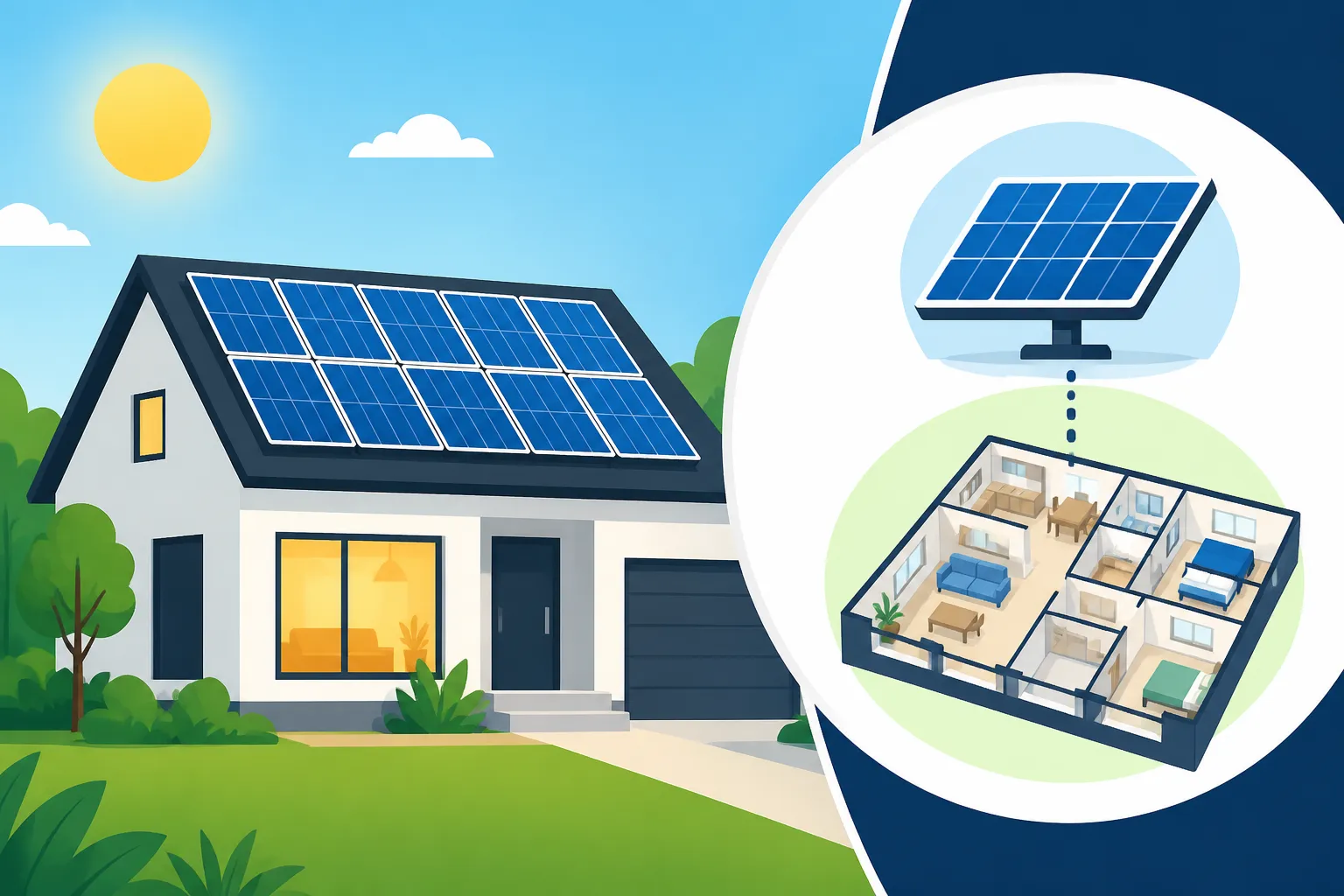
Figuring out how many solar panels you actually need to power your 2,000 sq ft home can feel like trying to hit a moving target. It’s a common misconception that square footage directly translates to solar needs, leading many homeowners to feel confused or overwhelmed. This guide will help demystify the process, walking you through the critical factors beyond mere size and offering a clearer path to understanding your home's unique solar requirements.
Beyond Square Footage: Understanding Your Real Energy Needs
When you first start looking into solar, it's easy to assume that if you have a 2,000 square foot home, there’s a magic number of panels you'll need. But trust me, as someone who’s seen countless utility bills and solar installations, it's just not that simple. Your home's footprint is only a tiny piece of the puzzle. The real driver behind how much solar power you need is your actual energy consumption, measured in kilowatt-hours (kWh).
Why Square Footage Alone Is Not Enough
Imagine two identical 2,000 sq ft houses, side-by-side in the same neighborhood. One might belong to a retired couple who are rarely home and keep their thermostat relatively high in summer and low in winter. Their energy usage could be quite modest, perhaps 600 kWh a month. The other house, however, might be home to a family of five with teenagers, constantly running air conditioning, multiple gaming systems, an electric vehicle charging in the garage, and a hot tub. Their monthly usage could easily soar to 1,500 kWh or more. See the huge difference? Relying solely on square footage would lead to a severely undersized or oversized solar system for one of these families, wasting money or leaving them still reliant on the grid.
What truly matters is how much electricity your household consumes on a daily or monthly basis. This figure is influenced by a myriad of factors: the number of occupants, their daily routines, the efficiency of your appliances, your heating and cooling habits, insulation levels, window quality, and even whether you have energy-hungry additions like a swimming pool or an electric car. These real-world details are far more important than the dimensions of your living space when it comes to designing an effective solar system.
How to Calculate Your Average Daily Energy Consumption
The absolute best place to start is your electricity bill. Most utility companies, whether it's Pacific Gas and Electric in California or Florida Power & Light, provide a detailed breakdown of your monthly energy usage in kWh. Don't just look at one month, though! Utility bills tend to fluctuate wildly depending on the season. You'll want to gather at least 12 consecutive months of bills to get a comprehensive average. This will capture the peaks of summer air conditioning, the demands of winter heating, and the milder shoulder seasons.
Once you have a year's worth of data, add up all the monthly kWh totals and divide by 12 to get your average monthly usage. Then, divide that number by 30 (the approximate number of days in a month) to arrive at your average daily kWh consumption. This average daily figure is crucial because it helps solar designers determine the total system size needed to offset your usage. Keep an eye out for any projected changes in your household's energy needs, like adding an EV or upgrading to a heat pump, which should be factored into this baseline.
Future-Proofing Your Solar System
Thinking about tomorrow is just as important as analyzing today's energy usage. Many homeowners decide to go solar only to realize a few years down the line that their needs have grown beyond what their system can produce. Perhaps you're considering buying an electric vehicle, installing an electric heat pump, or expanding your family. These changes can significantly increase your electricity demand.
When you're designing your system, it's wise to discuss these potential future energy loads with your solar installer. A good installer can help you size your system slightly larger than your current needs, or design it with the flexibility to add more panels later, if roof space allows. While you don't want to wildly oversize a system and incur unnecessary costs upfront, a little foresight can save you from costly upgrades or the frustration of still having high utility bills down the road. It's about finding that sweet spot between current demands and reasonable future growth.
Key Factors Influencing Solar Panel Sizing
Once you have a solid grasp on your home's energy consumption, it’s time to look at the factors that dictate how many panels it will take to meet those needs. It’s not just about the raw output of the panels; external environmental and structural elements play a huge role. Understanding these variables will help you make more informed decisions and ask better questions when you're talking to solar professionals.
Solar Panel Efficiency and Wattage
Not all solar panels are created equal, and their individual power output, or wattage, makes a big difference in how many you’ll need. Most residential solar panels today range from about 350 to 450 watts per panel. Higher wattage panels produce more electricity per square foot, meaning you'll need fewer of them to achieve your desired system size. This is particularly important if you have limited roof space. For example, if you need a 7 kW system, you’d need roughly 20 panels if each is 350W (7000W / 350W = 20 panels), but only about 16 panels if they are 450W (7000W / 450W ≈ 15.5 panels, so 16).
Panel efficiency, which is the percentage of sunlight hitting the panel that gets converted into electricity, also plays a critical role. Premium brands like Maxeon (SunPower) or REC are known for their high-efficiency panels, often exceeding 22%. While these might cost a bit more upfront, they can produce significantly more power in smaller footprints, making them ideal for homes with restricted roof area or those aiming for maximum production. When you're comparing quotes, don't just look at the total system cost; consider the wattage and efficiency of the panels being proposed, as this directly impacts the overall system performance and how many panels you'll see on your roof. You can learn more about Best Solar Panels of 2026.
Roof Characteristics and Orientation
Your roof is the canvas for your solar array, and its features are incredibly influential. The direction your roof faces is paramount. South-facing roofs generally receive the most direct sunlight throughout the day, making them ideal for solar production. East and west-facing roofs are also viable, but may require more panels to achieve the same output, as they capture sunlight more effectively during morning or afternoon peaks, respectively, rather than consistent midday sun. North-facing roofs are typically avoided for solar unless absolutely necessary, due to their significantly lower production potential.
Shading is another critical factor. Even a small amount of shade from nearby trees, chimneys, or other buildings can drastically reduce the output of an entire string of panels if you're using a string inverter system. This is where microinverters (like those from Enphase) or power optimizers (like SolarEdge) become invaluable, as they allow each panel to operate independently, minimizing the impact of shade on the rest of the array. The pitch or angle of your roof also affects how much sunlight the panels can capture. In many regions, a roof pitch between 30-40 degrees is considered optimal for year-round production, allowing sunlight to strike the panels at an ideal angle. Of course, the available, unobstructed roof space will dictate the maximum number of panels you can physically install.
Local Sunlight and Weather Patterns
It probably goes without saying, but the amount of sunshine your home receives plays a huge part in how many panels you'll need. A home in sunny Phoenix, Arizona, will likely require fewer panels to meet a certain energy demand than an identical home in Seattle, Washington, known for its cloudy skies. This is measured by "peak sun hours," which represents the average number of hours per day when the intensity of sunlight reaches 1,000 watts per square meter.
Different regions across the United States have vastly different average peak sun hours. For instance, California and the Southwest generally boast 5-7 peak sun hours per day, while the Northeast or Pacific Northwest might only see 3-4. These regional variations are factored into solar design calculations. Moreover, local weather patterns like consistent fog, heavy snowfall, or frequent storms can also impact daily and seasonal production. A reputable solar installer will use localized solar irradiance data to accurately model your system's expected output, ensuring that the number of panels proposed is appropriate for your specific climate. This is a key part of determining if Solar Panels Worth It in 2026 in your area.
Calculating Solar Panel Needs for a 2,000 Sq Ft Home
Now that we’ve covered the variables, let’s get down to some real numbers. While a precise calculation requires a professional site assessment, we can give you a solid framework for estimating how many solar panels you might need for a 2,000 sq ft home, keeping in mind the caveats we just discussed.
The General Rule of Thumb
For an average 2,000 sq ft home in the U.S., a reasonable starting point for monthly energy consumption is typically somewhere between 800 kWh and 1,200 kWh. Of course, as we discussed, this can fluctuate wildly. To offset this usage completely, you’d generally need a solar system ranging from 6 kW to 10 kW (kilowatts).
If we assume a common panel wattage of 400 watts per panel, here’s a rough idea:
- For an average 800 kWh/month usage: You might need a 6-7 kW system, translating to about 15-18 panels.
- For a higher 1,200 kWh/month usage: You could be looking at an 8-10 kW system, which would require around 20-25 panels.
Keep in mind this is a very general starting point. Factors like shading, roof orientation, and local sunlight levels will significantly impact the final count. This is why a precise calculation is so vital.
Step-by-Step System Sizing Example
Let’s walk through a hypothetical scenario for a 2,000 sq ft home.
Step 1: Determine Average Daily Energy Consumption.
Let's say your annual electricity consumption from your utility bills is 10,800 kWh.
Average monthly consumption: 10,800 kWh / 12 months = 900 kWh/month.
Average daily consumption: 900 kWh / 30 days = 30 kWh/day.
Step 2: Account for System Losses.
Solar systems aren't 100% efficient due to factors like wiring, temperature, dust, and inverter losses. A typical loss factor is around 20-25%. Let’s use 20% for this example.
Energy production needed to cover usage = 30 kWh / (1 – 0.20) = 30 kWh / 0.80 = 37.5 kWh/day.
Step 3: Find Your Location's Average Peak Sun Hours.
Using online resources or data from a solar installer, let's assume our hypothetical home is in a region like central North Carolina, which averages around 4.5 peak sun hours per day.
Step 4: Calculate Required System Size (in kW).
System size (kW) = Daily production needed (kWh) / Peak sun hours per day (hours)
System size = 37.5 kWh / 4.5 hours = 8.33 kW.
Step 5: Determine Number of Panels.
Let's assume you're looking at solar panels with a 400-watt rating.
Number of panels = (System size in watts) / (Panel wattage)
Number of panels = (8.33 kW * 1000 W/kW) / 400 W = 8330 W / 400 W ≈ 20.8 panels.
Since you can't install a fraction of a panel, you would round up to 21 panels.
So, for this hypothetical 2,000 sq ft home with 900 kWh/month usage and 4.5 peak sun hours, you’d be looking at approximately a 8.33 kW system requiring 21 x 400W solar panels.
Getting a Professional Assessment
While the above calculation is helpful for a ballpark estimate, nothing beats a professional solar site assessment. Solar installers have access to sophisticated software that can map your roof, analyze shading patterns throughout the year, factor in your specific utility rates, and precisely model the expected energy production of different system configurations. They can also advise on optimal panel placement, inverter types (string vs. microinverter), and battery storage options.
This initial assessment is usually free, and it's where you'll get a tailored proposal that considers every nuance of your home and energy habits. It's highly recommended to get quotes from at least three different installers to compare not only pricing but also equipment, warranties, and system design. Platforms like Modernize can help connect you with reputable local solar installers who can provide these personalized assessments and ensure you get a system that truly meets your needs. This is also where you can ask questions about the Solar Panel Cost Per Watt Explained and ensure you're getting a fair price.
Here's a quick reference table showing estimated system sizes and panel counts for a 2,000 sq ft home based on varying average monthly electricity consumption and assumed 400W panels with 4.5 peak sun hours:
| Avg. Monthly Usage (kWh) | Est. Daily Usage (kWh) | Est. System Size (kW) | Est. Number of 400W Panels |
|---|---|---|---|
| 600 kWh | 20 kWh | 5.6 kW | 14 panels |
| 800 kWh | 26.7 kWh | 7.4 kW | 19 panels |
| 1000 kWh | 33.3 kWh | 9.3 kW | 24 panels |
| 1200 kWh | 40 kWh | 11.1 kW | 28 panels |
Note: This table assumes a 20% system loss factor and 4.5 peak sun hours daily. Actual numbers will vary based on your specific location, roof conditions, and chosen equipment.
Maximizing Your Solar Investment for a 2,000 Sq Ft Home
Investing in solar is a significant decision, and for your 2,000 sq ft home, you want to ensure you're getting the best possible return. It's not just about installing panels; it's about optimizing their performance and understanding the financial landscape. A little extra planning can make a huge difference in your long-term savings and satisfaction.
Understanding Available Incentives and Rebates
One of the biggest factors that can make solar more affordable and increase its value for your 2,000 sq ft home are the various incentives available. While the federal solar tax credit is a major one, there are often state-specific programs, local utility rebates, and even property tax exemptions that can significantly reduce your upfront costs and improve your overall return on investment.
Many states offer their own tax credits or rebates. For instance, some states have specific programs for installing solar batteries, which can be a game-changer for homes under new net metering rules like California's NEM 3.0. Always research what's available in your specific area. Your solar installer should be well-versed in these programs and help you navigate the application process. Don't leave money on the table – these incentives are designed to make solar more accessible and can substantially shorten your Solar Panel Payback Period Explained. You can also explore options like Utility Solar Rebates: How to Find Yours to potentially save even more.
Considerations for Adding Battery Storage
As more utilities move away from full retail net metering, like in California with NEM 3.0, adding a solar battery to your 2,000 sq ft home's system becomes an increasingly attractive option. Net metering allows you to send excess solar energy back to the grid for credit. When those credits are reduced, storing your excess power for later use becomes economically beneficial. Instead of selling your power for a low "export rate," you can use it during peak utility hours when electricity prices are highest, or during power outages.
For a 2,000 sq ft home, a typical battery system might consist of one or two units, such as a Tesla Powerwall or an Enphase IQ Battery, depending on your energy usage and desired backup capacity. Batteries provide energy independence and resilience, ensuring you have power even when the grid goes down. They can also help optimize your self-consumption, meaning you rely less on your utility company and get more value out of every kWh your panels produce. Learn more about Solar Battery Incentives in 2026.
The Importance of Reputable Installers and Warranties
Choosing the right solar installer is as important as choosing the right panels. A shoddy installation can lead to long-term problems, inefficiency, and headaches. For your 2,000 sq ft home, you want an installer with a proven track record, proper licensing, and excellent customer reviews. They should offer comprehensive warranties that cover not just the solar panels themselves (product and performance), but also the workmanship of the installation and the inverter.
A typical solar panel product warranty lasts 25 years, guaranteeing the panel against manufacturing defects. Performance warranties ensure the panels will still produce a certain percentage of their original output (e.g., 85% by year 25). Workmanship warranties, often 10-25 years, cover the installation itself. Before signing any contract, make sure you understand all the warranty terms. Don't be afraid to ask tough questions, check references, and get multiple quotes to ensure you're working with a trustworthy company. A platform like Modernize can be a great starting point for finding reliable local installers who prioritize quality and customer satisfaction, helping you to How to Choose a Solar Installer with confidence.
Disclaimer
This guide is intended for informational purposes only and does not constitute financial, tax, or professional solar design advice. The figures and estimations provided are generalizations, and actual solar system requirements, costs, and savings for your specific 2,000 sq ft home will vary significantly based on your individual energy consumption, location, roof characteristics, equipment choices, and available incentives. Always consult with certified solar professionals and financial advisors before making any purchasing or investment decisions.