Solar Permit Process in Nevada
Let's be honest, trying to figure out the solar permit process in Nevada can feel like deciphering ancient hieroglyphs while walking through a desert mirage. You're ready to embrace clean energy, cut down on those skyrocketing NV Energy bills, and enjoy the sunny Nevada skies, but then you hit the bureaucratic wall of permits, inspections, and approvals. This guide is here to demystify the solar permit process in Nevada, walking you through what to expect, how to prepare, and how to navigate the system to get your solar panels up and running without unnecessary headaches.
Understanding Nevada's Solar Permitting Landscape
When you decide to go solar in the Silver State, you're not just buying panels; you're embarking on a journey that involves local city or county building departments and utility companies. It's a multi-layered process, and understanding each piece is key to avoiding frustrating delays.
Why Permits Are Essential and Sometimes Frustrating
It’s completely normal to feel overwhelmed when faced with permit requirements for something as exciting as installing solar panels. You might think, "Why do I need a permit for something that's just going to sit on my roof?" But here's the honest truth: permits are absolutely crucial for your safety and the longevity of your investment. Think of them as a protective layer, ensuring that your solar system is installed correctly, meets all structural and electrical codes, and won't pose a hazard to your home or the community. Without proper permitting, you could face issues with your homeowner's insurance, future home sales, or even fines.
However, we also know that bureaucracy can be incredibly frustrating. The rules aren't always crystal clear, and what applies in one city, say Las Vegas, might have slight differences from Henderson or Reno. This patchwork of regulations can make it feel like you're jumping through hoops without a clear map. It's this very complexity that often leads homeowners to feel a sense of dread when they hear the word "permit." The goal of these permits, however, is to guarantee that the installation adheres to the latest safety standards, ensuring everything from the wiring to the roof mounts can withstand Nevada's unique climate, from scorching summers to occasional high winds.
Key Regulatory Bodies and Local Jurisdictions
In Nevada, while there are some overarching state guidelines, the granular details of your solar permit process are largely handled at the local level. This means your journey will involve interacting with your specific city or county building department. For instance, if you live in the populous Clark County area, you'll be dealing with either the City of Las Vegas Building Department, the City of Henderson Planning and Building Department, or the Clark County Department of Building and Fire Prevention, depending on your exact address. Similarly, homeowners in northern Nevada will typically work with the City of Reno Building and Safety Division or the Washoe County Community Services Department.
Each of these local jurisdictions will have its own specific forms, submission procedures, and review timelines, which can vary significantly. Beyond local building permits, you'll also need to coordinate with the utility company that serves your area, primarily NV Energy, for what’s called an interconnection agreement. This separate, but equally critical, process ensures your solar system can safely connect to the electrical grid. Many homeowners find it incredibly helpful to work with a reputable solar installer, who often handles the bulk of these interactions, acting as a knowledgeable guide through the local nuances. Services like Modernize can help connect you with experienced professionals who understand these local requirements inside and out.
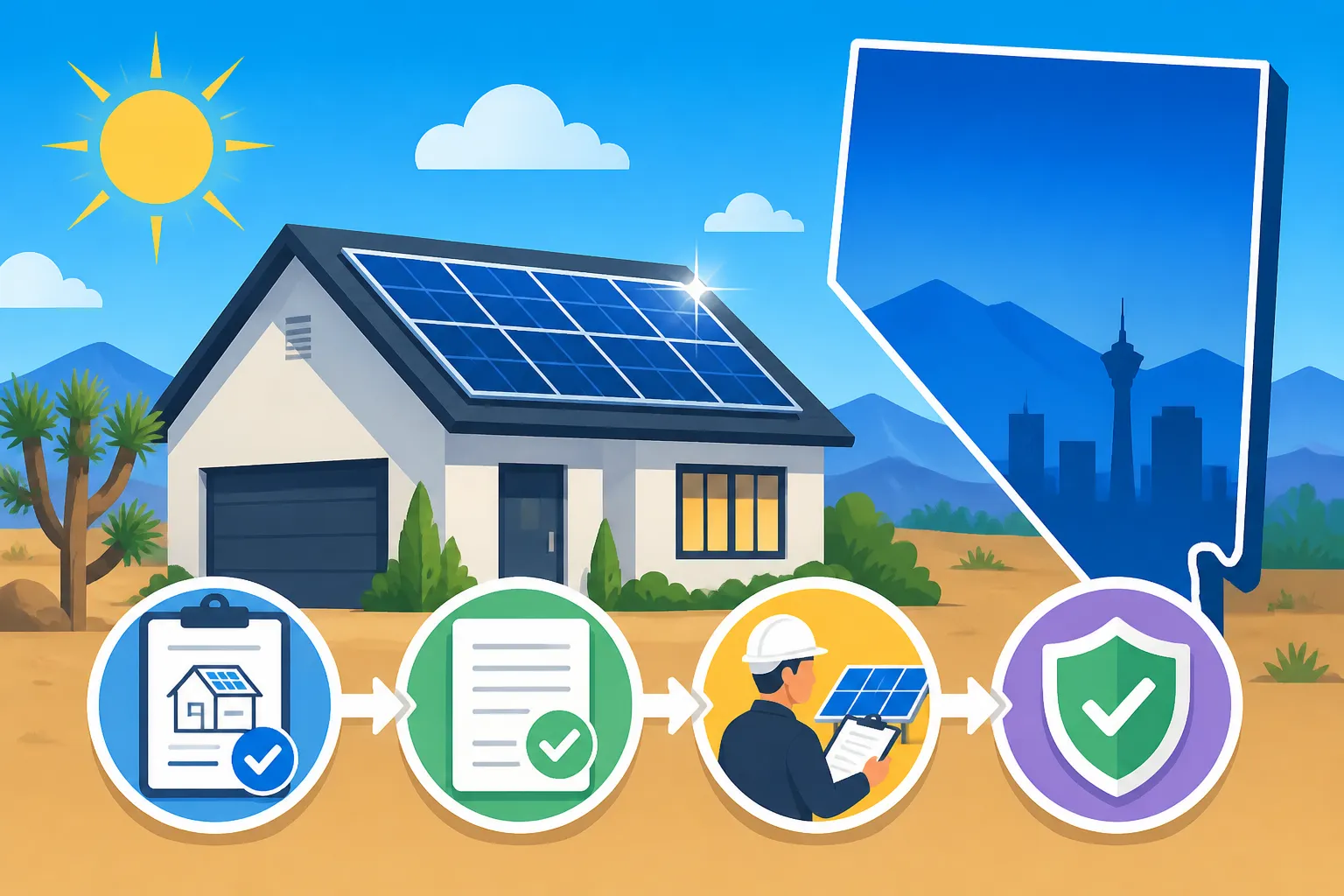
Navigating the Nevada Solar Permit Application Steps
The permit application process can seem daunting, but breaking it down into manageable steps makes it much clearer. Your solar installer will be your best friend here, as they typically manage the heavy lifting of preparing and submitting these documents.
Initial Planning and System Design
Before any papers are filed, a significant amount of planning and design work goes into your solar project. This stage is critical because the details generated here will form the foundation of your permit application. It starts with a comprehensive site assessment where your installer evaluates your roof's condition, orientation, shading, and structural integrity. They'll determine the optimal number and placement of solar panels, taking into account your home's energy consumption needs and potential for future expansion.
The system design will include selecting the right solar panels, inverters (whether string inverters, microinverters, or power optimizers), and racking systems. Every component chosen must meet local and national electrical codes, as well as manufacturer specifications. Your installer will produce detailed electrical schematics, a precise site plan showing panel layout, and structural drawings if any modifications to your roof are required. This phase ensures that the proposed system is not only efficient but also safe and compliant, anticipating the requirements of both the local building department and NV Energy. Without a meticulous design, you're almost guaranteed to face delays during the review process.
Gathering Required Documentation
This is where the paperwork really comes into play, and it’s often the most intimidating part for homeowners. Your solar installer will be responsible for compiling a detailed set of documents that typically includes:
- Permit Application Forms: These are the specific forms from your local city or county building department, filled out with your project details.
- Site Plan: A diagram showing your property boundaries, the location of your home, and the precise placement of your solar panels on the roof, including distances from edges and any obstructions.
- Electrical Single-Line Diagram: A detailed drawing illustrating the entire electrical pathway of your solar system, from the panels to the inverter, electrical panel, and connection to the grid. This is crucial for verifying electrical safety and code compliance.
- Structural Review/Engineering Letters: Documents that confirm your roof can safely support the additional weight of the solar panels, especially important in older homes or for larger systems.
- Product Specification Sheets: Datasheets for all major components, including panels, inverters, and racking, to ensure they are certified and approved for use in your area.
- Shading Analysis: Sometimes required to demonstrate that the system will receive adequate sunlight and perform as expected.
Ensuring all these documents are complete and accurate is paramount. An incomplete application is the quickest way to get rejected or significantly delay your project. Your chosen installer should have extensive experience with these requirements, making the process smoother. Many reputable installers streamline this by using digital platforms to manage and submit documents, sometimes even leveraging online permitting portals offered by various Nevada jurisdictions.
Submitting Your Application
Once all the necessary documentation is compiled, your solar installer will typically submit the application on your behalf. Most major cities and counties in Nevada, like Las Vegas, Henderson, and Reno, now offer online portals for permit submissions, which can expedite the initial filing and review process. However, some smaller jurisdictions might still require in-person submission or mail. Along with the application, there will be associated permit fees. These fees can vary widely depending on the size of your system and the specific jurisdiction. For example, a permit for a 5 kW residential system in Clark County might have different fees than the same system in Washoe County.
After submission, the building department will review your plans for compliance with local building, electrical, and fire codes. This review period can take anywhere from a few days to several weeks, or even longer during peak construction seasons. Be prepared for potential requests for additional information or minor revisions to your plans. This back-and-forth is normal, and it's another area where a seasoned installer proves invaluable, as they can quickly address any concerns raised by the plan checkers.
The Interconnection Agreement
Separate from your local building permit, but equally vital, is the interconnection agreement with your utility provider, NV Energy. This agreement legally allows your solar system to connect to the grid and for you to participate in programs like net metering (or its successors). The process for this usually runs concurrently with the building permit application. Your installer will submit detailed system specifications to NV Energy, including inverter models, panel count, and expected energy production.
NV Energy will review these details to ensure grid stability and safety. Once approved, you'll receive a formal agreement. It's important to understand that your solar system cannot be turned on and connected to the grid until both the local building permit is approved, the final inspection passed, and NV Energy has granted you official "Permission to Operate (PTO)" for your solar system. This step is a critical milestone, as without it, you can't start saving money on your electricity bills by sending excess power back to the grid. Learn more about the specifics of Net Metering Explained: How It Works by State.
Common Challenges and Tips for a Smooth Process
Navigating the permitting maze can present a few hurdles, but with the right approach and a good team, you can clear them efficiently.
Avoiding Delays and Rejections
The most common reasons for permit delays or outright rejections often boil down to preventable issues. Incomplete applications are a primary culprit; missing a single required document or leaving a section blank on a form can send your application right back to the drawing board. Incorrect or inconsistent information across different documents is another major red flag for reviewers. For instance, if the electrical diagram specifies a different inverter model than the product specification sheet, it will certainly cause a holdup.
Another frequent challenge is non-compliance with local codes. Building codes are updated regularly, and what was acceptable a few years ago might not be today. This is especially true for fire setbacks, structural load requirements, and electrical safety standards. For example, many Nevada jurisdictions have specific fire access pathways that must be maintained on roofs, dictating where panels can and cannot be placed. If your proposed design doesn't meet these specific requirements, it will lead to revisions and delays. Choosing a solar installer that is intimately familiar with the most current codes in your specific city or county is crucial.
The Role of Your Solar Installer
Let's be clear: your solar installer is your greatest asset in navigating the permit process. A reputable installer will have a dedicated team that specializes in permitting and interconnection. They know the ins and outs of the local building departments, understand the specific requirements of Clark County, Washoe County, and other jurisdictions, and have established relationships that can help streamline communication. They will prepare all the complex engineering drawings, complete the extensive paperwork, and submit everything on your behalf. This expertise not only saves you an enormous amount of time and stress but also significantly reduces the likelihood of errors that lead to delays.
Furthermore, a good installer will act as your advocate, responding to any questions or revision requests from the permitting office or NV Energy quickly and accurately. They understand the nuances of the permit review and inspection process, from scheduling site visits to addressing potential issues that might arise during construction. When you're researching potential solar companies, ask them about their experience with permitting in your specific area. A service like Modernize can help you connect with top-rated installers who have a proven track record of successfully handling the solar permit process in Nevada, ensuring you get through this stage with minimal fuss.
Understanding Local Variations
Nevada is a diverse state, and its local permitting processes reflect that. While the overarching goals of safety and compliance are universal, the specific details can vary from city to city, and even between unincorporated county areas. For instance, the City of Reno might have slightly different wind load requirements or fire access codes for rooftop solar installations compared to the City of Henderson. Even within the same county, an application submitted to the City of Las Vegas will go through a different department and might have different forms than one submitted directly to Clark County for properties outside city limits.
These variations can include everything from the format of required drawings to specific setback requirements for panels from the edge of your roof or from skylights. Some municipalities might require a more extensive structural analysis, while others are satisfied with a standard engineering letter for most residential systems. It's imperative that your installer is not only licensed statewide but also intimately familiar with the specific jurisdiction where your home is located. This local knowledge is invaluable and can make the difference between a smooth approval and weeks of frustrating delays. Before you sign any contracts, ensure your installer can clearly articulate their experience with the specific solar permit process in your Nevada locality.
After Permit Approval: Inspections and Permission to Operate
Congratulations, your permit is approved! But don't break out the champagne just yet. There are still a couple of critical steps before your solar system is fully operational.
The Inspection Phase
Once your local building department has approved your permit, and your solar installer has completed the physical installation of the panels, wiring, and inverters, it's time for the inspection. This is a critical step where a city or county inspector will visit your property to ensure that the installation precisely matches the approved plans and complies with all local building, electrical, and fire codes. This isn't just a quick glance; inspectors are thorough.
They will meticulously check various aspects:
- Electrical Inspection: This is often the most detailed part. The inspector will verify all wiring, conduit, disconnect switches, and grounding. They'll check that all components are correctly sized and installed according to the approved electrical schematics and that all safety labels are in place. They'll also ensure proper integration with your home's existing electrical panel.
- Structural Inspection: The inspector will confirm that the racking system is securely fastened to your roof and that the roof structure can indeed handle the added weight of the solar array. This often involves checking the attic space to see the attachment points.
- Fire Safety Inspection: This typically focuses on ensuring adequate clearance from roof ridges, valleys, and edges for emergency responders, as well as access pathways.
- Workmanship: Beyond code compliance, they'll also look for overall quality of installation, ensuring everything is neat, secure, and professionally done.
If the inspector finds any issues, they will issue a "red tag" or a list of corrections that need to be made. Your installer will then have to fix these issues and schedule a re-inspection. This is a normal part of construction, but a good installer minimizes the chances of red tags. Passing the final inspection is a major hurdle cleared, but you're still not quite done.
Permission to Operate (PTO)
Even after your local building department gives its final stamp of approval on the physical installation, your solar system still can't officially connect to and energize the grid until your utility, NV Energy, grants you "Permission to Operate," or PTO. This is the ultimate green light you've been waiting for. Once your local inspection is passed, your installer will notify NV Energy that the system is ready. NV Energy will then review your final inspection report and often conduct its own final check of the meter and interconnection points.
This final check by NV Energy is crucial. They need to ensure that your solar system won't negatively impact the stability or safety of the broader electrical grid. Once NV Energy is satisfied, they will officially grant you PTO. At this point, your solar system can be turned on, you can begin generating your own electricity, and any excess power you produce will be sent back to the grid, often earning you credits under net metering or a similar program. The waiting period for PTO can sometimes feel like the longest part of the process, but it's essential for safe and legal grid integration. Knowing the ins and outs of what happens during "Solar Inspection & Permission to Operate (PTO)" can really help manage expectations.
Key Permit Requirements & Timelines in Nevada Jurisdictions
Here's a simplified look at what you might encounter in some major Nevada areas. Remember, these are general guidelines, and specific projects may have unique requirements.
| Jurisdiction | Key Building Department | Estimated Permit Review Time (Business Days) | Common Required Documents | Notes |
|---|---|---|---|---|
| City of Las Vegas | Building & Safety Department | 10-20 | Application, Site Plan, Electrical Diagram, Structural Calcs | Online submission portal available. Emphasis on fire access and wind load requirements. |
| City of Henderson | Planning and Building Department | 10-15 | Application, Site Plan, Electrical Diagram, Structural Review | Known for efficient online permitting. Requires detailed roof plans for structural review. |
| Clark County | Building & Fire Prevention | 15-25 | Application, Site Plan, Electrical Diagram, Structural Eng. | Covers unincorporated areas around Las Vegas. Strict adherence to ICC codes. |
| City of Reno | Building and Safety Division | 5-15 | Application, Site Plan, Electrical Schematics, Structural Ltr. | Offers expedited permits for standard residential systems. Specific snow load considerations due to Sierra Nevada proximity. |
| Washoe County | Community Services Department | 10-20 | Application, Site Plan, Electrical Diagram, Structural Support | Covers unincorporated areas around Reno. Requires careful consideration of seismic activity and varying weather conditions. |
Note: Timelines are estimates and can fluctuate based on workload, completeness of submission, and complexity of the project.
Don't Go It Alone: Partner with an Expert
Trying to tackle the solar permit process in Nevada on your own can lead to considerable frustration, delays, and potentially costly mistakes. This is precisely why partnering with a knowledgeable and experienced solar installer is not just a convenience, but a necessity. They serve as your project manager, navigating the intricate requirements of local building codes and utility interconnection agreements, all while keeping your project on track.
Choosing the right solar installer involves asking thoughtful questions and looking for specific indicators of their expertise. Do they have a strong local presence and deep understanding of your specific city or county's regulations? Are they transparent about the timeline and potential challenges? These are key considerations. Remember, while the journey to solar can seem complex, with the right team supporting you, it becomes a seamless transition to a more sustainable and cost-effective home. To ensure you're working with professionals who understand the nuances of the solar permit process in Nevada, consider using services like Modernize to find certified and reliable local installers. They can guide you through every step, from initial design to final Permission to Operate, ensuring your solar installation is a success.
Disclaimer
The information provided in this guide is intended for general informational purposes only and does not constitute professional advice. Solar permitting rules, regulations, and incentives are subject to change by local, state, and federal authorities. Always consult with a qualified solar professional and your local permitting authority for the most accurate and up-to-date information pertaining to your specific project and location.