Does Virginia Have Net Metering in 2026?
If you have been watching your Dominion Energy bill climb higher every summer while the humidity in Richmond or Northern Virginia reaches stifling levels, you have probably wondered if solar is finally the answer to escaping those rising costs. This guide digs deep into whether net metering still exists in Virginia for 2026 and how you can use it to effectively wipe out your monthly electricity expenses.
Understanding the Current State of Virginia Net Metering
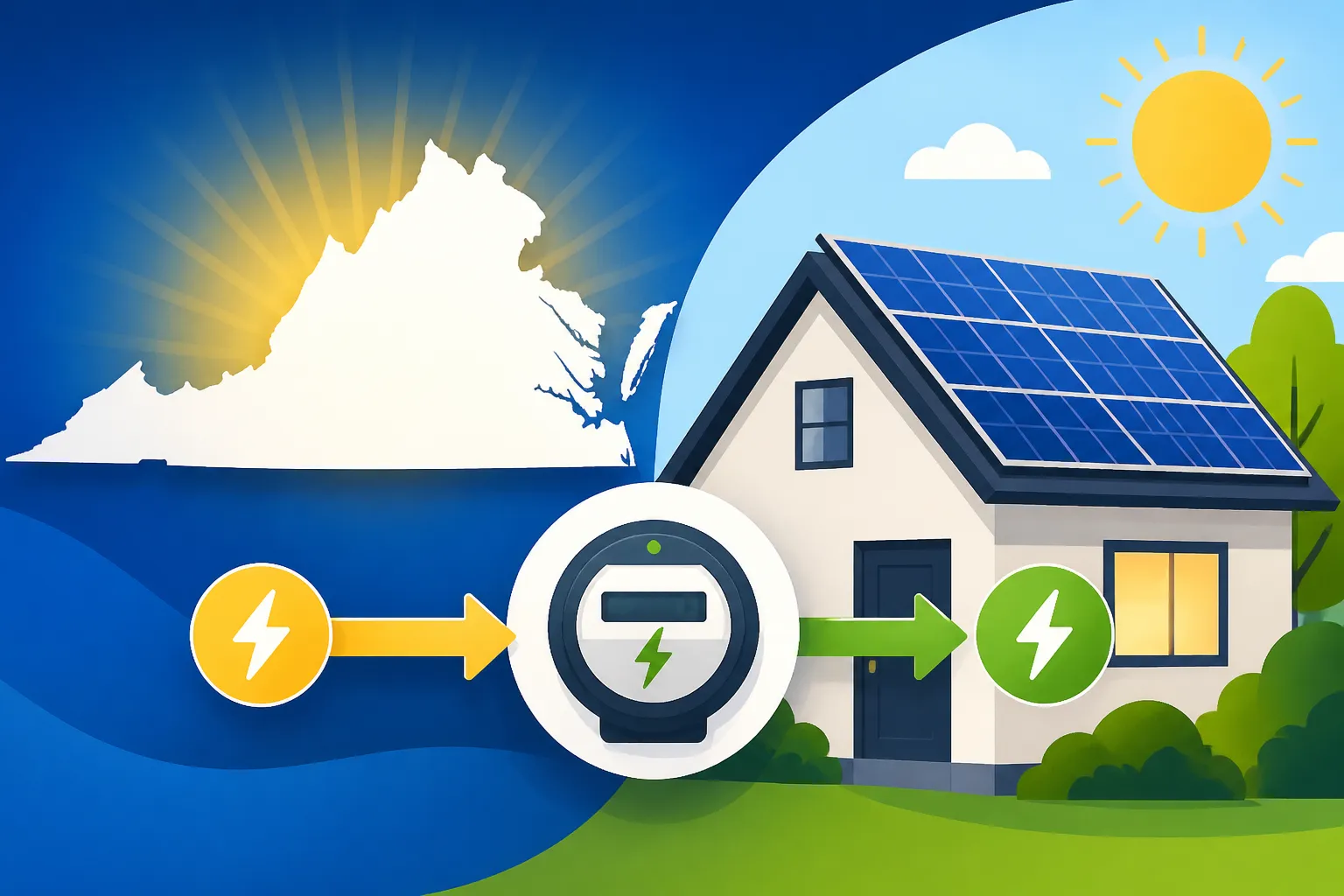
The short answer is yes, Virginia still has net metering, but the landscape is much more nuanced than it was a few years ago. Net metering is the policy that allows you to send the excess electricity your solar panels produce during the day back into the grid in exchange for credits on your utility bill. In Virginia, this has traditionally been a "one-to-one" credit system, meaning one kilowatt-hour (kWh) sent to the grid cancels out one kWh you pull from the grid later that night.
However, the reason many homeowners are confused right now is the ongoing implementation of the Virginia Clean Economy Act (VCEA). While this landmark legislation pushed the state toward renewable energy, it also opened the door for utilities to rethink how they compensate solar owners. As of 2026, we are seeing a shift where the "full retail" net metering we’ve enjoyed is under constant scrutiny. For now, if you are a residential customer, you can still lock into these favorable rates, but there are capacity limits that vary by utility provider.
Understanding the mechanics is vital. When your panels are cranking out power at noon while you are at work in Tysons or Alexandria, that energy doesn't just vanish. It flows through your bi-directional meter and out to your neighbors. Your meter literally keeps track of this "export." At the end of the month, the utility subtracts your exports from your imports. If you exported more than you used, those credits typically roll over to the next month. It is a powerful way to stay ahead of the curve, especially when you consider how Net Metering Explained: How It Works by State varies so wildly across the country.
Net Metering Rules for Major Virginia Utilities
Not all Virginia utilities play by the exact same rulebook, and where you live in the Commonwealth significantly dictates your solar savings potential. Dominion Energy, the state's largest utility, has specific caps on how much total solar can be on the grid. As of 2026, we are closely watching these "program caps." Once a utility reaches a certain percentage of its peak load in solar capacity, they are legally allowed to stop offering the generous 1:1 net metering and move toward a less favorable "net billing" or "avoided-cost" model.
For Dominion customers, the residential system size limit is generally capped at 25 kilowatts (kW), which is more than enough for most homes, even those with high-consumption items like swimming pools or multiple electric vehicles. However, there is a "standby charge" for larger systems (usually over 15 kW) that can eat into your savings. It is a frustrating hurdle that many homeowners don't realize exists until they see their first post-solar bill. You should always check Virginia Solar Incentives in 2026 to see if new legislative tweaks have altered these specific capacity thresholds.
If you are served by Appalachian Power (APCo) or one of the many electric cooperatives like Rappahannock Electric Cooperative, the rules might be slightly different. APCo has historically had lower caps for net metering participation, meaning the "window" to lock in 1:1 credits can close faster. Electric cooperatives are often more flexible, but they may have different ways of valuing the "excess" power you have left over at the end of a 12-month cycle. Usually, if you have a surplus at the end of the year, they don't pay you the full retail rate for it; instead, they pay the "avoided cost" rate, which is essentially the wholesale price of power.
| Utility Provider | Net Metering Type | Residential Cap | Surplus Payout Rate |
|---|---|---|---|
| Dominion Energy | 1:1 Retail Credit | 25 kW | Avoided Cost (Annual) |
| Appalachian Power | 1:1 Retail Credit | 20 kW | Avoided Cost (Annual) |
| VA Electric Co-ops | Varies by Co-op | 20-25 kW | Wholesale/Avoided Cost |
| Municipal Utilities | Varies by City | Varies | Varies |
Maximizing Your Solar ROI in Virginia
To get the most out of net metering in Virginia, you have to look at the "total package." Net metering is the foundation, but it is not the only way you make money back. Virginia homeowners should also be taking advantage of the Solar Renewable Energy Credit (SREC) market. Every time your system produces 1,000 kWh (1 megawatt-hour) of electricity, you earn one SREC. You can sell these credits on an open market to utilities who need them to meet state mandates. It is a completely separate stream of income from your utility bill savings.
I often tell people that SRECs Explained: Selling Solar Renewable Energy Credits is the "secret sauce" for Virginia solar. While net metering lowers your bill, SRECs are a check you get in the mail (or a direct deposit). For a standard 10 kW system in Virginia, SRECs can generate several hundred dollars a year in additional revenue. When you combine this with Solar Property Tax Exemptions by State rules—which in many Virginia jurisdictions like Fairfax and Loudoun County mean your home’s assessed value won't go up because of the panels—the ROI becomes much more attractive.
However, we have to talk about the reality of the "avoided-cost" transition. Many people ask, Is Net Metering Going Away? and the truth is that the 1:1 retail rate is a "limited time offer" in the grand scheme of the energy transition. If you wait until 2027 or 2028, you might find yourself in a "Net Billing" scenario where the utility pays you much less for the power you export than what they charge you to buy it back. Locking in your net metering agreement in 2026 is often the best way to "grandfather" your system into the old, better rules for the next 20 years.
The Growing Importance of Solar Batteries in Virginia
As we move deeper into 2026, the conversation about net metering is shifting toward self-consumption. If the utility ever decides to reduce the value of the credits they give you for exporting power, the smartest move is to stop exporting it altogether. This is where solar batteries come in. By storing your midday solar surplus in a battery, you can use it yourself at 8:00 PM when the sun is down. This makes you less dependent on whatever net metering rules the State Corporation Commission (SCC) decides to change.
In Virginia, there are also emerging "Virtual Power Plant" (VPP) programs. Some utilities are beginning to offer incentives if you allow them to tap into your battery during extreme heatwaves or winter storms to help stabilize the grid. This is a game-changer because you aren't just saving money via net metering; you are getting paid to provide a service. You should check out Solar Battery Incentives in 2026 to see if there are upfront rebates available in your specific zip code to help offset the cost of a Tesla Powerwall or similar storage solution.
Even if you don't care about "saving the grid," a battery protects your ROI against "Net Billing" changes. If Virginia eventually moves toward the California Net Billing (NEM 3.0) Affect Savings model, having a battery will be the only way to keep your payback period under 10 years. In the current market, many Virginia installers are bundling batteries with panels because the labor costs are lower when done at once. It’s a strategy worth considering if you want to bulletproof your energy independence for the next two decades.
How to Navigate the Interconnection Process
Getting your net metering agreement approved is a process called "interconnection." In Virginia, this involves a few bureaucratic steps that your installer should handle, but you need to be aware of the timeline. After your panels are physically on the roof, you cannot just flip a switch and start spinning the meter backward. You have to wait for the utility to perform a final inspection and grant you "Permission to Operate" (PTO).
During this waiting period, which can take anywhere from two weeks to two months depending on how busy the utility is, your system will sit idle. It is one of the most common frustrations I hear from homeowners in places like Virginia Beach or Chesapeake. They see the beautiful panels on the roof, the sun is shining, but they are still paying full price for electricity because the utility hasn't swapped out the meter yet. Understanding What Is Permission to Operate (PTO)? will help set your expectations so you don't lose your mind while waiting for that final email from Dominion or APCo.
Lastly, make sure your contract explicitly states that the system is designed for net metering compliance. If an installer builds a system that is too large for your historical usage, the utility might reject the interconnection application or force you to pay for expensive grid upgrades. A reputable pro will look at your last 12 months of electricity bills and size the system to 100% or 110% of that usage to ensure it sails through the approval process. If you're still on the fence about the financial side of this, ask yourself Is Solar Still Worth It in 2026 for Most Homeowners?—in Virginia, the answer remains a resounding yes, as long as you act before the current net metering caps are reached.
Short Disclaimer
This guide is for informational purposes only and does not constitute legal, tax, or financial advice. Solar policies, utility rates, and net metering rules in Virginia are subject to change by the State Corporation Commission and the Virginia General Assembly. Always consult with a qualified solar professional and a tax advisor to confirm your specific eligibility for incentives and the current status of utility programs in your area.