Ground-Mount Solar Cost vs Roof-Mount
Deciding where to place solar panels can be a massive headache for homeowners who have the land but worry about the aesthetics or roof integrity of their home. This guide dives deep into the financial and logistical trade-offs of ground-mount versus roof-mount systems, helping you determine which setup offers the best return on investment for your specific property and energy needs.
Understanding the Core Structural Differences
When most people picture solar power, they immediately think of panels bolted to a shingle roof. This is the "standard" for a reason—it utilizes existing space that isn't being used for anything else. Roof-mount systems use specialized racking that is lag-bolted into your home’s rafters. The goal is to create a secure, weather-tight seal while providing a sturdy foundation for the modules. For many, this is the most seamless way to transition to clean energy without altering the "footprint" of their yard.
Ground-mount systems, on the other hand, are entirely independent structures. Instead of relying on your home’s architecture, these systems use a substructure typically made of galvanized steel or aluminum. They are anchored into the earth using concrete piers, ballasted weights, or driven piles. Because they aren't restricted by the size or shape of a roof, they can be significantly larger and are often used in rural areas or on properties with expansive acreage.
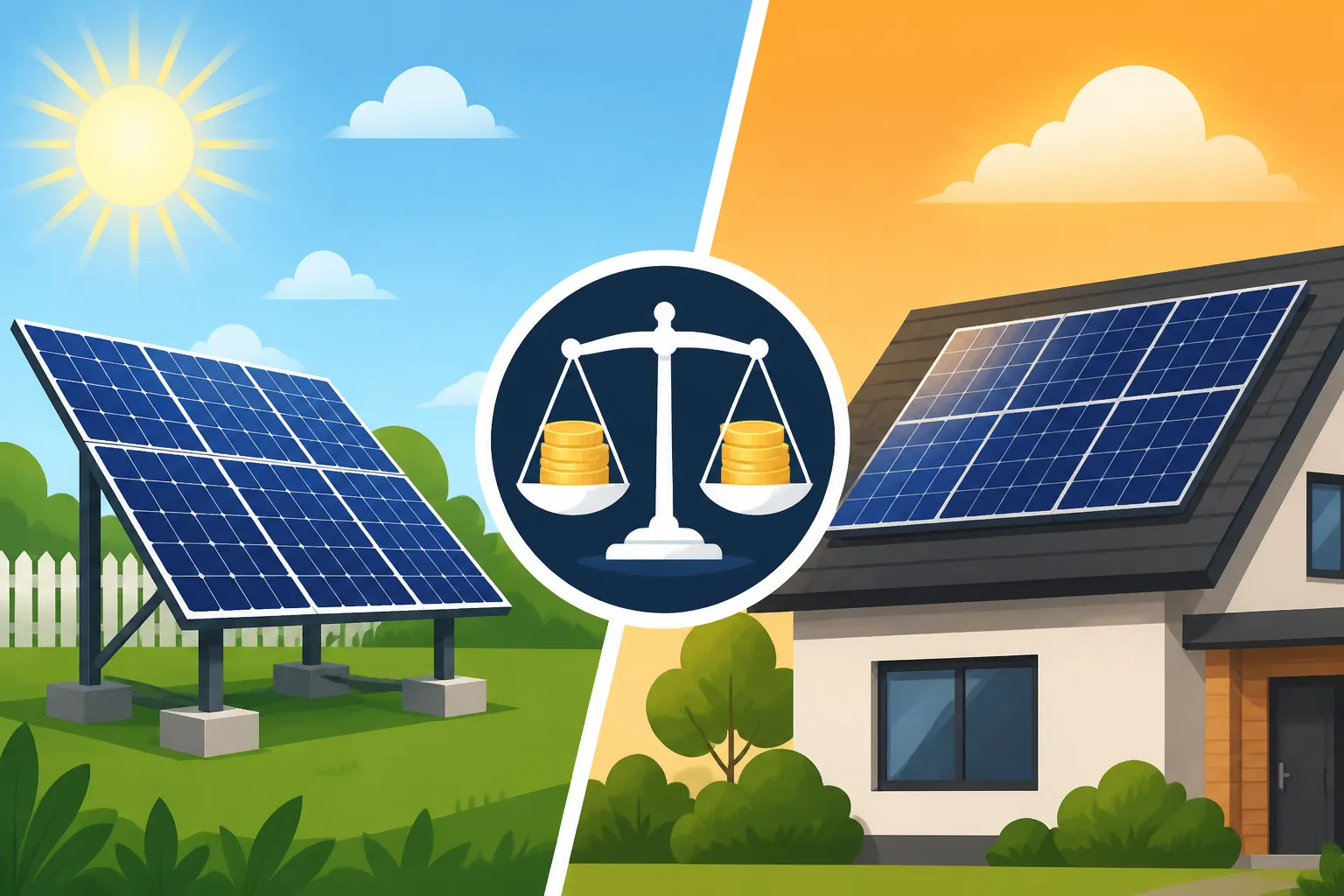
Choosing between the two often comes down to a battle between convenience and optimization. A roof-mount system is often the default because it feels like a home "upgrade," whereas a ground-mount system feels like a small construction project in the backyard. Both have distinct engineering requirements that will affect your homeowners' insurance and local building permits, so it is never as simple as just "picking a spot." You have to consider soil quality for ground mounts and structural load capacity for roof mounts.
The Mechanics of Roof Mount Systems
A roof-mount installation is a marvel of modern hardware. Installers must locate the rafters of your home—the "bones" of the structure—and secure the racking system directly to them. This ensures that even in high-wind events, the panels stay put. However, this process involves creating penetrations in your roof. High-quality installers use advanced flashing and sealants to prevent leaks, but the psychological hurdle of "putting holes in the roof" is a real frustration for many homeowners.
One of the biggest limitations of roof-mounted solar is that you are beholden to your house's orientation. If your roof faces north or is heavily shaded by a neighbor’s chimney or a massive oak tree, your energy production will suffer. You can't just rotate your house to catch more sun. This is why many people find themselves asking Is a South-Facing Roof Best for Solar? before they even sign a contract. If your roof isn't ideal, the efficiency loss can be a tough pill to swallow over a 25-year period.
The Mechanics of Ground Mount Systems
Ground-mount solar systems offer a level of freedom that roof mounts simply cannot match. Since they are built from the ground up, they can be placed in the exact spot on your property that receives the most sunlight. You can choose the precise tilt angle and orientation to maximize every minute of daylight. Some ground systems even feature "tracking" technology that allows the panels to follow the sun across the sky like a sunflower, though this adds significant mechanical complexity and cost.
However, the "ground" part of the name is where the labor gets intense. Unlike a roof, which is already a flat, elevated surface, a ground mount requires a foundation. This usually involves digging deep holes—sometimes six feet or more—to get below the frost line. If your property is rocky or has high clay content, the excavation costs can skyrocket. You also have to consider the distance from the array to your home’s electrical panel. Long distances require heavy-duty wiring and deep trenching, which adds a layer of complexity many homeowners aren't prepared for.
Comparing Initial Installation Costs
It is a well-known reality in the solar industry that ground-mount systems are more expensive than roof-mount systems. On average, you can expect to pay anywhere from 10% to 25% more for a ground-mounted array. The reason for this isn't the panels themselves—a 400W panel costs the same whether it sits on a roof or a rack—but rather the infrastructure required to hold those panels up and get the power back to your house.
Roof-mount systems are generally more affordable because your house has already done the heavy lifting. The "structure" is provided by your home's framing. The labor involved is primarily focused on attaching the racking and running the conduit. When you start looking into Solar Panel Cost Per Watt Explained, you'll see that the labor and "balance of system" (BOS) costs are significantly lower when the mounting surface is already built and permitted as a residence.
| Feature | Roof-Mount System | Ground-Mount System |
|---|---|---|
| Foundation Requirement | Existing Roof Structure | Concrete Piers or Driven Piles |
| Average Cost (per Watt) | $2.50 – $3.30 | $3.00 – $4.00 |
| Labor Intensity | Moderate (Roof work) | High (Excavation & Trenching) |
| Ease of Maintenance | Low (Requires ladder/safety gear) | High (Accessible from the ground) |
| Orientation Flexibility | Restricted by roof pitch/angle | Fully customizable |
| Cooling/Efficiency | Lower (Less airflow) | Higher (Excellent airflow) |
Why Ground Mount Systems Cost More Upfront
The price jump for ground mounts is almost entirely due to the substructure and the excavation. For a standard 10kW system, a roof mount might require a few thousand dollars in racking hardware. A ground mount, however, requires hundreds of pounds of steel or aluminum piping, bags of concrete, and the rental of a backhoe or auger. This heavy machinery and raw material cost add up quickly.
Another hidden cost is the trenching. Electrical code requires that the wires running from your solar array to your home be buried at a specific depth—usually 18 to 24 inches—in a protective conduit. If your ideal sun spot is 100 feet away from your house, that is 100 feet of digging through your lawn, landscaping, or even a paved driveway. Many homeowners find that using a service like Modernize to compare local pros is essential here, as different contractors have vastly different rates for the "dirty work" of trenching and masonry.
Labor and Permit Considerations
Labor for ground mounts is often specialized. While many crews are comfortable walking a 4/12 pitch roof, a ground mount requires knowledge of soil loads and structural engineering. In many jurisdictions, a ground-mount system is treated like a detached building or a shed. This means you might need a separate building permit, a land survey, or even a variance if the structure sits too close to your property line. These administrative hurdles don't just take time; they cost money in filing fees and engineering stamps.
Roof-mount permits are generally more streamlined because the "impact" on the land is zero. However, there is a catch: if your roof is old, you might face the dreaded Roof Replacement Cost Before Solar dilemma. If an installer tells you that your shingles only have five years left, you should never put panels over them. Removing and reinstalling panels later can cost $3,000 to $5,000, effectively wiping out years of energy savings. In this specific scenario, a ground mount might actually end up being the cheaper long-term play because it avoids the roof-syncing issue entirely.
Performance and Long-Term Savings
If the upfront cost is higher for ground mounts, why does anyone choose them? The answer lies in the "Yield." Because ground-mount systems are not limited by the slope or direction of a roof, they almost always produce more electricity per panel than a roof-mounted counterpart. This increased production can lead to a shorter Solar Panel Payback Period Explained if the site conditions are right.
Furthermore, ground-mount panels stay cooler. Solar panels are actually less efficient as they get hotter. On a scorching July day, a dark roof can reach 150 degrees Fahrenheit, trapping heat behind the panels and stifling their performance. Ground-mount panels have air circulating freely on both sides, which keeps their operating temperature lower and their voltage higher. This "thermal advantage" can result in a 3% to 5% boost in annual energy production compared to a flush-mounted roof system.
Maximizing Efficiency with Ground Mounts
When you have a ground mount, you can utilize bifacial panels. These are modules that can absorb sunlight from both the front and the back. Light that hits the grass or gravel beneath the array reflects up into the underside of the panel, generating "free" extra electricity. This is almost impossible to do on a standard roof because there is no space for reflected light to reach the back of the modules.
Using a platform like Modernize to find installers who specialize in high-efficiency ground mounts can help you calculate the exact ROI of these upgrades. If you have the space, you can also easily add more panels later. On a roof, you are limited by the physical "real estate" of the shingles. If you buy an electric vehicle three years from now and need more power, a ground-mount system can often be expanded by simply adding another "table" of racking, whereas a roof-mount might require an entirely new (and expensive) secondary installation on a less-than-ideal roof facet.
Roof Limitations and Production
For the average suburban homeowner, the roof is the only option. While it is less efficient, it is also "out of sight, out of mind." However, the production limitations are real. Most roofs have multiple "planes"—sections that face different directions. If your installer has to split your system between a South-facing facet and an East-facing facet, the East-facing side will "go dark" much earlier in the afternoon.
This leads to the frustration of "clipping" or under-production during peak hours. You might have paid for an 8kW system, but because of the roof angles, it only ever produces like a 6kW system. Before you commit, it's worth reading up on How Much Can You Save With Solar Panels? to see if the roof-mount production at your specific address actually covers your monthly bill. If it doesn't, and you have the yard space, the ground-mount option starts looking a lot more attractive despite the higher price tag.
Maintenance and Longevity
Maintenance is the "hidden" chapter of the solar journey. People often assume that because there are no moving parts, nothing ever needs to be done. While solar is very low-maintenance, "low" does not mean "no." Dust, pollen, bird droppings, and snow can all create "shading events" that significantly drop your production. How you clean those panels depends entirely on where they are located.
Ground-mount systems win the maintenance battle every single time. If a heavy snowstorm hits, you can walk out with a soft-bristled brush and clear the panels in five minutes. If they get dusty during a dry spell, a quick spray with a garden hose (while standing safely on the grass) does the trick. For roof-mount systems, cleaning usually requires a ladder, a safety harness, and a certain amount of bravery. Most homeowners end up ignoring their roof panels, which can lead to a 5% to 10% loss in annual production over time simply due to "soiling."
Cleaning and Accessibility
Accessibility isn't just about cleaning; it’s about troubleshooting. If a microinverter fails or a squirrel chews through a wire (a common frustration), a technician can fix a ground-mount system in a fraction of the time it takes to service a roof mount. On a roof, the technician has to set up safety equipment, climb up, and potentially lift panels to find the fault.
This ease of access also means you can more easily monitor your system's health. When you're looking at Solar Panel Maintenance & Cleaning, it's clear that ground mounts are the "DIY-friendly" option for people who like to keep their equipment in top shape. If you value being able to physically touch and inspect your investment without calling a pro and paying a $200 truck-roll fee, the ground mount offers a peace of mind that a roof system cannot.
Roof Lifespan and Panel Removal
One of the most overlooked "costs" of roof solar is what happens 20 years down the line. Most solar panels are warrantied for 25 years, but the average asphalt shingle roof only lasts 20 to 30 years. There is a high probability that you will need to replace your roof while your solar panels are still perfectly functional.
When this happens, you have to pay a solar company to come out, de-install the entire array, store it in your garage, wait for the roofers to finish, and then come back to re-install everything. This "detach and reset" process is a logistical nightmare and a significant expense. Ground-mount systems are immune to this. They sit on their own dedicated structures that can last 40 or 50 years with minimal upkeep. If you are worried about the longevity of your home's exterior, a ground mount is the "set it and forget it" solution.
Deciding Which Option Fits Your Lifestyle
Ultimately, the choice between ground and roof mounts isn't just a financial one—it's a lifestyle one. Your property's layout, your aesthetic preferences, and your future plans for your home play a massive role. Some people hate the look of "blue glass" on their beautiful architectural shingles, while others find a 30-foot-wide solar array in their backyard to be an eyesore.
If you live in a neighborhood with a strict Homeowners Association (HOA), you might not even have a choice. Many HOAs have rules against ground-mounted structures but are legally prohibited in many states from blocking rooftop solar. On the flip side, if you live in a rural area and want to keep your roof "clean" for aesthetic reasons or to prevent potential leaks, a ground mount tucked away in a back pasture is the gold standard.
Space and Aesthetic Requirements
Space is the ultimate gatekeeper. To install a standard 8kW to 10kW ground-mounted system, you need a clear, flat area of about 600 to 800 square feet. This area needs to be free of shadows from trees, fences, or buildings. For those with a quarter-acre lot, a ground mount is basically out of the question—it would eat up the entire backyard.
For those with larger lots, the aesthetics are a personal call. Some homeowners prefer to integrate ground mounts with their landscaping, perhaps planting pollinator-friendly flowers underneath. Others find that a ground mount is a great "dual-use" structure, providing shade for a patio or a covered area for garden equipment. If you're struggling to visualize how either would look on your property, using Modernize to connect with a consultant who can provide 3D renderings is a great way to avoid "buyer's remorse" later.
Future Planning and Scalability
Are you planning on adding a swimming pool, a workshop, or a detached ADU (Accessory Dwelling Unit)? A ground-mounted system is far more flexible when it comes to future property development. Since it doesn't occupy your roof, you keep that space open for dormers, skylights, or even a future roof deck.
Scalability is also much easier on the ground. If you decide to go fully off-grid or add significant battery storage, you might find that you need more panels than your roof can hold. You can read more about the limitations in How Many Solar Panels Do I Need for My Home? to see if your roof actually has the capacity for your future goals. If you're a "power user" who anticipates higher energy needs in the future, the ground mount provides the most headroom for growth.
Summary Table: Choosing the Right Mount
To help you make the final call, here is a quick summary of the winners in each category.
| Category | Winner | Reason |
|---|---|---|
| Upfront Cost | Roof-Mount | Uses existing home structure; no excavation needed. |
| Energy Yield | Ground-Mount | Perfectly optimized angle and better cooling. |
| Installation Speed | Roof-Mount | Typically takes 1-2 days; no trenching or concrete curing. |
| Maintenance Ease | Ground-Mount | No ladders; easy to clean and troubleshoot. |
| Property Flexibility | Ground-Mount | Can be expanded or moved more easily. |
| Aesthetics (Suburban) | Roof-Mount | Keeps the yard open and fits the neighborhood look. |
Important Considerations for 2026 and Beyond
As you weigh these options, keep in mind that state and local incentives still play a massive role in the final price tag. While the federal landscape has shifted, many regions still offer aggressive benefits. For example, if you are in the Northeast, looking into Massachusetts Solar Incentives in 2026 can help offset the higher cost of a ground-mount system. Similarly, those in the South should check Texas Solar Incentives in 2026 to see if local utility rebates can help bridge the gap.
Whether you choose the roof or the ground, the most important step is getting multiple quotes. The "ground-mount premium" varies wildly between installers. Some companies specialize in it and have the machinery on hand, making their prices competitive. Others "sub out" the trenching and concrete work, which leads to massive markups. Using a resource like Modernize helps you filter for pros who actually have experience with your chosen mounting style, ensuring that your solar journey starts on solid ground—or a solid roof.
Disclaimer
This guide is provided for informational purposes only and does not constitute financial, legal, or professional engineering advice. Solar installation costs, local permitting requirements, and efficiency ratings vary significantly based on your specific location, property conditions, and local utility regulations. Always consult with a licensed solar contractor and a tax professional before making any major home improvements or investment decisions. Information regarding incentives and rebates is subject to change as state and local policies evolve.