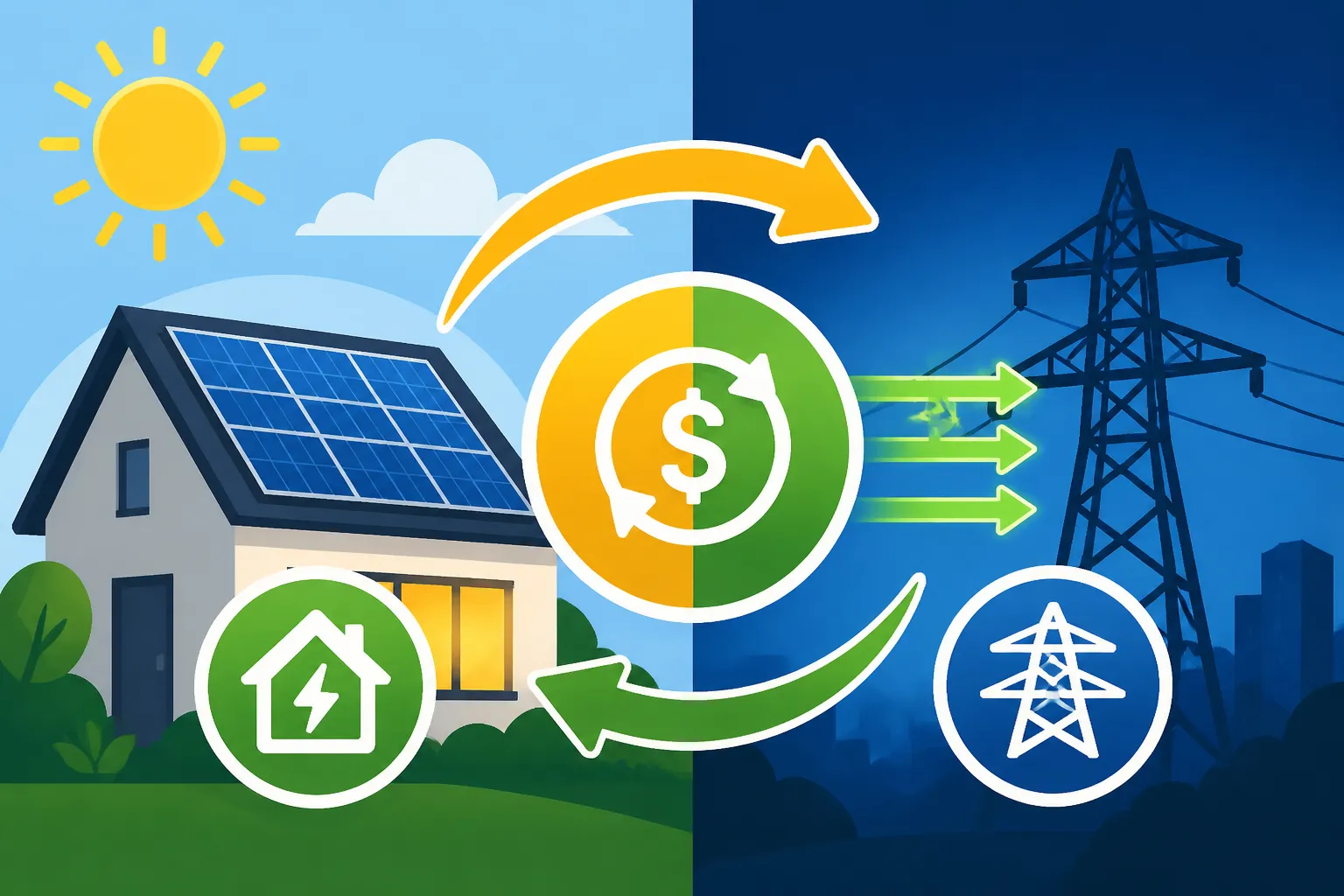
Avoided-Cost Rate & Export Credits Explained
Let's face it, trying to figure out how your solar panels actually save you money, beyond just seeing your electric bill drop, can feel like deciphering ancient hieroglyphs. Many homeowners go solar with a clear understanding that they'll generate their own power, but when it comes to the nitty-gritty of getting credit for all that glorious excess electricity sent back to the grid, that's where things can get seriously confusing. This guide is here to untangle the often-frustrating world of avoided-cost rates and export credits, explaining exactly what they are, how they work, and what they mean for your wallet.
The Tricky Business of Solar Energy Compensation
You've made the leap, invested in solar panels, and now you're watching your meter spin backward – or at least hoping it is! But what happens when your panels are cranking out more electricity than your home can use at that exact moment? That surplus power doesn't just vanish; it flows back onto the utility grid, helping to power your neighbors' homes. The big question is, how much does your utility company actually pay you for that valuable contribution? This is where the concept of compensation gets interesting, and often, contentious.
When Your Panels Outproduce Your Home's Needs
Imagine a sunny afternoon in July in Phoenix, Arizona. Your air conditioning is running, but your 10 kW solar system is probably generating far more power than even a high-usage home can consume. All that extra electricity, cleanly generated by the sun, pushes through your meter and onto the broader electrical grid. For many homeowners, the expectation is that they'll get compensated fairly for this power, helping to offset the times they do pull electricity from the grid, like at night or on cloudy days. This exchange is fundamental to the financial viability of residential solar.
It's a beautiful concept: you generate clean energy, reduce your carbon footprint, and help stabilize the grid. But the method of compensation for this excess energy varies wildly depending on where you live and which utility company serves you. This variation is precisely what leads to so much head-scratching and frustration among homeowners. It's rarely a one-size-fits-all situation, and what might be a fantastic deal in one state could be a real disappointment just a state over.
The Utility's Perspective on Buying Your Surplus Power
From a utility company's viewpoint, buying electricity from thousands of individual solar homeowners isn't quite the same as buying from a large, centralized power plant. They have their own costs to consider when generating or procuring electricity. When your solar panels feed power into the grid, you're essentially providing a decentralized source of power, which can help reduce the utility's need to fire up peaker plants or purchase power from wholesale markets, especially during peak demand times. This is the core idea behind "avoided cost."
Utilities often argue that they shouldn't pay retail rates for residential solar exports because they still incur costs to maintain the grid infrastructure, distribute the power, and manage demand fluctuations. They see the power you export as something that "avoids" a cost they would have otherwise incurred, rather than something they are actively "buying" at market value to resell. This fundamental difference in perspective is at the heart of many debates between solar advocates and utility companies, and it significantly impacts how much credit you actually receive.
Deconstructing Avoided-Cost Rates
So, what exactly is an avoided-cost rate? In its simplest form, it's the rate a utility company calculates as the cost it avoids by not having to generate or purchase that same amount of electricity from another source. It's often significantly lower than the retail rate you pay when you draw power from the grid. Imagine paying 15 cents per kWh for electricity you use, but only getting 3-5 cents per kWh for the electricity you send back – that's the avoided-cost rate in action.
How Utilities Calculate Avoided Costs
The calculation of avoided costs is complex and varies by utility and regulatory body. Generally, it includes several components:
- Fuel Costs: This is the cost the utility would have paid for fuel (natural gas, coal, etc.) to generate that electricity.
- Purchased Power Costs: If the utility would have bought that power from a wholesale market, the avoided cost reflects that purchase price.
- Variable Operation & Maintenance (O&M) Costs: These are the operational expenses that fluctuate with electricity production, like staffing and routine maintenance at power plants.
- Transmission and Distribution (T&D) Costs: Sometimes, avoided costs can also factor in deferred or avoided investments in T&D infrastructure, especially if local solar generation reduces strain on the grid in specific areas.
- Environmental Adders: In some progressive regulatory frameworks, an avoided cost might even include the cost of carbon emissions or other environmental impacts that are avoided by using clean solar power. This is less common in direct homeowner compensation but is a consideration in broader energy planning.
Because these components fluctuate – especially fuel costs and wholesale electricity prices – the avoided-cost rate can change over time. It's rarely a fixed, static number, which adds another layer of complexity for solar homeowners trying to project their savings.
The "Fairness" Debate and Homeowner Frustration
For many solar homeowners, the idea of getting paid an "avoided-cost rate" feels inherently unfair. You're generating clean, reliable power that reduces the strain on the grid and helps the environment, yet you're often compensated at a fraction of the price you pay for the power you consume. This disparity can significantly extend your [Solar Panel Payback Period Explained|https://www.solar.com/learn/solar-panel-payback-period-explained/].
Consider a scenario in, say, Georgia, where many utilities offer an avoided-cost compensation model. You might pay Georgia Power around 12-14 cents per kWh for the electricity you pull from the grid, but only receive 3-5 cents per kWh for the power you send back. This can be incredibly frustrating, as it means you need to consume as much of your own generated power as possible to truly maximize your savings, rather than relying on credits for exports. It essentially devalues the clean energy you're producing, making it harder to justify the initial investment for some, especially in states where [Solar Tax Credit 2026: What Happened to the Federal Credit|https://www.solar.com/learn/solar-tax-credit-2026-what-happened-to-the-federal-credit/] or other strong incentives might be absent or reduced.
Export Credits: How They Appear on Your Bill
When you hear "export credits," this is essentially the monetary value you receive for that surplus electricity sent back to the grid, calculated based on the avoided-cost rate. These credits don't usually result in a check from your utility; instead, they're applied to your monthly utility bill, reducing the amount you owe.
Reading Your Utility Bill with Export Credits
Understanding how these credits show up on your bill is crucial. Here's a typical breakdown of what you might see:
- Energy Consumed (kWh): This is the total amount of electricity you pulled from the grid.
- Energy Exported (kWh): This is the total amount of surplus electricity your solar system sent to the grid.
- Retail Rate Charge: The cost for the energy you consumed from the grid (e.g., $0.15/kWh).
- Export Credit: The monetary value calculated by multiplying your exported kWh by the avoided-cost rate (e.g., 100 kWh exported * $0.04/kWh avoided cost = $4.00 credit).
- Net Bill: Your total charges minus any export credits, plus any fixed charges or taxes.
Let's look at an example. Suppose you used 800 kWh from the grid in a month and exported 500 kWh of solar energy. If your retail rate is $0.14/kWh and the avoided-cost rate is $0.04/kWh:
- Grid Consumption Cost: 800 kWh * $0.14/kWh = $112.00
- Export Credit Value: 500 kWh * $0.04/kWh = $20.00
- Net Energy Bill Impact (before fixed charges): $112.00 – $20.00 = $92.00
As you can see, the credits help, but they don't fully offset the cost of the power you consume at a higher retail rate. This system, sometimes referred to as "net billing" or a "buy-all, sell-all" model (if no true net metering is available), puts a strong emphasis on self-consumption.
Factors Influencing Export Credit Value
The value of your export credits isn't always a flat rate throughout the day or year. Several factors can influence how much your utility pays you for your exported solar energy:
- Time-of-Use (TOU) Rates: Many utilities, especially those in regions like California with its [California Net Metering Rules in 2026|https://www.solar.com/learn/california-net-metering-rules-in-2026/] (NEM 3.0, which is primarily a net billing or avoided cost model), have Time-of-Use (TOU) rate structures. This means electricity is more expensive during peak demand hours (e.g., late afternoon/early evening) and cheaper during off-peak hours. Under an avoided-cost model, your export credit value might also fluctuate with these TOU periods, meaning exports during peak hours could fetch a slightly higher credit than off-peak exports. This encourages homeowners to export when the grid needs it most.
- Seasonal Variations: Some avoided-cost rates might also vary by season, reflecting higher utility generation costs in summer (due to increased AC use) or winter (due to heating demand).
- Grid Congestion: In very rare or specific pilot programs, export credits might even be influenced by localized grid conditions, with higher credits offered for exports into congested areas where more generation is needed. This is less common for residential customers but reflects the true value of distributed generation.
For homeowners, this means that strategically shifting electricity usage (e.g., running dishwashers or charging EVs during off-peak solar production hours) or integrating a [Solar Battery Incentives in 2026|https://www.solar.com/learn/solar-battery-incentives-in-2026/] to store excess power for later use can become even more financially beneficial under an avoided-cost system.
Avoided-Cost Rate vs. Net Metering: A Critical Comparison
This is where the rubber meets the road for solar savings. Understanding the fundamental difference between avoided-cost rates and net metering is essential for anyone considering solar, as it directly impacts your return on investment.
Full Retail Net Metering: The Gold Standard
Historically, and still in many states, "full retail net metering" has been the most favorable compensation mechanism for solar homeowners. Under full retail net metering, when your solar panels generate more electricity than you consume, your utility essentially buys that excess power back from you at the same retail rate you pay to them for electricity.
Imagine this: if you pay 15 cents per kWh for power from the grid, under full retail net metering, you also get 15 cents per kWh for every unit of electricity you send back. Your meter literally spins backward (or digitally credits you) at the full retail rate. This effectively means your excess generation during a sunny day perfectly offsets consumption at night or on a cloudy day, kilowatt-hour for kilowatt-hour. This straightforward, 1:1 crediting system makes solar economics much simpler and often more attractive. States like New York, with its strong [New York NY-Sun & State Solar Tax Credit (25%)|https://www.solar.com/learn/new-york-ny-sun-state-solar-tax-credit-25/], still largely benefit from favorable net metering policies.
| Feature | Full Retail Net Metering | Avoided-Cost Rate / Net Billing |
|---|---|---|
| Compensation | 1:1 credit for exported electricity at retail rate | Lower rate for exported electricity, based on utility's avoided costs (often 25-50% of retail rate) |
| Bill Impact | Exports directly offset consumption dollar-for-dollar. | Exports reduce the monetary amount owed, but not necessarily kWh for kWh. Stronger emphasis on self-consumption to maximize savings. |
| Simplicity | Very straightforward; easy to understand savings. | More complex to calculate savings, as export value differs from import value. |
| Financial Value | Generally higher financial benefit for solar owners. | Lower financial benefit for exports; may require larger systems, batteries, or behavioral changes to maintain similar savings levels as full net metering. |
| Prevalence | Still available in many states, but facing pressure. | Increasingly common, especially in states transitioning from older net metering policies (e.g., California's NEM 3.0) or states with less solar-friendly regulations (e.g., parts of Florida or Texas). |
The Shift Away from Net Metering: Why It's Happening
Unfortunately, full retail net metering is under increasing pressure and is being modified or replaced in many jurisdictions. Utilities often argue that net metering shifts grid maintenance costs onto non-solar customers, as solar owners who export a lot of power don't pay as much in fixed charges or volumetric charges for grid services. Regulators, often influenced by utility lobbying, sometimes agree, leading to policies that move towards avoided-cost rates or net billing.
A prime example is California, which transitioned from NEM 2.0 to NEM 3.0 (also known as Net Billing) in April 2023. Under NEM 3.0, the export credit value for residential solar dropped significantly, often to avoided-cost levels, especially during midday when solar production is highest and grid demand is lower. This shift dramatically altered the economics of solar in California, making energy storage (solar batteries) much more appealing to maximize self-consumption and export during higher-value peak evening hours. Similarly, in states like Texas and Florida, where comprehensive statewide net metering policies are less common, solar customers often find themselves subject to avoided-cost rate structures or various solar buyback programs. This trend highlights the importance of researching your local utility's specific policies before going solar.
Real-World Impact on Homeowners
The transition to or existence of avoided-cost rates can significantly alter the financial calculus of going solar. It requires homeowners to think differently about how they use their solar energy to maximize savings.
Maximizing Your Savings with Avoided-Cost Rates
When you're compensated at a lower rate for your exports, the game changes: self-consumption becomes king. The more of your own solar-generated electricity you use directly in your home, the more you avoid paying the higher retail rate to your utility. This is where strategies come into play:
- Load Shifting: This involves consciously moving your energy-intensive activities to times when your solar panels are producing the most electricity. Think running the dishwasher, doing laundry, or charging your electric vehicle during peak solar production hours (typically midday). This simple behavioral change can drastically increase your self-consumption.
- Energy Storage Solutions (Solar Batteries): This is perhaps the most impactful strategy. A solar battery, like a [Tesla Powerwall 3 Review|https://www.solar.com/learn/tesla-powerwall-3-review/] or Enphase IQ Battery, allows you to capture that excess solar energy that would otherwise be exported at a low avoided-cost rate. You can then use that stored energy later, such as in the evening when electricity rates are higher, or during a power outage. This transforms your home into a more energy-independent unit and maximizes the value of every electron your panels produce. You can find more information on [Are Solar Batteries Still Eligible for Incentives in 2026?|https://www.solar.com/learn/are-solar-batteries-still-eligible-for-incentives-in-2026/] if you're considering adding one.
- Optimized System Sizing: Under avoided-cost rates, oversizing your system can sometimes lead to diminishing returns if you're exporting a significant amount of power at a low rate. It becomes more important to size your system to meet your historical usage, with perhaps a slight buffer for future needs, rather than aiming for massive overproduction that gets undervalued.
Navigating the Regulatory Landscape State by State
The specific policies regarding avoided-cost rates and export credits are determined at the state and often utility level. This means your experience can be wildly different depending on your address.
For instance, in states like Arizona, some utilities, like Arizona Public Service (APS), have transitioned away from traditional net metering to a "resource comparison proxy" (RCP) rate, which functions similarly to an avoided-cost rate for solar exports. This rate is usually lower than retail and encourages battery storage. Contrast this with a state like Maryland, which still offers robust incentives, including a solid net metering policy alongside its SREC program. Understanding these local nuances is critical. You can learn more about this in our guide on [State Solar Incentives: Complete 2026 Guide|https://www.solar.com/learn/state-solar-incentives-complete-2026-guide/].
Before committing to solar, it's absolutely essential to:
- Contact your local utility: Ask them directly about their current solar compensation policies for residential customers. Inquire about their net metering program (if any), avoided-cost rates, or any specific solar buyback programs.
- Consult with local solar installers: Reputable installers will be well-versed in the local regulations and can provide accurate financial projections based on your utility's specific compensation scheme. They can help you understand [How Much Can Solar Incentives Save Me in 2026?|https://www.solar.com/learn/how-much-can-solar-incentives-save-me-in-2026/].
- Review your utility's tariffs: These publicly available documents detail the rates and rules for all customer classes, including solar. While they can be dense, they contain the definitive answers.
The Future of Solar Compensation
The landscape of solar compensation is anything but static. As more homes adopt solar, utilities and regulators are continually re-evaluating policies. The trend suggests a continued move away from generous full retail net metering towards more nuanced compensation structures, often incorporating elements of avoided-cost rates.
The good news is that innovation in solar technology, particularly in battery storage and smart home energy management systems, is rapidly advancing. These technologies empower homeowners to adapt to changing compensation models by increasing self-consumption and optimizing when they use and export power. The debate over fair compensation for distributed generation will undoubtedly continue, but informed homeowners with access to advanced technologies will be best positioned to maximize their solar savings, no matter how the rules evolve. Staying updated on topics like [What Is NEM 3.0 (California Net Billing)?|https://www.solar.com/learn/what-is-nem-3-0-california-net-billing/] and [Net Metering vs Net Billing: What's the Difference?|https://www.solar.com/learn/net-metering-vs-net-billing-whats-the-difference/] will be key to understanding future trends.
Disclaimer
This article is for general informational purposes only and does not constitute professional advice. Laws, prices and regulations vary by location and change over time. Consult a qualified professional for guidance on your specific situation.