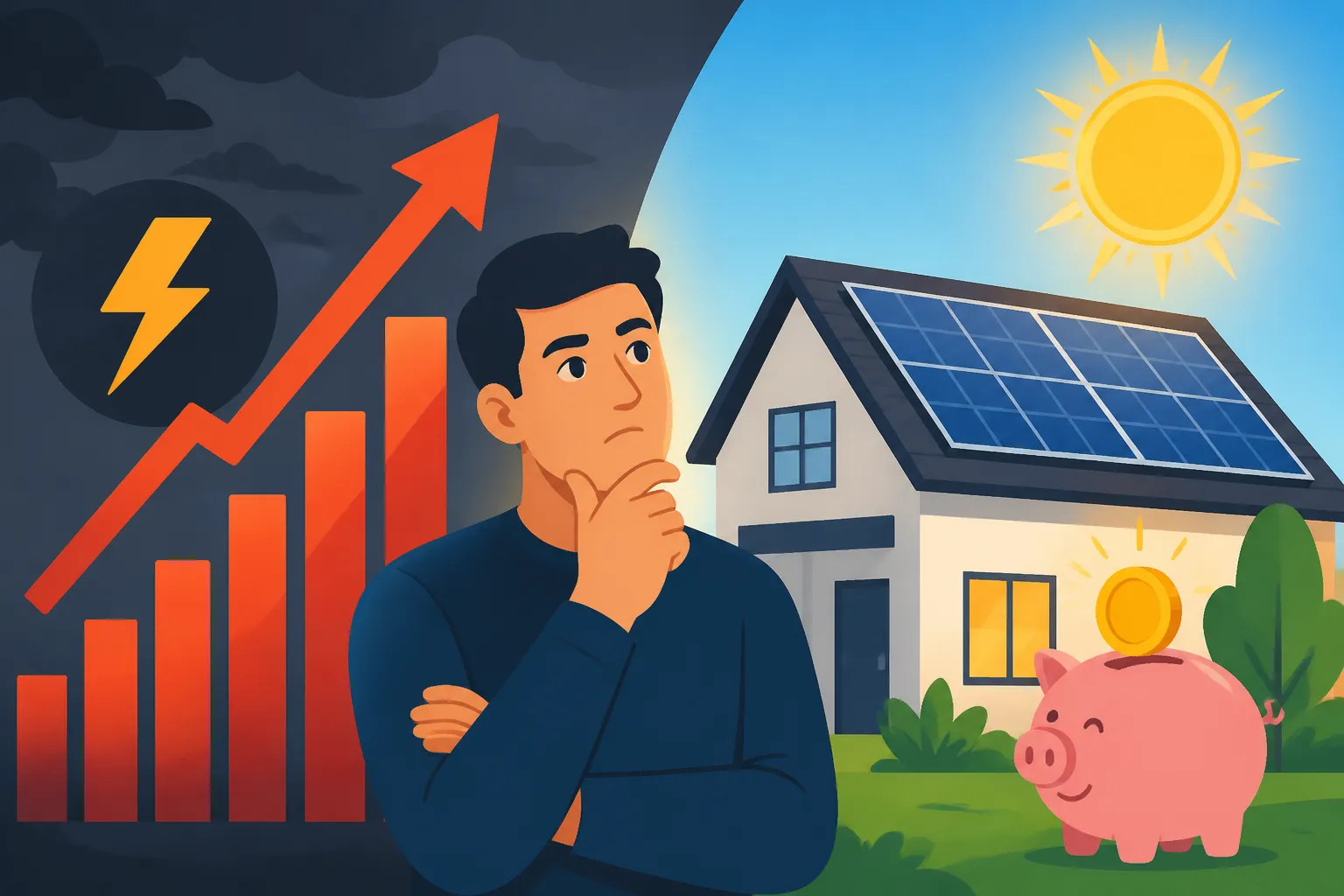
Will Solar Save Me Money if Electricity Rates Keep Rising?
Feeling that knot in your stomach every time your utility bill arrives? You're not alone. So many homeowners are fed up with watching their electricity rates creep up year after year, feeling helpless against forces seemingly beyond their control. This comprehensive guide is here to shed light on how investing in home solar can offer a powerful shield against those ever-increasing costs, bringing predictability and peace of mind back to your household budget.
The Unpredictable Rollercoaster of Electricity Rates
It’s a frustrating reality: for most of us, our monthly electricity bill feels like a lottery. You might get a relatively mild one, only to be hit with a massive surge the next month, leaving you scrambling to understand why. This unpredictability makes budgeting a nightmare and leaves many feeling powerless.
Why Electricity Prices Keep Climbing
There isn't just one simple reason why your electricity bill seems to defy gravity. It's usually a cocktail of factors that conspire against your wallet. At the core, we're talking about fuel costs. A huge portion of our nation's electricity still comes from natural gas and coal-fired power plants. When the price of natural gas spikes, which it often does due to global supply issues, geopolitical events, or even just a particularly cold winter across the country, those costs get passed directly onto consumers like you. Similarly, if there are disruptions in coal supply or carbon pricing schemes become more prevalent, that impacts the bottom line.
Beyond fuel, the grid itself is aging and constantly needs upgrades. Transmission lines, substations, and other infrastructure are expensive to maintain and modernize. Utility companies often get approvals to recover these investment costs through rate increases. Think about states like California, which has seen some of the most dramatic rate hikes due to wildfire mitigation efforts, infrastructure improvements, and the transition to cleaner energy sources. Or consider New England states, where reliance on natural gas imports can lead to volatile pricing during peak demand. Then there's the ever-present impact of extreme weather events—hurricanes, blizzards, heatwaves—which can damage infrastructure and drive up demand, leading to higher costs for everyone. Regulatory changes at the state and federal level also play a significant role, sometimes pushing for investments in renewables or grid hardening, which, while beneficial long-term, can result in short-term rate adjustments.
The Impact on Your Household Budget
When electricity prices are on an upward trend, it’s not just an abstract number on a bill; it directly translates into real-life budget strains. For a family in, say, Phoenix, Arizona, where air conditioning is a non-negotiable for much of the year, a sudden 10% increase in rates can mean hundreds of extra dollars annually. That’s money that could have gone towards groceries, a child’s education fund, or even a much-needed family vacation. It forces difficult choices and adds a layer of financial stress that no one wants.
You start to feel like you're constantly at the mercy of your utility company, with no control over one of your biggest household expenses. Trying to plan for the future becomes incredibly difficult when a core necessity like electricity has such an unstable price tag. This feeling of helplessness is exactly what makes so many homeowners start looking for alternatives.
How Solar Provides a Buffer Against Rising Costs
This is where solar energy steps in as a true game-changer. Imagine having the power to say goodbye to those anxiety-inducing utility bills and hello to a predictable, often lower, monthly energy cost. That's the promise of solar, especially in an era of unpredictable rate hikes.
Locking In Your Energy Costs with Solar
One of the most compelling arguments for going solar, particularly when electricity rates are volatile, is the ability to lock in your energy costs. When you install a solar panel system on your roof, you're essentially becoming your own power plant. The electricity you generate reduces, or in many cases eliminates, your reliance on grid power. If you purchase your system outright with cash, you effectively pay for your energy upfront and then enjoy free electricity (minus any small connection fees) for decades.
If you opt for a solar loan, which many homeowners do, your monthly payment for that loan is typically a fixed amount. This means that while your utility company might be raising its rates by 3%, 5%, or even more each year, your solar loan payment stays the same. Over time, as utility rates continue their ascent, your fixed solar payment looks more and more attractive, eventually becoming significantly lower than what you’d be paying the utility. This stability is invaluable for long-term financial planning, allowing you to budget with confidence rather than crossing your fingers every month. You gain control over a major household expense, transforming it from a variable cost to a predictable one.
Net Metering and Maximizing Your Savings
Another critical component of solar savings, and how it hedges against rising rates, is a policy called net metering. In states where robust Net Metering Explained: How It Works by State is available, your utility company essentially acts as a giant battery. When your solar panels produce more electricity than your home consumes—which often happens during peak sunlight hours—that excess energy is sent back to the grid. In return, your utility provides you with credits on your bill. Later, when your panels aren't producing enough (like at night or on cloudy days), you draw power from the grid, and those credits are used to offset the cost.
This system is incredibly powerful because it ensures that every kilowatt-hour your panels produce is put to good use, either by powering your home directly or by earning you credits. As utility rates rise, the value of those net metering credits also increases. This means that your solar system, which had a certain payback period based on current rates, becomes even more financially advantageous as rates climb.
It’s important to note that net metering policies can change, as seen with California's transition to NEM 3.0 (Net Billing). Under NEM 3.0, export credits for sending excess power back to the grid are significantly lower than the retail rate. In such scenarios, adding a solar battery becomes even more crucial. A battery allows you to store your excess solar production for use later, minimizing how much power you need to pull from the grid when rates are high. This self-consumption strategy helps maintain significant savings even in less favorable net metering environments, further safeguarding you from rate increases.
The Long-Term Financial Security of Going Solar
When we talk about solar, we're not just discussing short-term savings. We're talking about a long-term investment that provides financial security for decades. Solar panels are built to last, often coming with warranties that guarantee performance for 25 years or more. This means that for a quarter-century, you'll be producing clean, affordable energy from your rooftop.
Over this extended lifespan, the cumulative savings from avoiding ever-increasing utility bills can be substantial. For instance, if electricity rates average a 3-5% increase each year (which is a conservative estimate in many regions), the money you save by generating your own power will grow exponentially over time. This creates a significant financial buffer. Beyond direct savings, owning a solar system can also significantly increase your home's value, as detailed in our guide, Do Solar Panels Increase Home Value?. This added equity is another layer of financial security, making solar a wise investment both for daily savings and long-term asset growth.
Analyzing the Financial Equation: Is Solar Truly a Hedge?
The short answer is a resounding "yes." Solar effectively acts as a hedge against inflation and volatile energy markets. By generating your own power, you're opting out of the unpredictable pricing schemes of utility companies, at least for a significant portion of your energy consumption. But let's dig into the details of how this works financially.
Calculating Your Potential Savings
Understanding your potential savings with solar is a crucial step in assessing its value as a hedge against rising electricity rates. It’s not a one-size-fits-all calculation, as many variables come into play. First, you need a clear picture of your current electricity usage. Look at your past 12 months of utility bills to get an average monthly and annual kilowatt-hour (kWh) consumption. This will help determine the optimal system size for your home.
Next, factor in your local electricity rates. These vary widely by state and even by utility company within a state. Some states, like Hawaii or California, have notoriously high rates, making solar's payback period much shorter. Others, like parts of Washington state with hydropower, might have lower rates, extending the payback period but still offering long-term savings as rates inevitably rise. Knowing your current "cost per kWh" is essential. You can learn more about this in our article, Solar Panel Cost Per Watt Explained.
Then come the available incentives. The federal solar tax credit (also known as the Investment Tax Credit, or ITC) is a significant incentive, and you can explore more about it in Federal Solar Incentives That Still Exist in 2026. Many states and local municipalities also offer their own solar rebates and incentives, such as Solar Property Tax Exemptions by State or specific utility programs. These incentives drastically reduce the upfront cost of solar, accelerating your payback period and enhancing your overall return on investment, making solar an even stronger financial decision against future rate hikes.
Finally, consider your financing options. A cash purchase offers the greatest long-term savings, but solar loans can provide predictable monthly payments that are often lower than your previous utility bill. When you gather quotes from installers, they should provide a detailed breakdown of these factors, including projected savings over 20-25 years. Don't hesitate to ask for multiple quotes to compare. Platforms like Modernize can help connect you with pre-vetted local installers who can provide these detailed estimates, ensuring you get a competitive price and a clear understanding of your savings.
The Role of Incentives and Rebates
Incentives and rebates are the unsung heroes that make solar an even more compelling financial decision, especially in the context of rising electricity rates. They effectively reduce the "buy-in" cost of your personal energy hedge.
The federal solar tax credit is a massive boost, offering a percentage of your system's cost back as a credit on your federal income taxes. This immediately reduces your net cost, making the investment more accessible and improving your Solar Panel Payback Period Explained.
Beyond the federal level, many states offer their own robust incentive programs. For example, some states have Solar Renewable Energy Credit (SREC) markets, where you can earn income by selling credits generated by your solar system. Other states provide generous state tax credits, property tax exemptions, or sales tax exemptions. Local governments and utility companies also often jump in with their own programs. You can find more about these opportunities in resources like State Solar Incentives: Complete 2026 Guide and Utility Solar Rebates: How to Find Yours.
These incentives don't just lower your initial investment; they amplify your savings over the lifetime of your system. By reducing the upfront capital required, they decrease the financial risk and shorten the time it takes for your system to pay for itself. This means you start realizing pure savings sooner, which becomes increasingly valuable as utility rates continue their upward climb. The more incentives you can leverage, the stronger your financial shield against future rate increases will be.
Solar vs. Continued Utility Dependence: A Long-Term Outlook
Let's do a little thought experiment. Imagine two identical homes side-by-side, both with similar electricity usage. Home A decides to go solar, financing their system with a fixed-rate loan. Home B decides to stick with their traditional utility company.
Over the next 25 years, Home A has a predictable, stable monthly payment for their solar system. Even if electricity rates jump 5% next year, and another 4% the year after, Home A's solar payment remains constant, or they're effectively paying nothing if they bought their system outright. Their initial investment eventually pays off, and for the remaining years of their panels' lifespan, they enjoy drastically reduced or even free electricity. In our guide, How Much Can You Save With Solar Panels?, we dive deeper into potential savings.
Home B, on the other hand, watches their utility bill slowly but surely increase, year after year. They have no control over the price per kilowatt-hour, and every rate hike directly translates into more money out of their pocket. Over a decade or two, the cumulative difference in spending can be astronomical. The "opportunity cost" of not going solar for Home B is the sum of all those avoided rate increases, the thousands of dollars in savings, and the increased home value that Home A is now enjoying. Solar is not just a purchase; it's a strategic long-term financial move that locks in certainty in an uncertain energy market.
| Financial Aspect | With Solar (Owned) | Without Solar (Utility-Dependent) |
|---|---|---|
| Monthly Energy Cost | Predictable, often fixed loan payment or near-$0 after payoff | Volatile, subject to utility rate increases |
| Long-Term Savings | Significant, grows over 25+ years | Decreases as rates rise |
| Hedge Against Inflation | Excellent | Poor |
| Home Value Impact | Increases property value | No direct positive impact |
| Control over Energy | High control, self-generation | Little to no control |
| Initial Investment | Higher upfront, offset by incentives | Low/no upfront cost |
| Payback Period | Typically 6-12 years, then free energy | Never "pays back" – ongoing expense |
Practical Steps to Future-Proof Your Home with Solar
Ready to take control and future-proof your home against those ever-creeping electricity rates? Here’s a roadmap to help you navigate the journey to solar ownership.
Evaluating Your Home's Solar Potential
Before you get too far down the road, it's essential to assess if your home is a good candidate for solar. Not every roof is created equal, and several factors can influence how much electricity your system will produce. The first things to consider are your roof space and its sun exposure. An ideal setup usually involves a south-facing roof with minimal shading from trees or other buildings. Even if your roof isn't perfectly south-facing, systems can still perform well on east or west-facing sections, though perhaps with slightly different production profiles. Our guide on Roof Considerations for Solar Panels offers a deeper dive into these specifics.
Beyond orientation and shading, the condition and age of your roof are critical. Solar panels are a long-term investment, often lasting 25-30 years. If your roof is nearing the end of its lifespan, it generally makes sense to replace it before installing solar. This avoids the costly process of removing and reinstalling panels just a few years down the line. A reputable solar installer will conduct a thorough site assessment to evaluate all these factors, including the structural integrity of your roof, its pitch, and any potential shading issues. They’ll also look at your electrical panel to ensure it can handle the new system. This initial evaluation is crucial for designing a system that maximizes your energy production and long-term savings.
Navigating Your Options: From Purchase to PPA
Once you've determined your home is suitable for solar, the next big decision is how you'll acquire your system. This isn't a one-size-fits-all situation, and understanding the different models can significantly impact your long-term savings and your ability to hedge against rising rates.
The most common options include a cash purchase, a solar loan, a solar lease, or a Power Purchase Agreement (PPA). A cash purchase, while requiring the largest upfront investment, offers the highest return on investment and maximum long-term savings, as you own the system outright and don't pay interest. A solar loan allows you to own the system with little or no money down, making it more accessible. Your loan payments are typically fixed, providing a stable monthly cost that eventually becomes lower than what you'd pay for utility power as rates climb.
Solar leases and PPAs, on the other hand, mean you don't own the system; a third-party company does. With a lease, you pay a fixed monthly fee to use the panels. With a PPA, you pay for the electricity the panels produce at a fixed rate per kilowatt-hour, often with a small annual escalator. While these options typically offer immediate savings with no upfront cost, they usually provide less long-term financial benefit than owning the system, and you won't qualify for tax incentives. Our detailed comparison, Solar Lease vs PPA vs Buy: Which Is Best?, can help you weigh the pros and cons of each. Your choice should align with your financial goals, your budget, and how much ownership and control you want over your energy production. It's always a good idea to speak with financial advisors or expert solar consultants from platforms like Modernize to understand which option best fits your specific situation.
Choosing the Right Installer for Lasting Value
Selecting the right solar installer is paramount to ensuring your system delivers reliable, long-term savings and truly future-proofs your home. This isn't a decision to rush, as the quality of installation, equipment, and customer service will affect your experience for decades. Start by looking for installers with a strong local reputation, verified by customer reviews and industry accreditations. Membership in organizations like the Solar Energy Industries Association (SEIA) or certification by the North American Board of Certified Energy Practitioners (NABCEP) can be good indicators of professionalism.
When comparing quotes, don't just look at the bottom-line price. Dig into the details: what specific solar panel brands are they offering (e.g., Qcells, REC, Maxeon), what type of inverter (microinverters like Enphase or string inverters like SolarEdge), and what kind of warranties are included? A good installer will offer comprehensive warranties, covering equipment (product warranty), system performance (power production warranty), and the installation itself (workmanship warranty). You can delve deeper into this topic in our Solar Panel Warranties Explained article.
It's highly recommended to get at least three bids from different, pre-vetted installers. This allows you to compare not just pricing, but also equipment choices, proposed system sizes, and the overall customer service experience. Look out for any red flags, like high-pressure sales tactics or quotes that seem too good to be true. Platforms like Modernize are designed to help you connect with multiple reputable local installers, making the comparison process much smoother and ensuring you receive competitive offers for your solar project. This diligence in choosing your installer is a key step in ensuring your solar investment truly pays off against those ever-increasing electricity rates.
Disclaimer
Please note that this content is intended for informational purposes only and does not constitute financial, tax, or legal advice. Solar incentives, electricity rates, and policies can vary significantly by location and change over time. It is highly recommended to consult with qualified professionals, including a solar installer, financial advisor, and tax specialist, to determine the best options for your specific circumstances.