Florida Net Metering Rules in 2026
Florida homeowners are seeing their monthly electric bills climb higher than the humidity in July, leaving many wondering if the Sunshine State actually makes it easy to use the sun to your advantage. This guide dives deep into the Florida Net Metering Rules in 2026, explaining how you can still trade excess energy for credits and protect your household budget from unpredictable utility rate hikes.
Understanding Floridas Net Metering Landscape in 2026
If you have lived in Florida for any length of time, you know that our relationship with the utility companies can be a bit of a roller coaster. For years, there has been a lingering fear that the state would follow the path of others and gut the financial benefits of going solar. However, as we move through 2026, the fundamental structure of net metering in Florida remains a powerful tool for homeowners, though it requires a bit more savvy to navigate than it did five years ago.
The Basics of 1 to 1 Net Metering
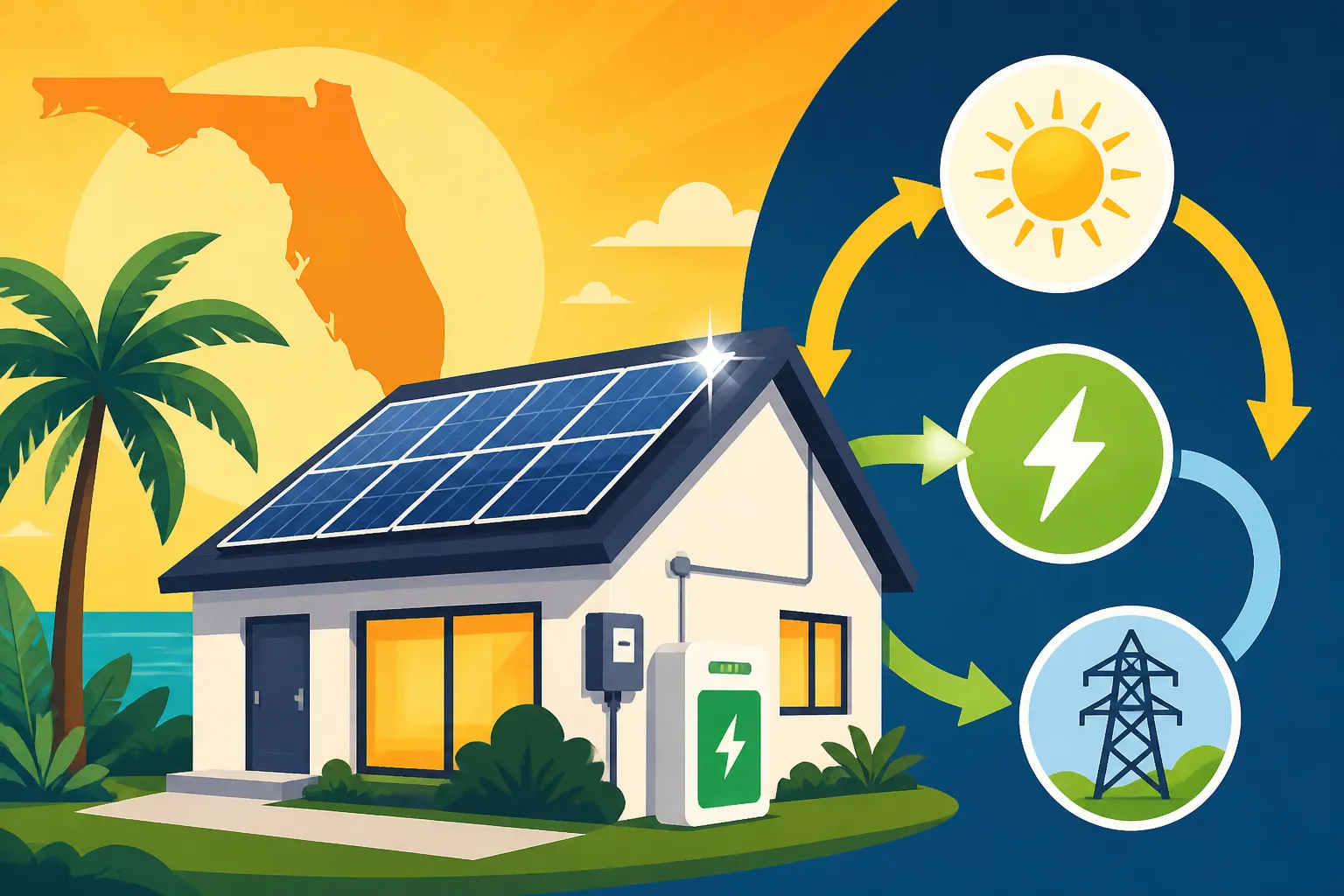
At its core, net metering is a billing arrangement that allows you to send excess electricity generated by your solar panels back to the grid. In exchange, the utility company gives you a credit on your bill. In Florida, the gold standard has always been "1:1 net metering." This means that for every kilowatt-hour (kWh) of solar energy you export to the grid, you receive a credit equal to the retail rate the utility would have charged you to buy that same kWh.
Think of the utility grid as a giant, communal battery. During the peak of a June afternoon, your panels are likely producing far more energy than your air conditioner and appliances can use. That extra power flows out through your meter and helps power your neighbor's house. Your meter literally spins backward (metaphorically, in the digital age), and you bank those credits. When the sun goes down and you’re running the dishwasher or the TV, you pull energy back from the grid, using up those banked credits first. It is a fair, simple system that has been the backbone of the solar movement here. You can learn more about how this compares to other regions in our guide on Net Metering Explained: How It Works by State.
Why 2026 is a Crucial Year for Florida Homeowners
The reason we are talking so much about 2026 is because of the narrow misses we’ve had with legislative changes. Back in 2022, a major bill attempted to phase out 1:1 net metering, which would have significantly extended the Solar Panel Payback Period Explained. While that bill was ultimately vetoed, the conversation hasn't stopped. Utility companies continue to lobby for "fixed charges" and "delivery fees" to offset the revenue they lose when you generate your own power.
In 2026, the rules remain favorable, but there is a sense of "get it while it’s good." Homeowners who lock in their net metering agreements now are often "grandfathered" into current rates for decades, even if the state decides to change the rules for new customers later. This makes the timing of your installation critical. If you are just starting your research, using a service like Modernize can help you connect with local professionals who understand the specific permit requirements in your county, whether you’re in Miami-Dade or the Panhandle.
How Net Metering Actually Works With Major Florida Utilities
Florida’s solar rules aren't just decided in Tallahassee; they are implemented differently depending on who sends you a bill every month. While the Public Service Commission (PSC) sets the broad rules, the "Big Three" investor-owned utilities—Florida Power & Light (FPL), Duke Energy, and Tampa Electric Company (TECO)—each have their own nuances.
Florida Power & Light and Net Metering
FPL is the largest utility in the state, and their approach to solar is often the benchmark for everyone else. For FPL customers, net metering remains 1:1. However, FPL has been a leader in implementing "minimum bills." Even if your solar panels produce 100% of the energy you use in a month, you will still see a minimum charge on your bill—typically around $30. This charge is designed to cover the cost of maintaining the wires, poles, and infrastructure that keep you connected to the grid.
When you're looking at Florida Solar Incentives in 2026, it's important to factor this minimum bill into your ROI calculations. You won't ever get a "$0 bill" in the literal sense, but you can certainly get a "negative" energy charge that offsets the energy portion of your bill entirely. FPL also requires a specific interconnection agreement, and for larger systems (Tier 2), you may be required to carry a personal liability insurance policy, which adds a small annual cost to your setup.
Duke Energy and TECO Policies
Duke Energy customers in the Orlando and St. Petersburg areas, as well as TECO customers in Tampa, face similar structures. Duke has been particularly active in exploring "time-of-use" rates, which can complicate net metering. In a time-of-use scenario, the credits you earn might be worth more during the middle of the day and less at night. Fortunately, for most residential solar users in 2026, standard 1:1 net metering is still the default.
The application process for Duke and TECO is relatively streamlined, but "Permission to Operate" (PTO) can still take several weeks after your panels are physically on the roof. During this waiting period, you might see your panels producing power, but you won't get credit for the export until the utility swaps out your meter for a bidirectional one. Understanding What Is Permission to Operate (PTO) is essential so you don't get frustrated when your first bill after installation doesn't show the savings you expected.
Navigating the Financials: Fees Credits and ROIs
The math of solar in Florida has changed slightly because of how utilities handle year-end balances. It is not just about what you save this month; it is about how those credits carry over through the seasons. In Florida, our "low" energy months are usually the shoulder seasons—March, April, October, and November—when the AC isn't fighting the humidity 24/7.
| Utility Feature | Florida Power & Light (FPL) | Duke Energy Florida | Tampa Electric (TECO) |
|---|---|---|---|
| Net Metering Ratio | 1:1 Retail Rate | 1:1 Retail Rate | 1:1 Retail Rate |
| Monthly Minimum Bill | ~$30.00 | ~$30.00 | Varies by Rate Class |
| Credit Rollover | Monthly | Monthly | Monthly |
| Annual Payout Rate | Avoided-Cost Rate | Avoided-Cost Rate | Avoided-Cost Rate |
| Insurance Required? | Only for Tier 2 (>10kW) | Only for Tier 2 (>10kW) | Only for Tier 2 (>10kW) |
Fixed Monthly Charges and Minimum Bills
The "minimum bill" is the most common point of confusion for Florida homeowners. It’s a flat fee that ensures the utility stays profitable even if you are totally energy-independent. While it feels like a penalty for doing the right thing, it's actually a compromise that has kept the 1:1 net metering rules alive. Without these fees, the utilities argue that non-solar customers are subsidizing the grid for solar owners.
When you get quotes through Modernize, ask the installers to show you a "post-solar" bill estimate that includes these fixed charges. A transparent installer will show you that while your $250 bill might drop to $30, it rarely disappears entirely. This transparency is vital for accurately calculating How Much Can You Save With Solar Panels.
Rollover Credits and Annual Payouts
What happens if you produce more than you use for an entire year? This is where the "Annual True-Up" comes in. In Florida, your excess credits roll over from month to month. If you build up a massive credit in the sunny spring, you can use it to offset the heavy AC usage in August. However, at the end of the calendar year, if you still have a surplus, the utility will "buy" those credits back from you.
The catch? They don't pay you the retail rate for those surplus credits at the end of the year. Instead, they pay you the "avoided-cost rate," which is much lower—usually only a few cents per kWh. This is why "oversizing" your solar system too much doesn't always make sense financially. You want to aim for 100% offset, not 120%, because the return on that extra 20% is significantly lower. You can find more details on this in our article on Avoided-Cost Rate & Export Credits Explained.
Maximizing Your Solar Investment in 2026
To get the most out of Florida Solar Incentives in 2026, you have to look beyond just the panels. The landscape is shifting toward a more integrated home energy strategy. With utility rates in Florida projected to continue their upward trend, the goal is to reduce your reliance on the grid as much as possible while still taking advantage of net metering.
The Role of Solar Batteries in a Post NEM World
While we still have 1:1 net metering, many Floridians are opting to add a battery like the Tesla Powerwall or Enphase IQ Battery. In other states, batteries are used to avoid "Net Billing" traps, but in Florida, the primary driver is hurricane resiliency. When a storm knocks out the grid, a standard solar system shuts down for safety. With a battery, you can keep your lights and fridge running.
Furthermore, a battery allows for "self-consumption." You can store your midday solar energy and use it at night instead of sending it to the grid. This protects you if the state ever decides to reduce the net metering credit value in the future. If you’re curious about the costs, check out our breakdown of Solar Battery Incentives in 2026. Modernize can also help you find installers who specialize in whole-home backup systems, which are increasingly popular in flood-prone areas.
Choosing the Right Installation Partner
Because Florida’s net metering rules are tied to the specific interconnection agreement you sign with your utility, the paperwork matters as much as the panels. A mistake in your Tier 1 vs. Tier 2 application can delay your savings by months. You want an installer who has a dedicated permitting department and deep experience with FPL, Duke, or your local co-op.
Don't be afraid to ask tough questions about Solar Panel Warranties Explained and how they handle the utility interconnection process. Using a platform like Modernize allows you to compare multiple vetted pros at once, ensuring you aren't just getting a sales pitch, but a realistic financial projection based on current 2026 net metering rates. If you're wondering about the overall value, read our analysis on Are Solar Panels Worth It in 2026.
Florida Solar Property and Sales Tax Exemptions
In addition to net metering, Florida offers two major "hidden" incentives that make the state one of the best for solar. First is the Solar Sales Tax Exemption. You don't pay the 6% state sales tax on your solar equipment. On a $20,000 system, that’s an immediate $1,200 savings. Second is the Solar Property Tax Exemption. While solar panels definitely increase the value of your home, Florida law prevents that added value from being included in your property tax assessment.
These two policies, combined with 1:1 net metering, create a very friendly environment for homeowners. Even without a state income tax credit, the total "stack" of incentives—including the remaining federal benefits discussed in Federal Solar Incentives That Still Exist in 2026—makes the financial case for solar in Florida very strong. Whether you are in Jacksonville or Naples, the combination of high sun exposure and these legislative protections means your Solar Panel Payback Period Explained is often shorter than the national average.
Disclaimer
This guide is for informational purposes only and does not constitute financial, legal, or tax advice. Solar policies, including net metering rules and utility rates, are subject to change by the Florida Public Service Commission and state legislature. Always consult with a qualified solar professional and a tax advisor to understand how current laws apply to your specific situation.