Which Solar Inverter Is Best for My System?
Deciding to go solar is a huge step, and it's exciting to imagine a future with lower electricity bills and a smaller carbon footprint. But then you start looking into the actual equipment, and suddenly you’re bombarded with terms like "string inverters," "microinverters," and "power optimizers." It can feel overwhelming, like you need an electrical engineering degree just to understand what powers your home. This guide is here to demystify solar inverters, helping you understand their role and confidently choose the best one for your unique home solar system.
The Heart of Your Solar System: What Is a Solar Inverter?
You've heard that solar panels convert sunlight into electricity, right? Well, that's true, but there's a crucial step in between the panels and your home's outlets: the inverter. Solar panels produce direct current (DC) electricity, which is the same kind of power found in batteries. Your home, however, runs on alternating current (AC) electricity, the standard for all your appliances, lights, and devices. The solar inverter is the unsung hero that takes that DC power from your panels and transforms it into usable AC power for your home. Without it, your solar panels would be generating power that your home simply couldn't use.
Why Inverters Are So Important Beyond Conversion
It's not just about flipping DC to AC. Modern solar inverters do so much more. Think of them as the brain of your solar energy system, constantly monitoring, optimizing, and communicating. They ensure your panels are operating at their peak efficiency, even when conditions aren't perfect, and they provide vital data about your system's performance.
For instance, a good inverter system will detect if one panel is underperforming due to shade or debris and try to compensate. It's also the gateway to understanding your energy production, often allowing you to track how much electricity your panels are generating in real-time via an app on your phone. This level of insight is invaluable for maximizing your savings and ensuring your system is always pulling its weight. Many homeowners get frustrated when they hear about their panels not performing, but without a good inverter system, they'd have no idea why.
Safety Features and Grid Connection
Beyond efficiency and monitoring, inverters play a critical safety role. They ensure that your system safely connects and disconnects from the utility grid. If there's a power outage, for example, the inverter will automatically shut down your solar production to prevent backfeeding electricity onto the grid, which could endanger utility workers. This is why when the grid goes down, even if the sun is shining, your grid-tied solar panels won't produce power unless you have a battery backup system. You might be wondering, "Do Solar Panels Work During a Power Outage?" The answer depends heavily on your inverter and whether you have a battery integrated.
The inverter is also responsible for meeting specific utility and electrical code requirements, ensuring your system operates safely and reliably within the broader electrical infrastructure. This compliance is essential for getting that all-important "Permission to Operate (PTO)" from your utility company.
Understanding the Main Types of Solar Inverters
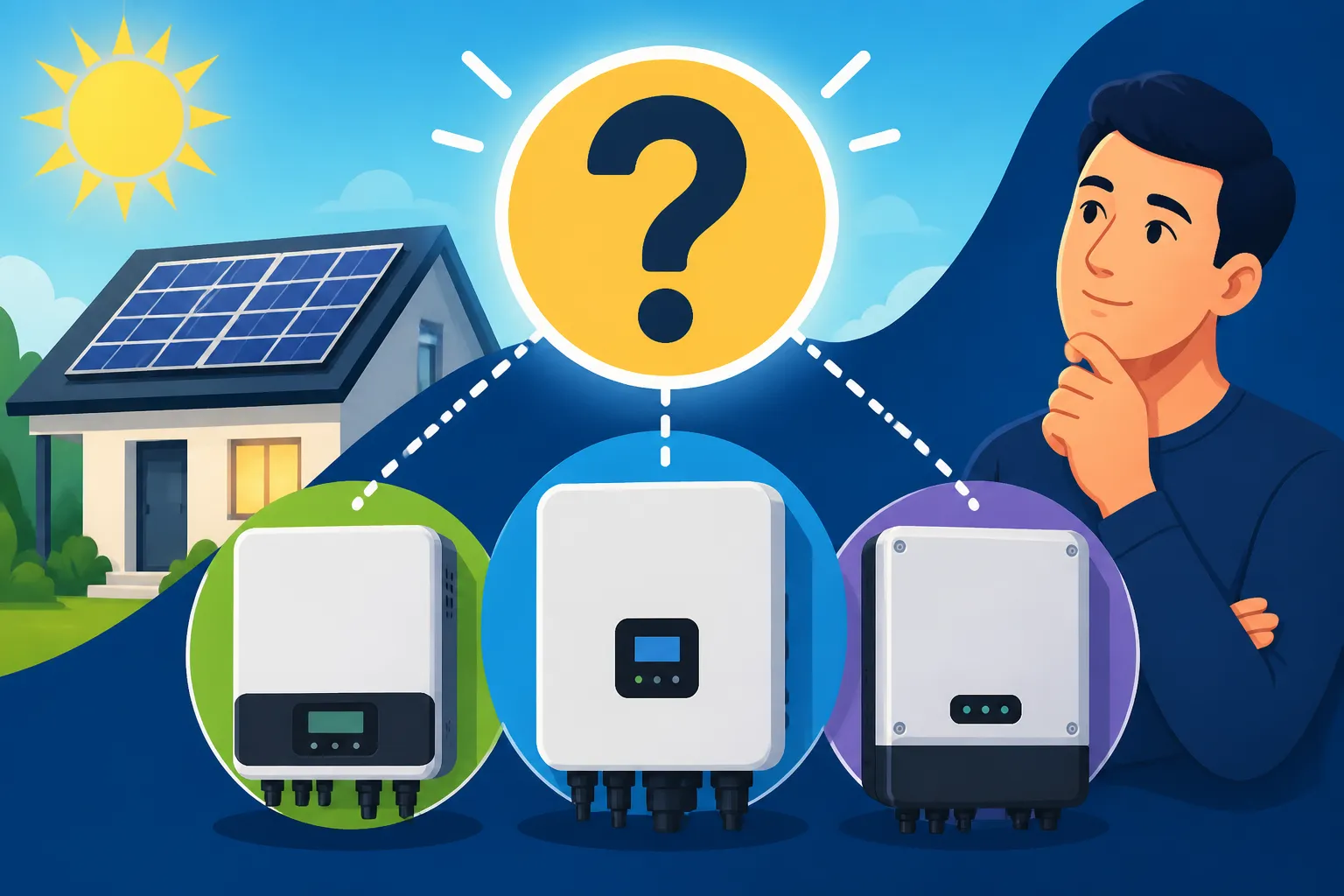
When you start getting quotes from solar installers, you'll primarily hear about three main types of inverters: string inverters, microinverters, and power optimizers. Each has its own way of doing things, and what’s best for your neighbor might not be what's best for your home. Let's break down the differences so you can understand the pros and cons of each.
String Inverters
String inverters are what most people think of as the traditional solar inverter. With a string inverter, multiple solar panels are wired together in a "string," and all the DC power from that entire string flows to a single central inverter, usually located near your electrical panel or outside your house. This inverter then converts all that DC power into AC power.
How String Inverters Work and Their Ideal Use Cases
Imagine a series of Christmas lights where if one bulb goes out, the whole string goes dark. A string inverter system operates similarly, though not quite as extreme. If one panel in a string is shaded or dirty, it can reduce the output of all the panels in that string to the level of the weakest panel. This is often called the "Christmas light effect."
However, string inverters are very reliable and typically less expensive upfront compared to other options. They're a fantastic choice for homes with a straightforward roof design that gets consistent, unobstructed sunlight throughout the day. If your roof has a large, unshaded, south-facing plane, a string inverter can be a very cost-effective and efficient solution. Many homes in sunny, open areas of Arizona or Nevada, for example, might find string inverters perfectly adequate.
Advantages and Disadvantages of String Inverters
The biggest advantage of string inverters is their lower cost and simpler installation, which can lead to a quicker Solar Panel Payback Period Explained. They also tend to have a longer track record in the industry, and many electricians are very familiar with their setup. They're often easier to troubleshoot if an issue arises, as there's only one main unit to inspect.
The primary disadvantage, as mentioned, is the "Christmas light effect." If even a small portion of your roof is shaded at certain times of the day – perhaps by a chimney, a dormer, or a nearby tree – that shading can significantly reduce the output of an entire string of panels. Another drawback is that monitoring is typically done at the system level, meaning you might see your total production but not necessarily how each individual panel is performing. This can make it harder to pinpoint specific panel issues.
Microinverters
Microinverters represent a more advanced approach to solar power conversion. Instead of one central inverter for a whole string of panels, each individual solar panel gets its own small inverter, mounted directly underneath it on the roof. Each microinverter converts the DC power from its specific panel into AC power right at the panel level.
Individual Panel Optimization with Microinverters
This individual conversion is the game-changer. Because each panel operates independently, if one panel is shaded, dirty, or simply underperforming, it doesn't affect the output of any other panel in your system. Each panel is optimized to produce its maximum possible power at all times. This means if you have a complex roof with multiple angles, varying sun exposure throughout the day, or persistent shading from trees or other structures, microinverters can significantly boost your overall system efficiency. Companies like Enphase are leading the charge in this technology.
Imagine a system where every light bulb has its own power source; if one goes out, all the others stay bright. That's essentially how microinverters work. They are excellent for homes where consistent, individual panel performance is critical. Homeowners in states like California, with varied rooflines and potential shading, often benefit greatly from microinverter systems, especially given the complexities of programs like What Is NEM 3.0 (California Net Billing)? where every watt of exported power counts.
Pros and Cons of Microinverters
The key advantages of microinverters are maximum power production, especially in shaded conditions, and enhanced system monitoring. With microinverters, you can typically monitor the performance of each individual panel, allowing you to easily identify and troubleshoot issues like a dirty panel or a failing unit. They also offer greater flexibility for system expansion; you can add more panels later without having to worry about compatibility with a central inverter's capacity. Furthermore, because DC voltage is converted to AC right on the roof, there's no high-voltage DC running through your home, which some consider a safety benefit.
The main downside of microinverters is their higher upfront cost. Because you need one for every panel, the equipment cost is generally greater than a single string inverter. Installation can also be slightly more complex due to wiring each individual unit. While reliability is high, if a microinverter does fail, it requires someone to get on the roof to replace it.
Power Optimizers
Power optimizers offer a hybrid solution, combining some of the benefits of both string inverters and microinverters. Like microinverters, power optimizers are installed on each individual solar panel. However, instead of converting DC to AC at the panel, they "condition" or optimize the DC power from each panel and then send that optimized DC power to a single, central string inverter, which then converts it to AC.
The Best of Both Worlds: Optimization with Central Inversion
Power optimizers are designed to ensure that each panel operates at its peak power point, even if some panels are shaded or performing differently. So, if one panel on your roof is experiencing shade from a nearby vent, the power optimizer ensures that it doesn't drag down the performance of the entire string. It isolates the impact of that underperforming panel, sending optimized DC power to the string inverter. This allows for individual panel performance optimization without the higher cost of full DC-to-AC conversion at each panel. Brands like SolarEdge are very prominent in the power optimizer market, often pairing their optimizers with their own central inverters.
This setup is particularly effective for roofs with moderate shading or where individual panel monitoring is desired but the budget for full microinverters isn't there. It also offers more flexibility than a traditional string inverter in terms of system design, allowing for panels on different roof planes or with varying orientations.
Power Optimizer Strengths and Weaknesses
The main strength of power optimizers is their ability to mitigate the effects of shading and panel mismatch, leading to higher overall system efficiency than a traditional string inverter, often at a lower cost than a full microinverter system. They also provide individual panel monitoring, similar to microinverters. This granular data helps homeowners track performance and quickly identify issues. They are also generally considered safer than traditional string inverter systems because optimizers often include rapid shutdown capabilities that reduce high DC voltage quickly during emergencies.
On the other hand, while generally less expensive than microinverters, they are still more costly than a basic string inverter system. They involve more components on the roof than a string inverter system (one optimizer per panel), which could potentially mean more points of failure, though modern optimizers are extremely reliable. The central inverter still remains a single point of failure for the entire system, unlike microinverter systems where if one microinverter fails, only that single panel's production is affected.
Comparison Table: Inverter Types at a Glance
To help you visualize the differences, here's a quick comparison of the three main inverter types:
| Feature | String Inverter | Microinverter | Power Optimizer |
|---|---|---|---|
| Conversion | DC to AC at central unit | DC to AC at each panel | DC optimized at panel, then DC to AC at central unit |
| Shading Impact | Significant reduction for entire string | Minimal, each panel optimized independently | Minimal, each panel optimized independently |
| Monitoring | System-level | Individual panel-level | Individual panel-level |
| Cost | Lowest upfront | Highest upfront | Moderate upfront |
| Installation | Simplest | More complex, more roof wiring | Moderate complexity |
| Expandability | Limited by central inverter capacity | High, can add panels easily | Moderate, depends on central inverter |
| Safety | High-voltage DC lines from roof | Low-voltage AC lines from roof | Rapid shutdown capabilities, optimized DC |
| Best For | Simple, unshaded roofs | Complex roofs, heavy shading, granular monitoring | Moderate shading, desire for individual monitoring at lower cost than microinverters |
Key Factors to Consider When Choosing Your Solar Inverter
Now that you understand the main types, how do you decide Which Solar Inverter Is Best for My System?? It's not a one-size-fits-all answer. Several crucial factors come into play when making this decision, impacting your system's performance, cost, and long-term satisfaction.
Roof Characteristics and Shading Assessment
Your roof is the most important factor. Is it a sprawling, unobstructed expanse, or does it have multiple peaks, valleys, and dormers? Are there tall trees, chimneys, or neighboring buildings that cast shadows during different times of the day or year?
Unshaded vs. Shaded Roofs
If your roof gets direct, consistent sunlight from sunrise to sunset with absolutely no obstructions, a string inverter is often the most economical and perfectly sufficient choice. Why pay more for optimization features you don't truly need? However, this ideal scenario is quite rare for many homeowners. Most roofs have at least some shading, even if it's just from a vent or a small tree branch at certain times.
For any roof with any amount of shading – whether it's intermittent, seasonal, or constantly present – microinverters or power optimizers are almost always the superior choice. The performance gains from individual panel optimization will far outweigh the increased upfront cost in the long run. Even a little bit of shade can drastically reduce the output of an entire string inverter system, essentially "choking" its potential. An installer should perform a detailed shading analysis during your site survey to help you understand your roof's unique sun exposure.
Roof Aesthetics and Panel Placement
Some homeowners are also concerned with the aesthetics of their solar system. While this primarily relates to the panels themselves, the choice of inverter can subtly affect it. Microinverters and power optimizers are mounted directly under each panel, making them virtually invisible from the ground. A string inverter, on the other hand, is a larger box usually mounted on an exterior wall or in a garage. While typically not an eyesore, it is a visible component of your system. If your roof has multiple facets or difficult angles, microinverters or optimizers offer greater flexibility in placing panels because each can perform optimally regardless of its neighbor's orientation. This means you can maximize the number of panels and, therefore, your energy production, even on challenging roofs.
Budget and Long-Term Savings
Let's be real, the initial cost is always a big consideration. String inverters generally have the lowest upfront cost. Microinverters are at the higher end, with power optimizers falling somewhere in the middle. However, it's crucial to look beyond just the initial price tag and consider the long-term savings and return on investment.
Upfront Costs vs. Efficiency Gains
While microinverters and power optimizers cost more initially, their ability to maximize individual panel output, especially on shaded or complex roofs, can lead to significantly higher electricity production over the system's lifetime. This increased production translates directly into greater savings on your electricity bills, potentially shortening your Solar Panel Payback Period Explained and boosting your overall Solar ROI & 25-Year Savings Breakdown. For example, if a microinverter system costs 10-15% more upfront but produces 20-30% more energy over 25 years due to superior shade mitigation, it's clearly the better financial choice. Don't let a slightly higher quote deter you without fully understanding the projected energy output.
Moreover, if you're looking to purchase smaller components or monitoring accessories, sites like Amazon can offer competitive pricing on complementary smart home energy devices that integrate with your inverter's data, helping you track savings even more granularly.
Warranty and Reliability
Inverter warranties vary significantly. String inverters often come with a 10-12 year warranty, while microinverters and power optimizers typically boast longer warranties, often 20-25 years, aligning more closely with the solar panels' lifespan. A longer warranty provides peace of mind and reduces the risk of unexpected replacement costs down the road. Consider the manufacturer's reputation and financial stability too. You want a company that will be around to honor its warranty if needed. Investing in high-quality components from reputable brands is always a smart move for long-term reliability.
Monitoring and Future Expandability
How important is it for you to see exactly how much electricity each individual panel is producing? And do you foresee wanting to add more panels or a battery storage system down the line?
Granular Monitoring and Troubleshooting
Microinverters and power optimizers offer sophisticated, panel-level monitoring, allowing you to track the performance of each individual panel in real-time. This level of detail is invaluable for quickly identifying and addressing any issues, like a dirty panel or a faulty component. You can see precisely which panel might be underperforming and why. A homeowner in New York City with a rooftop garden might appreciate knowing if a growing plant is starting to shade a specific panel, allowing them to trim it before it significantly impacts production. String inverters typically provide system-level monitoring, which is fine for overall production tracking but less helpful for pinpointing specific panel problems.
Planning for Growth: Batteries and Additional Panels
If you're considering adding a solar battery in the future (perhaps a Tesla Powerwall or an Enphase IQ Battery), or if you anticipate expanding your solar array, your inverter choice matters. Many modern inverter systems are designed to integrate seamlessly with battery storage, making the transition much smoother. Inverter systems that are modular, like those using microinverters, make it incredibly easy to add more panels incrementally without having to replace your central inverter. This is a significant advantage if your energy needs grow over time or if you initially installed a smaller system due to budget constraints. Always ask your installer about the inverter's compatibility with future battery additions and system expansion.
Matching Your Inverter to Your Home's Unique Needs
The perfect inverter doesn't exist; there's only the perfect inverter for your specific situation. Taking into account your home's characteristics, your budget, and your long-term goals is key to making the right choice.
The Unshaded, Simple Roof Scenario
Let's say you live in a newer home in a sprawling suburb of Phoenix, Arizona. Your roof is a large, single-plane expanse, perfectly pitched for solar, and there are no trees or buildings anywhere near it. You've done a How Many Solar Panels Do I Need for My Home? calculation, and it's a straightforward system. In this ideal scenario, a string inverter is often the most cost-effective and perfectly efficient choice. It's a proven technology, simpler to install, and given the lack of shading issues, you won't benefit significantly from the individual panel optimization offered by microinverters or power optimizers. The lower upfront cost means you'll hit your Solar Panel Payback Period Explained faster.
However, even in this scenario, if you highly value individual panel monitoring or want the absolute best flexibility for future expansion, a power optimizer system could still be a viable, slightly more expensive option that offers those benefits.
The Complex, Shaded, or Growing Household Scenario
Now, imagine you own a charming, older home in the rolling hills of Massachusetts. Your roof has multiple gables, a couple of skylights, and a beautiful, mature oak tree that shades a portion of the roof for a few hours in the late afternoon. You're also considering adding an electric vehicle in a few years, which will increase your energy consumption.
In this situation, opting for microinverters or power optimizers becomes almost essential. The individual panel optimization will ensure that even when a few panels are shaded by that oak tree, the rest of your system continues to produce at its maximum capacity. You won't suffer a significant system-wide dip in production. The panel-level monitoring will also be incredibly useful for you to keep an eye on how well each section of your system is performing, especially with the changing seasons and tree growth.
Furthermore, if you plan to expand your system for an EV charger, the modularity of microinverter-based systems like those from Enphase will make adding a few more panels much simpler than trying to upgrade a string inverter. This scenario highlights why many homeowners find value in systems that are optimized for complex realities.
The Role of Installer Recommendations
Ultimately, your solar installer will be your primary guide. Reputable installers work with a variety of inverter technologies and can recommend the best fit based on a thorough assessment of your home, your energy needs, and your budget. They should be able to articulate why they are recommending a particular inverter type over another. Don't be afraid to ask detailed questions about efficiency, warranties, and potential issues with shading.
Remember to How to Compare Solar Installer Quotes and ensure that the quotes clearly specify the inverter type and brand. Some installers might have preferred brands like SolarEdge for optimizers or Enphase for microinverters, and they can often get better pricing or have more specialized expertise with those systems. It's always a good idea to gather multiple quotes to get a comprehensive view of your options and pricing, ensuring you're making an informed decision that will serve your home for decades to come.
Disclaimer
The information provided in this article is for general informational purposes only and does not constitute professional financial, tax, or energy advice. Solar technology, incentives, and regulations can change rapidly. Always consult with qualified solar professionals, financial advisors, and relevant authorities to discuss your specific situation and make informed decisions.