How Much Does Panel Efficiency Matter for a Small Roof?
It's a common dilemma for homeowners with smaller roofs: you want to go solar, embrace renewable energy, and slash those ever-rising electricity bills, but you look up at your limited roof space and wonder, "Is it even worth it for me?" You might feel like you’re at a disadvantage compared to neighbors with vast, unobstructed rooflines. This guide is here to tell you that solar is absolutely still a viable option, and we'll dive deep into why solar panel efficiency becomes a critical factor for maximizing your energy production when roof space is at a premium.
Why Small Roofs Demand Strategic Solar Planning
Having a smaller roof doesn't automatically disqualify you from harnessing the sun's power, but it does mean you need to be a bit more strategic about your solar setup. Unlike larger homes where installers might have abundant space to spread out standard panels, a compact roof requires careful consideration of every square foot. This isn't just about fitting panels; it's about getting the most bang for your buck and ensuring your investment truly makes a difference in your energy consumption.
The Realities of Limited Space for Solar
When your roof space is limited, you're immediately faced with a few challenges. There might be less available area free from obstructions like chimneys, vents, skylights, or even shaded spots from nearby trees or taller structures. This means you can't just throw up any number of panels; you have to pick and choose. The goal shifts from simply installing some solar panels to installing the most productive solar panels possible within your constraints. It's like trying to pack for a long trip in a small suitcase – every item has to be the most essential and efficient.
Imagine living in a historic row house in Boston, or a charming bungalow in San Diego, where rooflines are often narrower or broken up. These aren't vast suburban expanses, and every inch counts. This is where the concept of solar panel efficiency really shines, quite literally. It determines how much electricity you can squeeze out of a given panel size, which directly translates to how much power your entire, smaller system can generate.
Understanding Solar Panel Efficiency Ratings
So, what exactly is solar panel efficiency, and why does it matter so much for a modest roof? At its core, efficiency refers to how effectively a solar panel converts the sunlight hitting its surface into usable electricity. It's expressed as a percentage. For instance, a 20% efficient panel means that 20% of the solar energy striking it is converted into electricity, while the rest is lost as heat or reflected away.
The higher that percentage, the more power a panel can generate from the same amount of sunlight and, crucially for small roofs, from the same physical footprint. This metric isn't just a marketing gimmick; it's a fundamental performance indicator. For those constrained by space, understanding and prioritizing higher efficiency panels becomes paramount. Without diving too deep into the nitty-gritty, newer technologies like TOPCon and HJT cells are pushing these efficiencies higher than ever, offering homeowners more power from fewer panels. To learn more about how panels convert sunlight, you might want to read our guide on Solar Panel Efficiency & Degradation Explained.
The Critical Role of High-Efficiency Panels on Smaller Roofs
For homes with limited roof real estate, solar panel efficiency isn't just a bonus; it's a necessity. It’s the difference between a system that barely offsets your energy needs and one that significantly reduces or even eliminates your electricity bill. Every percentage point in efficiency can translate to meaningful increases in kilowatt-hours generated over the lifetime of your system.
Maximizing Wattage per Square Foot
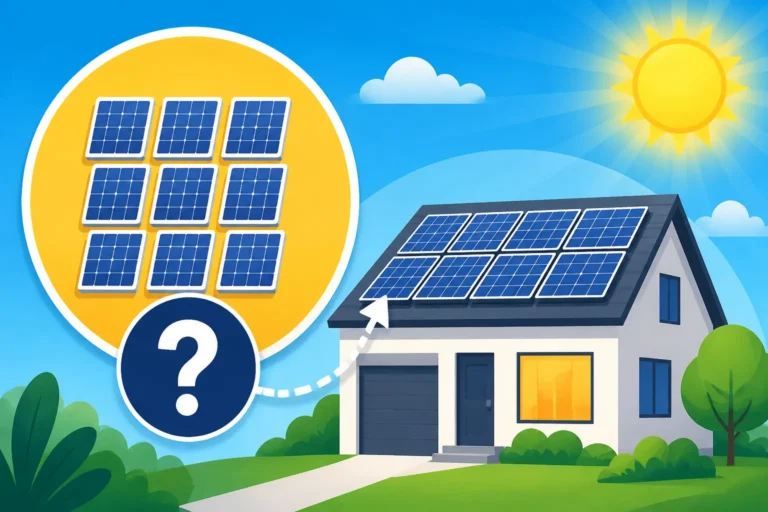
Consider two solar panels of the exact same physical dimensions. If one panel has an efficiency of 19% and another has an efficiency of 22%, the 22% efficient panel will produce more wattage under identical sunlight conditions. On a small roof, where you might only be able to fit, say, 10 panels, those extra watts per panel really add up.
Let's do a quick comparison. Imagine you have space for 10 standard-sized solar panels (roughly 65 inches by 39 inches, or about 17.5 square feet per panel).
- Scenario 1: Standard Efficiency Panels (e.g., 19% efficient, 360W per panel)
- Total system size: 10 panels * 360W/panel = 3,600 Watts (3.6 kW)
- Scenario 2: High Efficiency Panels (e.g., 22% efficient, 400W per panel)
- Total system size: 10 panels * 400W/panel = 4,000 Watts (4.0 kW)
That 0.4 kW difference might seem small on paper, but over a year of sunshine, it translates to hundreds of extra kilowatt-hours of electricity. If your annual usage is, for example, 8,000 kWh, that extra 400 watts from your higher-efficiency system could be the difference between offsetting 45% and 50% of your bill. For a more detailed look at system sizing, check out How Many Solar Panels Do I Need for My Home?.
The Cost-Benefit Analysis of Efficiency
It's true that higher-efficiency solar panels often come with a higher upfront cost per panel. Brands like Maxeon (SunPower) and REC are known for their premium efficiency and often carry a higher price tag. This is where the cost-benefit analysis becomes crucial for homeowners with small roofs. You might pay a bit more per panel initially, but if those panels enable you to generate significantly more electricity in your limited space, the long-term savings can outweigh the added expense.
Think about it this way: if a higher efficiency panel allows you to achieve your desired energy offset with 8 panels instead of 10, you might save on installation costs (fewer mounting points, less labor) and potentially maximize your system's overall value. However, it's not always a linear relationship. Sometimes, slightly less efficient panels at a much lower price point can still offer a better return on investment if you have just enough space for them. It's about finding that sweet spot. When you're comparing quotes, always look at the Solar Panel Cost Per Watt Explained to get a true apples-to-apples comparison.
Comparing Panel Output in Limited Space
To illustrate the impact of efficiency, let's look at how much power different panels might produce from a fixed area, assuming a consistent panel size.
| Panel Efficiency | Typical Wattage (Standard Panel, e.g., 1.7m²) | Estimated Total Output (for 10 panels) | Approximate Annual Generation (Sunny Climate) |
|---|---|---|---|
| 19% | 360 W | 3.6 kW | ~4,700 kWh |
| 20% | 380 W | 3.8 kW | ~4,950 kWh |
| 21% | 400 W | 4.0 kW | ~5,200 kWh |
| 22% | 420 W | 4.2 kW | ~5,450 kWh |
| 23% | 440 W | 4.4 kW | ~5,700 kWh |
Note: Annual generation estimates are highly dependent on local climate, shading, and system tilt/orientation. This table is for illustrative purposes only to show the relative difference in output.
As you can see, even a few percentage points in efficiency can make a substantial difference in the total power generated, which is exactly what homeowners with smaller roofs need. The goal isn't just to install any solar; it's to install the most effective solar.
Beyond Raw Efficiency: Optimizing Solar for Compact Roofs
While panel efficiency is undoubtedly important, it’s not the only piece of the puzzle for small roof solar success. A truly optimized system for limited space involves smart design choices, advanced inverter technology, and an understanding of local conditions. You're trying to get maximum output from minimum footprint, and that often means a holistic approach.
Smart System Design and Component Choices
On a smaller roof, every aspect of your solar array needs to be carefully considered. This includes the physical dimensions of the panels themselves. While most residential panels are similar in size, some manufacturers offer slightly more compact or uniquely shaped panels that might fit into awkward spaces better. Don't be afraid to ask your installer about these options.
Furthermore, the type of inverter technology you choose can play a huge role. For small roofs, especially those prone to partial shading at different times of the day, microinverters or power optimizers are often highly recommended. Traditional string inverters can have their entire string's output reduced to the lowest-performing panel, which is devastating if even one panel on your small roof is shaded. Microinverters, like those offered by Enphase, or power optimizers from companies like SolarEdge, allow each panel to operate independently. This means if one panel is shaded, the others continue to produce at their maximum potential. This is a game-changer for maximizing power on constrained or complex roof layouts. You can dive deeper into this topic by reading our comparison: Enphase vs SolarEdge: Which Inverter Is Better?.
Accounting for Shading and Orientation
Even with the most efficient panels and smartest inverters, shading remains the arch-nemesis of solar production. On a smaller roof, where panels might be crammed closer to chimneys, vents, or even parts of your own home, shading can be a persistent issue. A reputable solar installer will conduct a thorough site survey to map out potential shading throughout the year. They use specialized tools to model the sun's path and assess how much direct sunlight each potential panel location will receive.
Optimizing panel orientation and tilt also becomes more crucial. While a south-facing roof is generally ideal in the Northern Hemisphere, even an east or west-facing array can be highly effective, especially if designed with high-efficiency panels to capture morning or afternoon sun. The key is to work with an experienced professional who understands how to best utilize your specific roof geometry and sunlight exposure. For more insights on choosing the right professional, check out How to Choose a Solar Installer.
Navigating the Practicalities and Making the Best Decision
Deciding to go solar with a small roof requires a pragmatic approach, blending efficiency with affordability and expert guidance. It’s not just about picking the highest efficiency numbers you see; it’s about making a financially sound and environmentally responsible decision that truly works for your unique home.
Gathering Information and Getting Multiple Quotes
One of the most powerful tools at your disposal, especially with limited roof space, is information. Don't rely on a single sales pitch. Research solar panels and their efficiency ratings. You can often find detailed specifications for different brands on manufacturer websites or even through online retailers like Amazon, though you'll generally be buying a complete system from an installer. Familiarize yourself with top-tier brands known for efficiency, such as REC, Maxeon, and Qcells. Our article on the Best Solar Panels of 2026 can be a great starting point.
Crucially, always get at least three quotes from different solar installers. This allows you to compare not only the cost per watt but also the proposed system design, the types of panels and inverters suggested, and how each company plans to address the specific challenges of your small roof. A good installer will explain their reasoning for panel selection and system layout, emphasizing how they maximize production within your spatial limits. Don't be afraid to ask direct questions about panel efficiency, expected annual output, and the overall Solar Panel Payback Period Explained for your proposed system.
Leveraging Financial Incentives and Local Programs
Even if high-efficiency panels come with a slightly higher initial cost, don't forget the impact of solar incentives. The federal solar tax credit can significantly reduce your overall investment, and many states and even local utilities offer additional rebates, grants, or favorable net metering policies. For example, some utility companies might offer specific incentives for installing efficient equipment.
These incentives can dramatically improve the return on investment (ROI) for even a smaller, high-efficiency system, making the jump to solar more affordable than you might think. Be sure to explore all available options in your area, as they can vary widely. A great place to start is our comprehensive guide to State Solar Incentives: Complete 2026 Guide. Don't assume solar is out of reach just because your roof isn't massive; the financial landscape is designed to encourage adoption, and often these benefits are proportional to your system's output.
The Long-Term Perspective and Home Value
Ultimately, the decision to install solar panels on a smaller roof, prioritizing efficiency, is an investment in your home and your future. Highly efficient panels are often backed by strong warranties, promising performance over 25 years or more. This means reliable energy production and predictable savings for decades.
Furthermore, solar panels are increasingly seen as an asset that increases home value, particularly in competitive housing markets. Buyers are often willing to pay a premium for homes with existing solar arrays, especially if they are well-designed and efficient. Even on a small roof, a thoughtfully designed, high-efficiency system demonstrates a commitment to energy independence and lower utility costs, which is highly appealing. The peace of mind that comes from knowing you're generating your own clean power and reducing your carbon footprint is an invaluable benefit, regardless of roof size. So, yes, panel efficiency absolutely matters for a small roof – it's your key to unlocking maximum solar potential.
Disclaimer
The information provided in this article is for general informational purposes only and does not constitute professional advice. Solar system suitability, costs, savings, and available incentives can vary significantly based on location, individual energy consumption, roof characteristics, and prevailing policies. Always consult with qualified solar professionals and financial advisors before making any decisions related to solar energy installation.