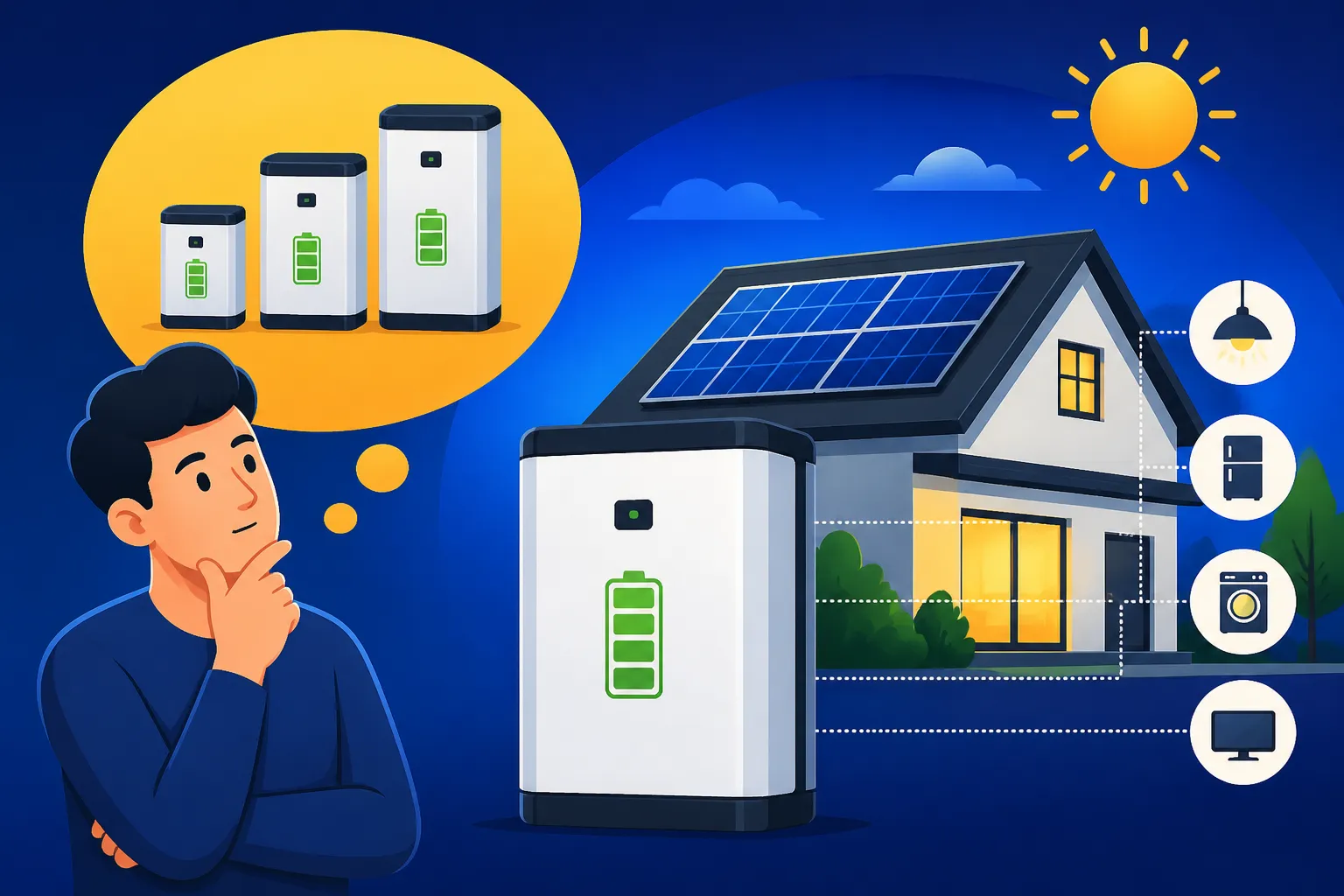
What Size Solar Battery Do I Need?
Deciding to go solar is a fantastic step toward energy independence, but then comes the often-overwhelming question: "What size solar battery do I really need?" It's easy to feel lost in a sea of kilowatt-hours and power ratings, worrying you'll either spend too much on capacity you don't use or, worse, be left in the dark during a critical outage because you didn't size it correctly. This comprehensive guide is here to walk you through everything you need to know to confidently determine the right solar battery size for your home and lifestyle.
Understanding Your Energy Needs for Battery Sizing
Before you even start looking at battery specs, the first and most crucial step is to get a really good handle on your own energy consumption habits. Think of it like buying a car – you wouldn't just pick one based on its color; you'd consider how many passengers you carry, how far you drive, and what kind of terrain you navigate. Your home's energy profile is just as unique, and understanding it is the foundation for smart battery sizing.
Daily Electricity Consumption: The Baseline
Your daily electricity consumption is the cornerstone of battery sizing. This isn't just a vague idea; it's a measurable quantity, usually expressed in kilowatt-hours (kWh) per day. Most utility bills will show your average daily or monthly usage. Digging into these past bills, especially over the last 12 months, gives you a clear picture of your energy footprint throughout different seasons. For instance, if you live in Phoenix, Arizona, your AC might be running non-stop in the summer, dramatically increasing your usage compared to milder spring or fall days. This seasonal variation is important to consider, as you'll want a battery that can handle your highest usage periods, or at least your most critical usage periods.
It's also worth noting that your historical usage directly influences how much solar production you’re aiming to offset. If you've already determined how many solar panels you need for your home, that calculation likely relied on this same consumption data. The battery essentially acts as a reservoir for any excess energy your panels produce that isn't immediately used by your home. The goal is to match that reservoir's capacity to how much excess you typically generate and how much you want to store for later.
Critical Loads vs. Whole-Home Backup: What to Prioritize
This is where the rubber meets the road. When the power goes out, what absolutely has to stay on? Are we talking about keeping the lights on and the refrigerator cold, or do you want your entire house, including your central air conditioning and electric oven, to function as normal? This distinction between "critical loads" and "whole-home backup" dramatically impacts the battery size you'll need. A critical loads approach focuses on essential appliances like your refrigerator, some lighting, medical devices, and Wi-Fi. This typically requires a smaller, more affordable battery system.
On the other hand, aiming for whole-home backup means you're looking to power everything, or almost everything, as if the grid never went down. This demands a significantly larger battery capacity, capable of handling higher peak demands and sustaining power for longer durations. For example, a home in a hurricane-prone area like Florida might lean towards whole-home backup for extended outages, while a homeowner in a region with only occasional, short-lived outages might be content with just critical load backup. Many battery systems, like the Enphase IQ Battery or Tesla Powerwall, offer flexibility to configure which circuits are backed up during an outage, allowing you to prioritize.
Peak Usage Habits and Time-of-Use Rates
Beyond just total daily consumption, when you use electricity matters, especially if your utility has time-of-use (TOU) rates. With TOU rates, electricity prices fluctuate throughout the day, often being much higher during "peak" hours (e.g., late afternoon to early evening) and lower during "off-peak" hours. This is a common strategy utilities use to encourage customers to shift their energy consumption. If you're subjected to these rates, a solar battery can be a game-changer for "time-of-use arbitrage."
Instead of sending your excess solar power back to the grid for a low credit during the day, your battery can store it. Then, during expensive peak hours when your solar production might be winding down, your home can draw power from the battery instead of the grid. This strategy can significantly reduce your electricity bill even if you never experience a power outage. The size of the battery will dictate how much of your peak usage you can offset, so understanding your household's peak demands – like when everyone comes home, turns on the TV, starts cooking, and runs the dishwasher – is essential for optimizing these savings.
Key Factors Influencing Solar Battery Size
It’s not just about how much energy you use; it’s also about how much your solar system produces, how your utility interacts with that production, and the technical specifications of the batteries themselves. These factors all intertwine to define the optimal battery size for your specific situation.
Battery Capacity and Power Output: The Numbers Game
When you see battery specifications, you'll encounter two primary numbers: capacity and power output.
- Capacity is measured in kilowatt-hours (kWh) and represents the total amount of energy the battery can store. Think of it as the size of the fuel tank. A 10 kWh battery can store 10 kilowatt-hours of electricity.
- Power output is measured in kilowatts (kW) and indicates how much electricity the battery can deliver at any given moment. This is like the engine's horsepower – it determines how many appliances can run simultaneously and how demanding those appliances can be.
A high-capacity battery with low power output might store a lot of energy but struggle to run energy-intensive appliances like an air conditioner or electric stove. Conversely, a battery with high power output but low capacity might run many things at once but only for a very short period. For example, a Tesla Powerwall 3 has a substantial capacity of 13.5 kWh and a continuous power output of 11.5 kW. In contrast, an Enphase IQ Battery 5P offers 5 kWh of capacity with 3.84 kW continuous power. You need to consider both numbers in conjunction with your specific needs. If you want to run your AC during an outage, you'll need sufficient power output, not just capacity.
Solar Panel System Size and Production
Your existing or planned solar panel system directly impacts how quickly your battery can charge and how much excess energy it has available to store. If you have a small solar array, it might not generate enough surplus energy to fully charge a very large battery, especially during periods of lower sunlight or high home consumption. Conversely, a large solar system paired with a small battery might mean you're still sending a lot of valuable energy back to the grid, missing out on potential savings or backup capacity.
The goal is to find a harmonious balance. A typical residential solar system might be 6 kW to 10 kW, potentially generating more power than your home uses during midday. This excess production is what charges your battery. If your system produces 8 kW, and your home is using 3 kW, you have 5 kW available to charge your battery. A larger battery can soak up more of this excess, but it needs sufficient solar production to do so efficiently. This interaction is critical for achieving optimal solar ROI and ensuring your battery is actually full when you need it most.
Local Net Metering Policies and Utility Programs
The rules your local utility has for solar owners, particularly regarding net metering, can significantly influence your battery sizing decision. Under traditional full retail net metering, your utility credits you at the same rate for the electricity you send back to the grid as they charge you for electricity you pull from it. In such a scenario, the financial incentive for a battery might be lower because you're already getting good value for your excess production. However, even with great net metering, a battery still provides invaluable backup during outages. You can learn more about how it works by state in our guide on Net Metering Explained: How It Works by State.
However, many states and utilities are shifting away from full retail net metering. California's NEM 3.0, for instance, significantly reduced the export credit rate, making solar batteries almost essential for maximizing savings. In these regions, a battery allows you to store your self-generated power and use it later, effectively "self-consuming" your solar energy rather than selling it back cheaply. Other programs, like virtual power plants (VPPs) offered by utilities or third-party aggregators, might even pay you to allow your battery to discharge to the grid during peak demand. Understanding these local policies is vital; they can shift a battery from a nice-to-have to a financial necessity.
Common Solar Battery Sizes and What They Power
Let's get practical. Instead of just numbers, let's talk about what different battery sizes actually mean for your day-to-day life and during a power outage. It can be hard to visualize 10 kWh or 20 kWh, so thinking in terms of what appliances they can run, and for how long, makes the decision much clearer.
Small Systems: Essential Backup (e.g., 5-10 kWh)
A smaller solar battery system, typically in the 5-10 kWh range, is perfectly suited for homeowners primarily looking for essential backup during short to moderate power outages, or those seeking to shave off a bit from their peak usage bills without a massive upfront investment. Think of it as the reliable emergency kit for your home.
With a 5-10 kWh battery, you can generally expect to power your critical loads for anywhere from 8 to 24 hours, depending on your actual consumption during an outage. This often includes:
- Your refrigerator and freezer, keeping food fresh.
- Essential lighting in key rooms.
- Your internet router and charging ports for phones and laptops.
- A well pump, if you rely on one.
- A few small appliances like a microwave or coffee maker for short bursts.
For instance, a single Tesla Powerwall 3 (13.5 kWh usable capacity) or two Enphase IQ Battery 5P units (10 kWh usable capacity total) would fall into this category. These systems are popular in areas with infrequent outages or for homeowners who want peace of mind without overspending. They are also excellent for houses with moderate energy consumption looking to optimize against time-of-use rates, allowing them to draw from stored solar during the evening peak without needing to power the entire home for an extended period. If your goal is to simply avoid the inconvenience of food spoilage and connectivity loss during a typical grid hiccup, this size range is often a sweet spot.
Medium Systems: Extended Backup & Peak Shaving (e.g., 10-20 kWh)
Stepping up to a medium-sized battery system, in the 10-20 kWh range, opens up more possibilities for extended backup duration and more aggressive peak shaving strategies. This is often achieved by combining multiple battery units, like two Tesla Powerwall units or four to five Enphase IQ Battery 5P units. This size range is ideal for households with higher energy demands, those in areas prone to longer outages, or those who want to significantly reduce their reliance on grid power during peak pricing periods.
With 10-20 kWh of capacity, you can typically sustain essential loads for 1-3 days, assuming some recharging from your solar panels during daylight hours. Beyond critical loads, you might be able to incorporate:
- One or two energy-efficient HVAC zones for cooling or heating, depending on the unit's wattage and runtime.
- A dedicated home office setup, allowing for remote work during outages.
- Electric vehicle charging for a few miles, if carefully managed.
- More frequent use of larger appliances like a dishwasher or washing machine.
A homeowner in a state like Texas, which has experienced significant grid instability, might opt for a system in this range to ensure greater resilience during multi-day events. This capacity offers a robust buffer against fluctuating electricity rates and provides a much greater sense of security. Companies like FranklinWH also offer modular solutions, allowing you to scale up to this size with relative ease as your needs evolve or your budget allows. Consider our guide on Is It Worth Adding a Battery to My Solar System? for a deeper dive into this decision.
Large Systems: Whole-Home Power & Off-Grid Capability (20+ kWh)
For ultimate energy independence, whole-home backup, or even partial off-grid living, you'll be looking at large battery systems exceeding 20 kWh. These setups typically involve multiple battery units working in tandem, like several Tesla Powerwalls, a robust array of Enphase IQ Batteries, or a high-capacity Generac PWRcell system. This level of storage is for those who want to minimize grid reliance, maintain full comfort during extended outages, or live in remote areas where grid connection is unreliable or non-existent.
A 20+ kWh battery system can provide multi-day to week-long backup for a substantial portion of your home's regular electricity consumption, sometimes even including high-demand appliances like central air conditioning or electric water heaters, provided your solar array can sufficiently recharge them. This means:
- Running multiple large appliances simultaneously without worry.
- Maintaining comfortable indoor temperatures regardless of grid status.
- Having ample power for workshops, home gyms, or other high-usage areas.
- The ability to completely disconnect from the grid for extended periods, making you truly energy independent.
These larger systems do come with a higher upfront cost, and you'll want to ensure your solar panel system is equally robust to keep them charged. For instance, a 10 kW solar array might pair beautifully with a 20+ kWh battery system, ensuring plenty of generation to fill the large storage capacity. If you're exploring the possibility of going fully off-grid, this is the minimum starting point, often requiring even larger capacities and careful load management. This scale of battery storage is a significant investment, but for some, the peace of mind and energy autonomy it provides are priceless. You can explore the overall costs in our article on Solar Plus Battery Cost.
How to Calculate Your Ideal Solar Battery Size
Now that we understand the different scales of battery systems, let's get down to the practical steps of figuring out what’s right for your home. This isn't just guesswork; it involves a bit of homework and, ideally, collaboration with a seasoned professional.
Gathering Your Data: Bills and Appliance Wattage
The first step in calculating your ideal battery size is to collect accurate data on your energy consumption. Start with your electricity bills. Look at your usage over a full year to capture seasonal variations. Most bills will show average daily or monthly kWh usage. Identify your highest usage month and your average usage.
Next, make a list of all the appliances you want to power, especially during an outage, and find their wattage. This can often be found on a label on the appliance itself, in the owner's manual, or with a quick online search. Don't forget standby power for things like TVs and gaming consoles, although these are usually low. For larger items, like refrigerators and air conditioners, look for their "running" wattage and their "surge" or "starting" wattage, which can be significantly higher for a brief moment when they kick on. An energy monitor, easily available on platforms like Amazon, can help you track real-time usage for specific appliances and even whole-home consumption, giving you incredibly accurate data. This level of detail ensures you won't undersize your system, which is a common frustration for new solar owners.
| Appliance (Example) | Running Wattage | Daily Usage (Hours) | Daily kWh | Backup Priority |
|---|---|---|---|---|
| Refrigerator | 150 W | 8 | 1.2 kWh | High |
| Freezer | 100 W | 6 | 0.6 kWh | High |
| LED Lighting (5 bulbs) | 50 W | 4 | 0.2 kWh | Medium |
| Wi-Fi Router | 10 W | 24 | 0.24 kWh | High |
| TV (40-inch) | 60 W | 3 | 0.18 kWh | Low/Medium |
| Laptop Charging | 50 W | 2 | 0.1 kWh | Medium |
| Coffee Maker | 1000 W | 0.25 | 0.25 kWh | Medium (brief) |
| Microwave | 1200 W | 0.1 | 0.12 kWh | Medium (brief) |
| Total Daily Critical Load | 2.89 kWh |
Note: Daily usage hours are estimates and vary greatly by household.
Estimating Backup Duration Needs
Once you have your list of critical loads and their daily energy consumption, you need to decide how long you want your battery to power them during an outage. Are you looking for a few hours of backup, enough to ride out a typical grid glitch? Or do you need several days of autonomy to handle more severe weather events or prolonged grid failures? This is a highly personal decision based on your local climate, grid reliability, and comfort level.
Multiply your total daily critical load kWh by the number of days you want to be able to power those items. For example, if your critical loads sum up to 3 kWh per day, and you want 3 days of backup, you'd need a minimum of 9 kWh of usable battery capacity. Remember to factor in efficiency losses, which can typically be around 10-15% for battery systems. Also, consider that your solar panels will likely recharge the battery during daylight hours in a multi-day outage, reducing the net discharge from the battery. This means you might not need a battery large enough to cover all your usage for all days if you have strong solar production. This is a nuanced calculation, and it's where an experienced solar professional becomes incredibly valuable.
Working With Solar Installers for a Personalized Assessment
While you can do a good amount of preliminary research yourself, the best way to get an accurate assessment of your solar battery needs is to work with reputable solar installers. They have the tools and expertise to conduct a thorough energy audit, analyze your historical usage data, and simulate various scenarios (e.g., cloudy days, multi-day outages) to recommend the optimal battery size and configuration for your home. They can also help you understand how your solar array interacts with battery storage and how local incentives, like specific state solar incentives or utility solar rebates, might apply.
Installers can also factor in the "surge" wattage requirements for appliances like refrigerators or well pumps, ensuring your battery's power output (kW) is sufficient, not just its capacity (kWh). They might even suggest a hybrid approach, where some less critical circuits are designed to automatically shut off during an outage, conserving battery power for the essentials. Don't be shy about asking questions and getting multiple quotes. A good installer will walk you through the entire process, helping you understand not just the numbers, but the real-world implications of your choices. For guidance on choosing a reliable partner, our article on How to Choose a Solar Installer offers valuable tips.
Brands and Considerations for Your Battery Choice
Once you've zeroed in on the capacity and power output you need, it's time to explore the actual battery products available. The market is robust, with several leading brands offering excellent solutions, but each has its own nuances in terms of features, compatibility, and cost.
Leading Solar Battery Brands and Their Offerings
The solar battery market is dominated by a few key players, each with a slightly different approach and target audience.
-
Tesla Powerwall: The Tesla Powerwall is arguably the most recognizable name in residential solar storage. Known for its sleek design and integration with Tesla's solar panels and inverters, the Powerwall offers substantial capacity (13.5 kWh usable) and high power output (11.5 kW continuous for the Powerwall 3). It's a vertically integrated solution, often appealing to those looking for a single-brand ecosystem. The Powerwall comes with an impressive 10-year warranty, guaranteeing a minimum of 70% capacity retention over that period. Many homeowners choose Powerwall for its proven track record and the potential for software updates that enhance functionality over time, such as participation in virtual power plants. You can find more specific details on How Much Does a Tesla Powerwall Cost?.
-
Enphase IQ Battery: Enphase is renowned for its microinverter technology, and their IQ Batteries are designed to seamlessly integrate with their existing solar ecosystems. These batteries are modular, meaning you can easily add more units as your needs grow. For example, the IQ Battery 5P offers 5 kWh of capacity and 3.84 kW of continuous power, making it a flexible choice for scaling up. Enphase systems are known for their resilience, as each battery unit operates independently, preventing a single point of failure. This modularity is a huge plus for homeowners who might want to start small and expand later. Their 10-year warranty is competitive, and the AC-coupled design means they can be easily added to existing solar systems, even if they don't use Enphase microinverters. For a head-to-head comparison, check out Tesla Powerwall vs Enphase IQ Battery.
-
FranklinWH Home Power System: The FranklinWH aPower is a newer, but rapidly growing, entrant in the market. It's a comprehensive home energy management system that bundles battery storage (13.6 kWh usable per unit) with a powerful intelligent control system (aGate). FranklinWH emphasizes whole-home energy management, allowing homeowners granular control over their energy flow, even powering high-surge appliances like electric vehicle chargers or heat pumps. Its focus on flexibility and intelligent load management makes it an attractive option for tech-savvy homeowners looking for advanced control.
Other notable brands include Generac PWRcell, which integrates well with Generac's backup generators, LG Energy Solution, and SolarEdge Home Battery, which pairs well with SolarEdge's optimizers and inverters. Researching these options will provide a good overview of the best solar batteries of 2026.
Warranty, Lifespan, and Cycle Rating
Beyond the brand name, delving into the warranty, expected lifespan, and cycle rating of a solar battery is critical.
-
Warranty: Most reputable solar batteries come with a 10-year warranty. However, pay close attention to what the warranty covers. It typically guarantees a certain percentage of usable capacity remaining at the end of the warranty period (e.g., 70% or 80%). This means that even after 10 years, your 13.5 kWh battery should still provide at least 9.45 kWh of usable capacity. A strong warranty gives you peace of mind about your long-term investment.
-
Lifespan: The physical lifespan of a battery is generally longer than its warranty period, often ranging from 10-15 years, and sometimes up to 20 years for newer technologies. However, just like your phone battery, its capacity will gradually degrade over time. The warranty acts as a safeguard against premature degradation.
-
Cycle Rating: This refers to the number of times a battery can be fully charged and discharged before its capacity significantly diminishes. A battery with a high cycle rating (e.g., 6,000 to 10,000 cycles) is built for daily use, making it ideal for applications like time-of-use arbitrage where you're cycling the battery every day. If your primary use is occasional backup, a lower cycle rating might be acceptable, but for daily optimization, aim for a robust cycle life. For comparison, a battery cycled daily for 10 years would undergo approximately 3,650 cycles. So, a battery rated for 6,000 cycles has plenty of headroom.
Integrating with Existing Solar Systems
If you already have solar panels installed, compatibility with your existing inverter system is a significant consideration.
-
AC-Coupled Batteries: Batteries like the Enphase IQ Battery are AC-coupled, meaning they connect to your home's AC (alternating current) electrical panel. This makes them highly compatible with virtually any existing solar system, regardless of the brand of panels or inverter. They're often easier to add on as a retrofit.
-
DC-Coupled Batteries: Some batteries are DC-coupled, connecting directly to your solar panels' DC (direct current) output before it goes through an inverter. These systems are typically more efficient as they avoid an extra conversion step, but they often require compatible inverters (e.g., a SolarEdge Home Battery with a SolarEdge inverter) or specific system architectures. They are usually integrated during the initial solar panel installation.
-
Hybrid Inverters: Many modern solar inverters are "hybrid" models, capable of managing both solar panel production and battery storage. If you're starting fresh, a hybrid inverter simplifies the system design.
Before making a purchase, always confirm compatibility with your current setup if you're retrofitting a battery. A good solar installer can assess your existing system and recommend the most suitable integration method and compatible battery options. You might even find smaller components or integration kits on marketplaces like Amazon that can aid in certain DIY retrofit scenarios, though professional installation for the main battery is highly recommended.
Maximizing Your Battery Investment Beyond Backup
A solar battery is far more than just a backup power source; it's a versatile energy management tool that can unlock significant savings and even generate revenue, truly maximizing your solar investment. Thinking beyond simply keeping the lights on during an outage can reveal a much higher return on your investment.
Time-of-Use Arbitrage for Savings
One of the most powerful financial benefits of a solar battery, especially in states with less favorable net metering policies or high time-of-use (TOU) rates, is time-of-use arbitrage. As we discussed earlier, TOU rates mean electricity prices are higher during peak demand hours (e.g., 4 PM to 9 PM) and lower during off-peak times. Without a battery, your solar panels generate power during the day, which your home consumes or sends to the grid for credit. However, when the sun sets, you start pulling expensive electricity from the grid during those peak hours.
With a battery, you can program your system to store excess solar energy generated during the day. Then, during the evening peak hours, your home automatically draws power from the battery instead of the expensive grid. Once the off-peak rates kick in overnight, the battery can then be recharged from the grid if needed (though usually it recharges from solar the next day). This strategy effectively "arbitrages" the price difference, allowing you to use cheap solar energy to avoid expensive peak rates, leading to substantial savings on your monthly utility bill. It's like having your own personal energy bank account that you manage strategically. This is especially impactful in markets like California where NEM 3.0 has made self-consumption via batteries a primary driver of solar savings.
Grid Services and Virtual Power Plants
The capabilities of modern solar batteries extend beyond your home's walls. Many utilities and third-party energy companies are developing "grid services" programs and "virtual power plants" (VPPs) that allow homeowners to essentially lease out a portion of their battery's capacity to help stabilize the grid. In a VPP, a network of residential batteries (and sometimes other distributed energy resources) is aggregated and managed as a single, large power source. When the grid experiences high demand or instability, the VPP operator can remotely discharge a small amount of energy from participating batteries back into the grid for a short period.
In return for participating, homeowners receive financial compensation, often in the form of bill credits or direct payments. This not only puts money back in your pocket but also contributes to grid reliability and helps integrate more renewable energy. Programs like these are becoming increasingly common in regions with high renewable energy penetration or grid stress, such as California, New England, and parts of the Pacific Northwest. Before committing, always check the terms of service for these programs, as they might have specific requirements for battery brands or system configurations.
Future-Proofing with Scalable Systems
Investing in a solar battery system isn't just about today's needs; it's also about preparing for tomorrow. Energy consumption patterns can change over time – you might add an electric vehicle, expand your family, or install more energy-intensive appliances like a heat pump or hot tub. Choosing a modular battery system, like those offered by Enphase, allows you to easily expand your storage capacity in the future without having to replace your entire system. This flexibility is a significant advantage, ensuring your investment remains relevant as your energy demands evolve.
Furthermore, a robust battery system enhances your home's resilience against future grid instability or natural disasters. As climate change leads to more extreme weather events, and aging infrastructure continues to be a concern for many utilities, having a reliable source of backup power is becoming less of a luxury and more of a necessity. By investing in a sufficiently sized and scalable battery, you're not just buying a product; you're investing in long-term energy security and adaptability for your home and family. For even more insights, read our deep dive on Solar Battery Incentives in 2026.
Disclaimer
The information provided in this article is for general informational purposes only and does not constitute financial, legal, or professional energy advice. Solar panel and battery system sizing, costs, and savings can vary significantly based on individual circumstances, geographic location, energy consumption, local utility rates, and available incentives. It is highly recommended to consult with qualified solar professionals and financial advisors before making any purchasing or investment decisions.