Does Pennsylvania Have Net Metering in 2026?
Many homeowners in Pennsylvania are feeling the squeeze of rising delivery charges and fluctuating supply rates from utilities like PPL and PECO. You might be wondering if the state’s solar-friendly policies have survived into 2026 or if the "meter spinning backward" dream has faded. This guide clarifies exactly how net metering works in the Keystone State right now.
Understanding Pennsylvania Net Metering Policy
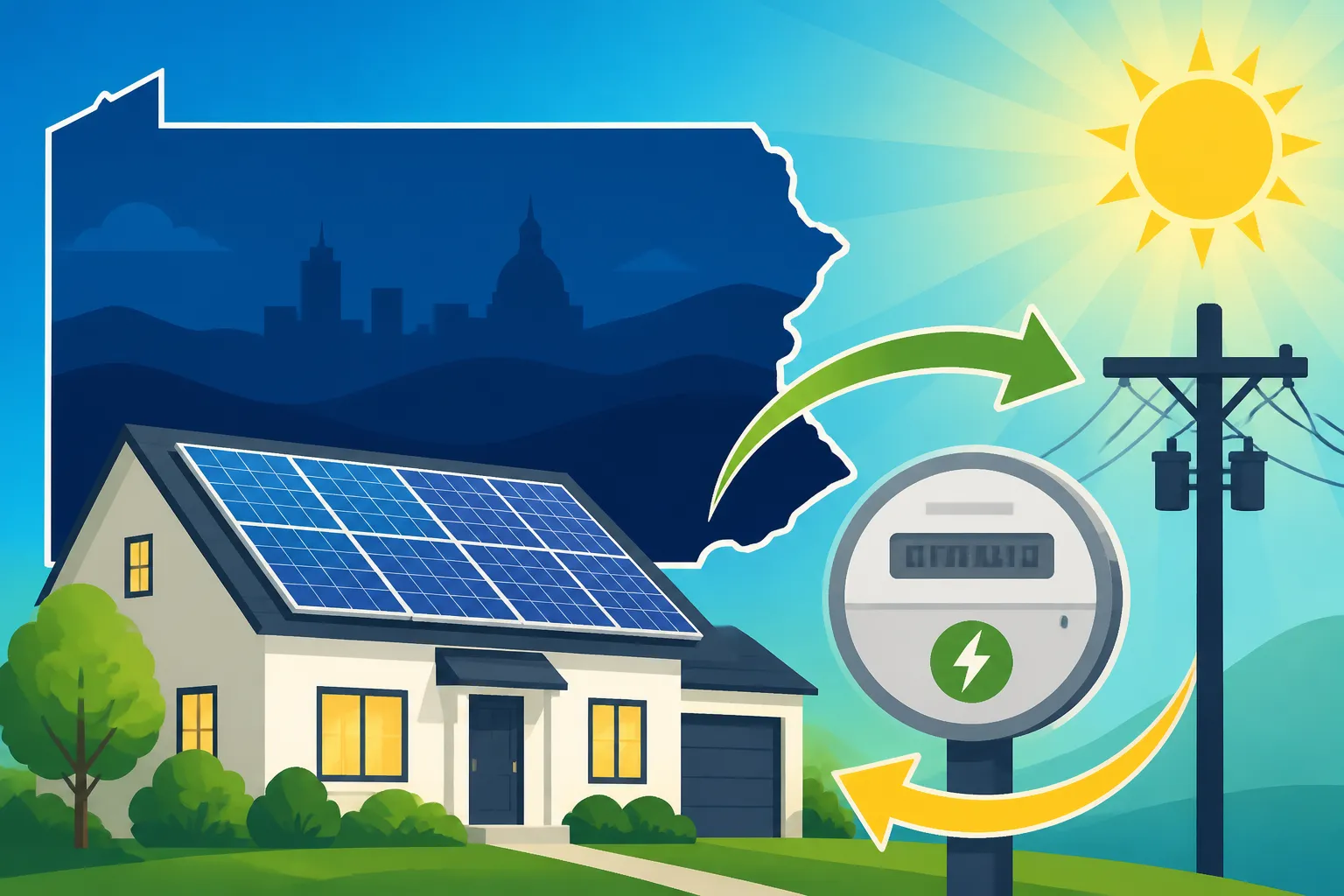
Pennsylvania remains one of the most stable and homeowner-friendly states for solar energy, largely thanks to the Alternative Energy Portfolio Standards (AEPS) Act. While other states have gutted their programs, Pennsylvania continues to offer a robust net metering framework. In essence, net metering is a billing arrangement that allows you to "bank" the electricity your solar panels produce but which you do not immediately use.
Imagine a bright Tuesday afternoon in West Chester. Your REC Solar Panel Review might show that your system is cranking out way more power than your air conditioner and refrigerator need. That excess energy doesn't just vanish; it flows back through your utility meter and onto the grid, serving your neighbors’ homes. In exchange, the utility gives you a credit on your bill for every kilowatt-hour (kWh) you export.
The policy in Pennsylvania is fundamentally a 1:1 retail credit system. This means if you are charged $0.15 per kWh for the power you buy, you receive a credit of $0.10 to $0.15 (depending on the specific components of your utility rate) for the power you sell back. It is the single most important factor in determining Are Solar Panels Worth It in 2026? because it treats the power grid like a giant, free battery for your home.
The Mechanics of the 1:1 Retail Credit
In Pennsylvania, the net metering cycle is managed monthly. If you produce more than you consume in a given month, your bill will show a "net negative" usage, and those credits will roll over to the next month. This is vital for Pennsylvania residents because our weather is famously inconsistent. You might generate a massive surplus during the sunny days of May and June, which you can then "spend" during the gray, snowy days of January.
One of the most frequent questions I hear from folks in Scranton or Harrisburg is: "What happens to the delivery charges?" In Pennsylvania, net metering credits generally apply to the generation and transmission portions of your bill. While you may still see a small fixed customer charge (the fee just to be connected to the grid), a well-sized solar system can effectively eliminate the variable portion of your electric bill. This is a massive relief for anyone who has watched their PPL bill spike during a summer heatwave.
System Size Limitations and the 110 Percent Rule
While Pennsylvania is generous, there are boundaries you need to know. For residential systems, the capacity limit is generally 50 kilowatts (kW). To put that in perspective, the average home only needs an 8 kW to 10 kW system. You can find more details on system sizing in our guide on How Many Solar Panels Do I Need for My Home? to ensure you aren't overbuilding.
However, the "110% Rule" is the real gatekeeper. Most Pennsylvania utilities, including Duquesne Light and Met-Ed, will only approve an interconnection agreement if the system is designed to produce no more than 110% of your historical annual electricity consumption. They want to ensure you are a "distributed generator" meant to offset your own needs, not a commercial power plant operating out of a suburban backyard. If you’ve recently bought an electric vehicle or plan to install a heat pump, make sure your installer documents that expected increase in usage so you can justify a larger system.
How Major Pennsylvania Utilities Handle Net Metering
Not all utilities in the Commonwealth are created equal, though they all must follow the state-level AEPS mandates. The experience of a homeowner in Philadelphia under PECO can feel quite different from someone in Allentown dealing with PPL. Understanding these nuances is key to a smooth Solar Installation Timeline: What to Expect in your specific region.
PECO and the Philadelphia Suburban Market
PECO has a very streamlined process for net metering, but they are meticulous about the What Is Permission to Operate (PTO)? phase. If you are in Bucks, Montgomery, or Delaware County, PECO will typically swap out your traditional meter for a smart, bi-directional meter once your system passes inspection.
One thing to watch out for with PECO is their billing cycles. Some homeowners find it confusing when they see "banked" credits in a different section of the bill than their current usage. It is important to remember that these credits are tracked in kWh, not dollars, until the end of the year. This protects the value of your credit even if electricity rates rise during the year.
PPL Electric Utilities and FirstEnergy
PPL is often cited as one of the most technologically advanced utilities in the state, but they have also been known for having stricter "hosting capacity" limits in certain areas like Lancaster or the Lehigh Valley. If too many people on your specific transformer or substation go solar, PPL might require a grid study or equipment upgrades before you can connect.
FirstEnergy subsidiaries (like Met-Ed and Penelec) generally follow a similar path, but their customer service interfaces for tracking solar production can be a bit more "old school." Regardless of which utility you have, you should always check if there are any Utility Solar Rebates: How to Find Yours specifically for smart inverters or battery storage that might be available.
| Utility Company | Residential Net Metering Rate | Annual True-Up Month | Service Territory Highlights |
|---|---|---|---|
| PECO | Full Retail (Generation/Transmission) | May 31 | Philadelphia, Bucks, Delco, Montco |
| PPL Electric | Full Retail (Generation/Transmission) | May 31 | Allentown, Lancaster, Harrisburg |
| Duquesne Light | Full Retail (Generation/Transmission) | May 31 | Pittsburgh and Allegheny County |
| Met-Ed / Penelec | Full Retail (Generation/Transmission) | May 31 | Reading, York, Erie, Altoona |
The Annual True-Up and the May 31st Payout
A unique feature of Pennsylvania net metering is the "reporting year," which runs from June 1st to May 31st. This is a crucial concept to grasp because it dictates how your excess power is valued over the long term. Many people assume they can just keep hoarding credits forever, but the state requires an annual "True-Up."
How the Payout Works
On May 31st of every year, your utility looks at your "bank" of credits. If you still have a surplus—meaning you produced more energy over the last 12 months than you used—the utility is required to pay you for those remaining credits. However, there is a catch: they do not pay you the full retail rate for this year-end surplus.
Instead, they pay you the "Price-to-Compare," which is essentially the wholesale cost of the electricity. This rate is usually about 30% to 50% lower than the retail rate you pay as a consumer. This is why we always recommend sizing your system to cover about 100% of your usage rather than 120%. You get the most "bang for your buck" when you use your own solar power to offset your $0.16/kWh bill, rather than selling it back for $0.06/kWh at the end of May.
Strategic Planning for the True-Up
If you find yourself with a massive surplus every May, it might be time to look at other ways to use that energy. Maybe 2026 is the year you finally swap that gas water heater for a high-efficiency electric hybrid model. By "electrifying" more of your home, you are essentially converting those low-value wholesale credits into high-value retail offsets. This is a common strategy discussed in our Pennsylvania Solar Incentives in 2026 guide.
Maximizing Your Returns with SRECs and Incentives
While net metering is the "bread and butter" of solar savings in Pennsylvania, it isn't the only way your system makes money. Pennsylvania still maintains a market for Solar Renewable Energy Credits (SRECs). This is often where people get confused—SRECs are entirely separate from net metering.
How SRECs Supplement Net Metering
For every 1,000 kWh (or 1 megawatt-hour) your system produces, you earn one SREC. You can sell these credits on the open market to utilities that need them to meet state mandates. Think of net metering as a "discount" on your bill and SRECs as a "cash paycheck." Even if your net metering credits are just breaking even, your SREC checks can provide extra cash for maintenance or to pay down a solar loan faster. You can dive deeper into this in our SRECs Explained: Selling Solar Renewable Energy Credits article.
Because Pennsylvania closed its borders to "out-of-state" SRECs a few years ago, the value of PA-specific credits has remained more stable than in some neighboring states. It provides a nice secondary income stream that works in tandem with the State Solar Incentives: Complete 2026 Guide for the Commonwealth.
Protection from Property Tax Increases
A common fear in Pennsylvania—where property taxes can be quite high in areas like the Main Line or the Lehigh Valley—is that adding solar will cause your home assessment to skyrocket. Fortunately, Pennsylvania has protections in place. Under current guidelines, the value added by a solar system is generally excluded from your property tax assessment. This means you get the benefit of increased home value without the penalty of higher annual taxes. For more on this, check out Solar Property Tax Exemptions by State.
The Future of Net Metering in the Keystone State
As we move through 2026, the question on everyone’s mind is: "Will this last?" We saw California move to "Net Billing" (NEM 3.0), which significantly reduced the value of exported solar energy. Could Pennsylvania follow suit?
Currently, there is no immediate legislative move to end 1:1 net metering in Pennsylvania. However, the solar industry is always evolving. Utilities occasionally lobby the Pennsylvania Public Utility Commission (PUC) to increase fixed charges or reduce export rates. This is why many homeowners are choosing to "grandfather" themselves into the current rules by installing systems now. Generally, once you have an interconnection agreement signed, you are protected under those rules for 10 to 20 years, even if the policy changes for new customers later.
If you are worried about future changes, adding a battery might be a smart move. Even with 1:1 net metering, a battery provides backup during the frequent storms we get in the Poconos or along the Susquehanna. You can compare options in our Best Solar Batteries of 2026 guide to see if the added cost makes sense for your peace of mind.
Ultimately, Pennsylvania remains a "green light" state for solar. The combination of 1:1 net metering, a functional SREC market, and rising utility rates makes the math work for most homeowners. Whether you are in a row home in South Philly or a farmhouse in Centre County, the grid is ready to take your excess power and give you the credit you deserve.
Disclaimer
This guide is intended for informational purposes only and does not constitute legal, financial, or tax advice. Solar policies, utility rates, and state laws are subject to change. Always consult with a qualified solar professional and a tax advisor to understand how solar incentives apply to your specific situation in Pennsylvania.