Does Arizona Have Net Metering in 2026?
Homeowners across the Phoenix Valley and the Tucson desert often feel a deep sense of frustration when they open their summer electric bills, only to find that their solar panels aren't "zeroing out" the cost like they expected. This confusion stems from Arizona's shift away from traditional credit systems. This guide clarifies exactly how net billing works in Arizona and how you can still save.
The Reality of Arizona Net Metering in 2026
If you are looking for a simple, one-to-one swap where every kilowatt-hour (kWh) your panels send to the grid cancels out one kWh you pull from the grid at night, I have some tough news: that version of net metering is officially a thing of the past in Arizona. In 2026, the state operates under a "Net Billing" structure, which the Arizona Corporation Commission (ACC) refers to as the Resource Comparison Proxy (RCP). This change has fundamentally altered the math for homeowners, making it more important than ever to understand the nuances of your utility's specific policy.
The Shift from Net Metering to Net Billing
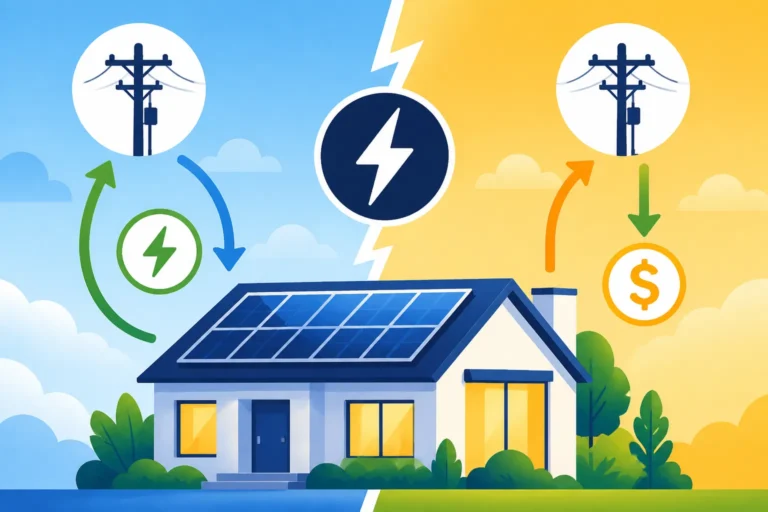
The transition from net metering to net billing wasn't an overnight accident; it was a calculated move by state regulators to change how solar customers interact with the grid. Under the old rules, the grid acted like a free battery. You could overproduce during the day and "bank" those credits to use for free at night. Today, the relationship is more like a transaction. When you export excess energy, the utility "buys" it from you at a set wholesale rate, which is significantly lower than the retail price they charge you to buy power back.
This gap between the "buy" price and the "sell" price is where most of the frustration lies. When people ask, Does Arizona Have Solar Incentives? They are often surprised to find that while the incentives are there, they require a much more strategic approach than they did a decade ago. You are essentially operating a small power plant, and the utility is your most difficult customer.
How the Resource Comparison Proxy RCP Works
The Resource Comparison Proxy (RCP) is the specific mechanism used to determine how much you get paid for your excess solar. Instead of matching the retail rate, the RCP rate is based on what it would cost the utility to buy that same amount of energy from a large-scale solar farm. Since utility-scale solar is much cheaper to produce than residential rooftop solar, the RCP rate is naturally lower.
The most critical thing to know about the RCP in 2026 is the "glide path." To avoid shocking the market, the ACC allowed these export rates to drop by no more than 10% each year. If you look at the Solar Panel Cost in Arizona, you have to weigh that initial investment against these gradually declining export credits. By 2026, these rates have settled into a range that makes "self-consumption"—using your solar power the moment it is generated—the primary goal for any savvy homeowner.
Understanding Your Specific Arizona Utility Rules
Arizona is a patchwork of different utility territories, and the rules in Scottsdale are not the same as the rules in Tempe or Tucson. Your experience with solar credits will depend almost entirely on whether you are served by Arizona Public Service (APS), Salt River Project (SRP), or Tucson Electric Power (TEP). Each has a different philosophy on how solar customers should be integrated into their systems.
Arizona Public Service APS and the RCP Glide Path
APS is the largest utility in the state, and they have been at the forefront of the move toward net billing. For APS customers in 2026, you are likely on a plan where your export rate is locked in for 10 years from the date your system was turned on. This is a small mercy; it means that even as the RCP rate for new customers continues to drop every October, your specific rate remains stable for a decade.
However, the "buy-back" rate in 2026 is often less than half of what you pay for power during peak hours. This makes it incredibly difficult to reach a $0 bill without significantly changing your habits. You might find yourself wondering, What Is Net Metering vs Net Billing: What's the Difference? as you see your neighbors with older systems still enjoying those 1:1 credits while you are credited at a fraction of the cost.
Salt River Project SRP and the Demand Charge Struggle
SRP is a different beast entirely. Because they are a political subdivision of the state and not regulated by the ACC, they have their own set of rules. For years, SRP has utilized "demand charges" in their solar plans, specifically the E-27 Customer Generation plan. A demand charge isn't based on how much total energy you use, but on your single highest "spike" of usage during peak hours.
Imagine you are running your AC, the dryer, and an electric stove all at once for 30 minutes on a Tuesday afternoon. That spike sets your demand charge for the entire month, regardless of how much solar you produced. This has led many to research How to Avoid High-Pressure Solar Sales, as some installers may downplay how much these demand charges can eat into your savings. In 2026, SRP has introduced more options, but the demand charge remains a hurdle that requires either a very smart home management system or a battery.
Tucson Electric Power TEP Export Rates
TEP followed the APS model fairly closely, implementing an RCP rate that also follows a 10% annual reduction path. For homeowners in Southern Arizona, the 2026 export rates are low enough that simply putting panels on the roof is no longer the "slam dunk" it used to be. You have to be meticulous about your system sizing. Over-building a system—installing more panels than you need—is actually a bad financial move now because the extra energy you sell back is worth so little. This has changed how experts calculate the Solar Payback Period in Arizona, shifting the focus from total production to "perfectly matched" production.
How to Maximize Solar Savings Without 1:1 Credits
Since you can't rely on the utility to give you a fair trade for your energy in 2026, you have to take matters into your own hands. The "Golden Rule" of Arizona solar today is: Keep your electrons at home. Every kWh you use to power your own lights or AC is worth the full retail price (roughly 13–16 cents), whereas every kWh you export is only worth the RCP rate (roughly 6–8 cents).
The Necessity of Home Battery Storage
This is the year that batteries transitioned from a "luxury backup" to a "financial necessity." In 2026, adding a battery allows you to store that midday sun and use it during the expensive "Peak" hours (usually 4 PM to 7 PM or 3 PM to 8 PM). By doing this, you avoid buying expensive power from the utility and you avoid selling your cheap power to them.
Many homeowners are now asking, Are Solar Batteries Still Eligible for Incentives in 2026? and the answer is a resounding yes. Between federal credits and local utility programs, the cost of storage has become much more manageable. When you look at the math, Is It Worth Adding a Battery to My Solar System? often comes down to how much your utility charges during peak windows. In Arizona's blistering heat, those peak charges are often double the off-peak rate, making a battery the most effective tool in your shed.
Navigating Time-of-Use TOU Rate Plans
All solar customers in Arizona are required to be on Time-of-Use (TOU) rates. This means the price of electricity changes based on the time of day. While this sounds like a headache, it is actually an opportunity if you have a battery or a smart home.
In 2026, the strategy is to "pre-cool" your home. You crank the AC down to 68 degrees at 2 PM when your solar panels are screaming with production. By the time the expensive "Peak" window hits at 4 PM, your home is a thermal icebox. You can then turn the AC up to 78 degrees and coast through the evening without pulling a single watt from the grid. This kind of "load shifting" is the only way to see a massive ROI in a post-net-metering world.
Comparison of Arizona Utility Solar Credits in 2026
| Utility | Credit Type | 2026 Estimated Export Rate | Credit Duration | Key Hurdle |
|---|---|---|---|---|
| APS | Net Billing (RCP) | ~$0.07 – $0.08 / kWh | 10-Year Lock-in | High Peak-hour rates |
| SRP | Net Billing / Demand | ~$0.04 – $0.06 / kWh | Varies by Plan | Peak Demand Charges |
| TEP | Net Billing (RCP) | ~$0.06 – $0.07 / kWh | 10-Year Lock-in | Lower total solar radiation in winter |
| Co-ops | Varies | $0.03 – $0.10 / kWh | Varies | Limited infrastructure support |
Is Solar Still a Good Investment in Arizona for 2026?
Despite the loss of 1:1 net metering, Arizona remains one of the best places in the world for solar energy. We have more "solar fuel" (sunlight) than almost anywhere else on the planet. The question isn't whether solar works; it’s whether the financial structure works for your specific home.
Calculating Your Payback Period
When you sit down to look at the numbers, you have to be realistic. The days of a 5-year payback period are mostly gone for new installations. In 2026, you are likely looking at an 8 to 11-year payback period. However, considering solar panels are warrantied for 25 years, you are still looking at 15+ years of virtually free power.
You should also factor in the rising cost of grid power. Arizona utilities have been aggressively seeking rate increases to keep up with the state's massive population growth and the cooling demands of data centers. Even if your export credit is low, every year that retail rates go up, your solar panels become more valuable. This long-term perspective is vital when determining Is Solar Worth It in Arizona? for your family.
Final Steps to Permission to Operate
Once you’ve decided to move forward, don't forget the final bureaucratic hurdle. Many homeowners get their panels installed and think they can just flip the switch. In reality, you must wait for What Is Permission to Operate (PTO)? from your utility. This process involves a final inspection from the city and a meter swap from the utility to ensure they can accurately track your exports. This can take anywhere from two weeks to two months, so plan your "go-live" date accordingly.
In conclusion, while Arizona doesn't have traditional net metering in 2026, the combination of high sunshine, declining battery costs, and strategic TOU management still makes solar a powerhouse for home savings. You just have to play the game by the new rules.
Arizona Solar Policy Disclaimer
The information provided in this guide is for educational purposes only and reflects the solar landscape in Arizona. Utility rates, RCP glide paths, and state regulations are subject to change by the Arizona Corporation Commission (ACC) and individual utility boards. Always consult with a qualified solar professional and review your specific utility's current tariff sheets before making a financial commitment. Arizona solar policies can vary significantly between investor-owned utilities and local cooperatives.