Are Microinverters Worth the Extra Cost?
One of the biggest head-scratchers for folks considering home solar is figuring out the right equipment, especially when it comes to inverters. You’ve probably heard about different types, and the term "microinverter" often comes with a slightly higher price tag, leaving many homeowners wondering if that extra expense is truly justified. It's a valid concern, particularly when you're making such a significant investment. This guide is here to break down exactly what microinverters are, how they stack up against other options, and help you decide if they're the smart choice for your home.
Understanding What Microinverters Are and How They Work
Before we dive into the "worth it" question, let's get a clear picture of what microinverters actually are and how they differ from the more traditional setups you might encounter. The inverter is the brain of your solar system; it takes the direct current (DC) electricity generated by your solar panels and converts it into alternating current (AC) electricity, which is what your home appliances use and what the grid accepts.
The Traditional String Inverter Setup
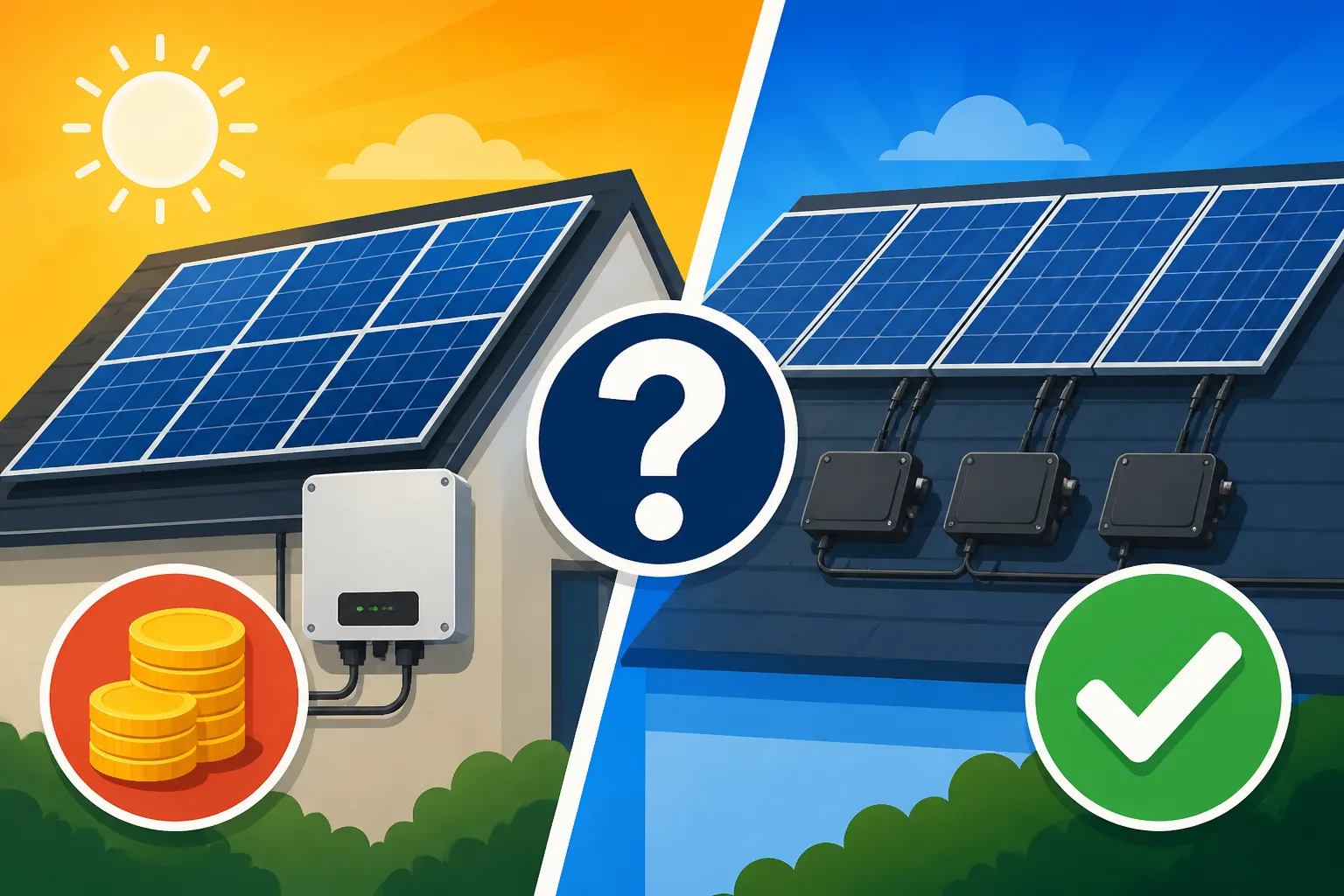
For many years, the standard approach in solar installations involved what's known as a string inverter. Imagine a series of Christmas lights where if one bulb goes out, the whole string goes dark. That's a pretty good analogy for a string inverter system. Multiple solar panels are wired together in a "string" (or several strings), and all the DC electricity from these panels flows to a single, central inverter, typically located on the side of your house or in your garage.
The biggest challenge with this setup is that the performance of the entire string is dictated by the weakest link. If even one panel in a string is shaded by a tree branch, a chimney, or even bird droppings, its reduced output can drag down the efficiency of all the other panels in that same string. This can significantly impact your overall energy production, especially on roofs with intermittent shading throughout the day. Troubleshooting can also be a bit like finding a needle in a haystack; if your system's overall output drops, pinpointing exactly which panel or connection is causing the issue can be tough without specialized equipment.
Microinverters to the Rescue
Now, let's talk about microinverters. Instead of one central inverter handling all the panels, a microinverter system places a small, dedicated inverter directly underneath each individual solar panel. Each panel essentially gets its own brain. This means the DC power generated by each panel is converted to AC power right there on the roof, at the panel level.
The immediate benefit here is isolation. If one panel is shaded, dirty, or underperforms for any reason, it only affects that single panel's output. All the other panels continue to operate at their maximum potential, ensuring your system as a whole maintains higher energy production. This is a game-changer for homeowners with complex rooflines, varied panel orientations, or roofs that experience sporadic shading. Leading brands in this space, like Enphase Energy, have made these systems incredibly reliable and efficient, offering robust solutions for maximizing your solar harvest. You can dive deeper into the differences by checking out our guide on Solar Inverters: String vs Microinverter vs Optimizer.
The "Extra Cost" – Breaking Down the Financial Aspect
Let's address the elephant in the room: yes, microinverters typically involve a higher upfront investment compared to string inverters. It's a common point of hesitation for many folks looking at solar quotes, and it's completely understandable to want to know if that initial spend truly pays off.
Upfront Investment Compared
When you look at the raw cost per watt for a solar installation, systems with microinverters usually sit at the higher end. We're generally talking an increase of about $0.10 to $0.30 per watt, sometimes even more depending on the specific brand and installer. For an average 6 kW (6,000-watt) system, this could translate to an additional $600 to $1,800 or more in upfront costs. It's not a negligible amount, and it’s something your solar installer will factor into your overall Solar Panel Cost Per Watt Explained. This difference primarily comes from the fact that you're buying multiple smaller inverters rather than one larger one, and the installation labor for connecting each microinverter can also add a bit to the cost.
However, it's crucial to understand that "cost" isn't just about the initial sticker price. It's about the value you get over the entire lifespan of your solar system. Many homeowners, myself included, scrutinize every line item, sometimes even looking up reviews for smaller solar components or tools on platforms like Amazon to get a sense of overall quality, though full microinverter systems are professionally sourced. This due diligence helps you understand the full picture beyond just the basic hardware cost.
Long-Term Savings and Value
Here’s where the narrative shifts. While microinverters cost more initially, they often lead to greater long-term savings and provide significant added value through enhanced performance, monitoring, and safety.
- Increased Energy Production: This is the big one. Because each panel operates independently, a microinverter system can harvest significantly more energy over its lifetime, especially if your roof has any shading issues. More energy production means lower electricity bills and a faster return on your investment. Over 25 years, even a 5-10% increase in annual production can add up to thousands of dollars in extra savings.
- Improved Monitoring Capabilities: Microinverter systems provide panel-level monitoring, allowing you to see exactly how much power each individual panel is producing in real-time. This granular data is invaluable. If there's an issue, you'll know instantly which panel is underperforming, making troubleshooting incredibly efficient. This proactive approach prevents prolonged dips in production that might go unnoticed with a string inverter system until your utility bill arrives.
- Enhanced Safety Features: Microinverters convert DC to AC right at the panel. This means there's no high-voltage DC current running through conduit across your roof or into your home, which is a significant safety advantage for both installers and emergency responders. They also inherently meet "rapid shutdown" requirements, allowing firefighters to quickly de-energize your system from the ground in an emergency.
- Longer Warranties: Typically, microinverters come with much longer warranties than string inverters. It's not uncommon to see 20- to 25-year warranties for microinverters, matching the lifespan of your solar panels. Traditional string inverters usually have warranties of 10-12 years, meaning you'll likely need to replace your central inverter at least once during your solar panels' lifespan, adding an unexpected cost down the road. This difference in warranty coverage means more peace of mind and potentially significant savings on replacement costs.
When you factor in these long-term benefits, the initial "extra cost" often starts to look less like an expense and more like a smart investment in your system's efficiency and longevity. To get a better handle on these long-term gains, consider how the Solar Panel Payback Period Explained will be affected by these factors.
Performance Advantages and Disadvantages of Microinverters
Beyond the financial implications, microinverters bring a host of performance advantages that directly impact your solar system's efficiency and user experience. But like any technology, there are trade-offs to consider.
Maximized Energy Harvest, Especially with Shading
This is arguably the most compelling advantage of microinverters. Let's revisit that Christmas light analogy. With a string inverter, if even one panel is shaded by, say, a growing tree, a chimney, a satellite dish, or a dormer that casts a shadow for part of the day, that single shaded panel can drastically reduce the output of all the panels in its string. It forces every panel to produce at the lowest common denominator, essentially throttling your entire system's potential.
With microinverters, that problem simply doesn't exist. Each panel operates independently, converting its own DC power to AC power. So, if your north-facing roof has panels that get morning shade from a neighbor's tree, while your west-facing panels are basking in the afternoon sun, the microinverters ensure that only the shaded panels are affected. The unshaded panels continue to produce at 100% capacity. This is an enormous benefit for homes with anything less than a perfectly south-facing, completely unshaded roof. Over the course of a year, this maximized energy harvest can mean hundreds of extra kilowatt-hours of electricity, translating directly to more savings on your utility bill. This improved performance also means you're getting more out of your panels even as Solar Panel Efficiency & Degradation Explained inevitably occurs over decades.
Enhanced Monitoring and Diagnostics
Imagine knowing exactly how every single solar panel on your roof is performing, in real-time, right from an app on your phone. That's precisely what microinverter systems offer. Brands like Enphase provide intuitive monitoring platforms that give you granular data, showing the output of each individual panel.
Why is this a big deal? If your overall system production suddenly drops, with a string inverter, you'd know something is wrong, but pinpointing the exact cause could be a lengthy process involving an installer climbing on your roof to test individual panels or components. With microinverters, if a specific panel is underperforming due to, say, a fault, an accumulation of dirt, or even a branch that fell on it, the monitoring system immediately flags that single panel. This allows for much faster and more targeted troubleshooting, minimizing downtime and ensuring your system is always operating at its best. This kind of detailed monitoring isn't just cool tech; it's a practical tool for protecting your investment and ensuring maximum savings.
System Expandability and Flexibility
Life changes, and so might your energy needs. Maybe you get an electric vehicle, decide to add a pool, or convert your garage into an ADU. With a microinverter system, expanding your solar array is remarkably straightforward. Since each panel has its own inverter, you can simply add more panels to your existing system without needing to replace or upgrade your central inverter or re-engineer the entire electrical balance. This modularity is a huge plus for homeowners who anticipate their energy consumption might grow in the future.
This flexibility also applies to complex roof designs. Many homes aren't blessed with a single, large, perfectly oriented roof plane. Microinverters allow installers to place panels on different sections of your roof, facing various directions, and optimize each section independently. This means you can maximize the usable space on your roof, even if it has multiple gables, dormers, or different orientations.
Longevity and Warranty
One of the less obvious but hugely significant advantages of microinverters is their impressive lifespan and associated warranties. As mentioned earlier, microinverter warranties typically extend for 20-25 years, often matching the performance warranty of your solar panels themselves. This level of coverage provides immense peace of mind.
Compare this to string inverters, which usually carry warranties of 10-12 years. This means that, statistically, you're very likely to need a replacement string inverter halfway through the lifespan of your solar panels. The cost of a replacement string inverter, plus the labor for installation, can be a significant unexpected expense. With microinverters, the risk of a full system shutdown due to a single inverter failure is eliminated. If one microinverter fails, only its associated panel stops producing, and the rest of your system continues to function. This distributed architecture significantly enhances system reliability over the long haul. Understanding these Solar Panel Warranties Explained can truly clarify the long-term value.
Disadvantages of Microinverters
While the benefits are clear, it's also fair to acknowledge the downsides:
- Higher Upfront Cost: We've discussed this, but it's the primary drawback. For some homeowners, that initial price difference can be a deal-breaker, especially if they have a perfectly unshaded roof.
- More Components on the Roof: Having an inverter under each panel means more electronic components exposed to the elements on your roof. While these are designed to be durable and withstand harsh weather, it's still more points of potential failure compared to a single central unit. However, as noted, a failure of one microinverter only impacts that one panel, unlike a central inverter failure which impacts the entire system.
- Maintenance Can Be More Complex (Hypothetically): If a microinverter does fail, an installer needs to get onto the roof to replace it. This is in contrast to a string inverter, which is usually easily accessible on the ground. However, the significantly longer warranties and rare instances of failure often mitigate this concern. Furthermore, the detailed monitoring usually allows for a precise diagnosis, meaning fewer trips up to the roof to troubleshoot.
When Microinverters Are Absolutely Worth It (and When They Might Not Be)
Deciding on the right inverter technology isn't a one-size-fits-all situation. The "worth it" factor truly depends on your specific home, roof, budget, and priorities.
Ideal Scenarios for Microinverters
If any of these descriptions sound like your situation, microinverters are likely to be a fantastic investment:
- Shaded Roofs: This is the number one reason to choose microinverters. If your roof experiences any degree of shading from trees, chimneys, vents, adjacent buildings, or even seasonal shadows, microinverters will dramatically outperform string inverters by ensuring only the shaded panels are affected, not your entire system. This means significantly more electricity production over the lifetime of your system.
- Complex Rooflines with Multiple Orientations: Many homes have roofs with different sections facing various directions (e.g., east, west, and south). Microinverters allow each panel to be optimally positioned and produce independently, maximizing output from every available roof section. A string inverter would struggle to efficiently manage panels facing different directions, as their peak production times would vary significantly.
- Homeowners Prioritizing Maximum Energy Harvest and Granular Monitoring: If you want to squeeze every last electron out of your solar system and appreciate the ability to monitor each panel's performance from your smartphone, microinverters offer an unparalleled level of control and insight. This is great for those who are tech-savvy and want to ensure their investment is always performing optimally.
- Those Who Plan to Expand Their System in the Future: If you foresee adding more solar panels down the road – perhaps for an EV charger, a heat pump, or just increased energy consumption – the modularity of microinverters makes future expansion much simpler and often more cost-effective.
- Safety-Conscious Homeowners: The inherent rapid shutdown capabilities and the absence of high-voltage DC lines running through your home are significant safety advantages that appeal to many.
Situations Where String Inverters May Suffice
While microinverters offer numerous advantages, there are scenarios where a string inverter might be a perfectly adequate and more budget-friendly choice:
- Simple, Unshaded Roofs with a Single, Optimal Orientation: If your home has a large, south-facing roof that receives direct, uninterrupted sunlight all day long, year-round, then the shading advantage of microinverters becomes less critical. In such ideal conditions, a well-designed string inverter system can perform quite efficiently.
- Budget-Conscious Homeowners Where Every Dollar Upfront Counts: For some, the absolute lowest upfront cost is the primary driver. If you're working with a very tight budget and your roof conditions are ideal (minimal shading, simple layout), a string inverter system will get you into solar for less initial outlay. However, always remember to weigh this against potential long-term savings and inverter replacement costs.
- When the System Size Is Very Small and Simplicity is Key: For very small systems, perhaps just a few panels, the cost differential per watt for microinverters might feel disproportionately high.
- Considering Power Optimizers as a Middle Ground: It's worth noting that there's a hybrid option called power optimizers, often associated with brands like SolarEdge. These devices are installed at each panel (like microinverters) to optimize individual panel performance and enable panel-level monitoring, but they still feed DC power to a single, central string inverter. This offers many of the performance benefits of microinverters while sometimes coming in at a slightly lower price point. You can read more about this in our guide on Enphase vs SolarEdge: Which Inverter Is Better?.
Comparative Table: Microinverters vs. String Inverters
To help you visualize the differences, here’s a quick comparison:
| Feature | Microinverters | String Inverters |
|---|---|---|
| Upfront Cost | Higher | Lower |
| Performance in Shade | Excellent (panel-level optimization) | Poor (entire string affected by weakest panel) |
| Monitoring | Panel-level data | System-level data |
| Warranty (Inverter) | 20-25 years (often matches panels) | 10-12 years (likely needs replacement) |
| Expandability | Easy, modular addition of panels | More complex, may require inverter upgrade |
| Safety (DC Voltage) | Low DC voltage on roof, rapid shutdown inherent | High DC voltage on roof/to inverter |
| Failure Impact | Single panel affected if one fails | Entire system affected if central inverter fails |
| Ideal for | Shaded roofs, complex designs, future expansion | Unshaded, simple roofs, budget-conscious |
Ultimately, the decision comes down to your priorities. Are you looking for the absolute lowest upfront cost, or are you willing to invest a bit more for superior long-term performance, reliability, and peace of mind? Most homeowners find that the benefits of microinverters, especially in real-world scenarios with less-than-perfect roof conditions, easily justify the added expense. To make the best choice, always get multiple quotes and discuss these options thoroughly with your solar installer. They can analyze your specific roof and energy needs to recommend the best system for you. A good installer will walk you through the How Many Solar Panels Do I Need for My Home? and the associated inverter technology.
Disclaimer
Please note that the information provided in this guide is intended for general informational purposes only and does not constitute professional financial, tax, or energy advice. Solar technology, incentives, and costs can vary significantly based on location, utility policies, and individual circumstances. It is highly recommended to consult with qualified solar professionals and financial advisors to determine the best solution for your specific needs.