Does Georgia Have Net Metering in 2026?
If you have been watching your Georgia Power bill climb during those sweltering July afternoons in Atlanta or Savannah, you have probably wondered why everyone isn't just slapping solar panels on their roofs. The frustrating reality is that while the sun shines bright in the Peach State, the rules about how you get paid for your power are incredibly confusing. This guide breaks down exactly where Georgia stands on net metering and how you can still make solar work for your wallet.
The Reality of Net Metering in Georgia
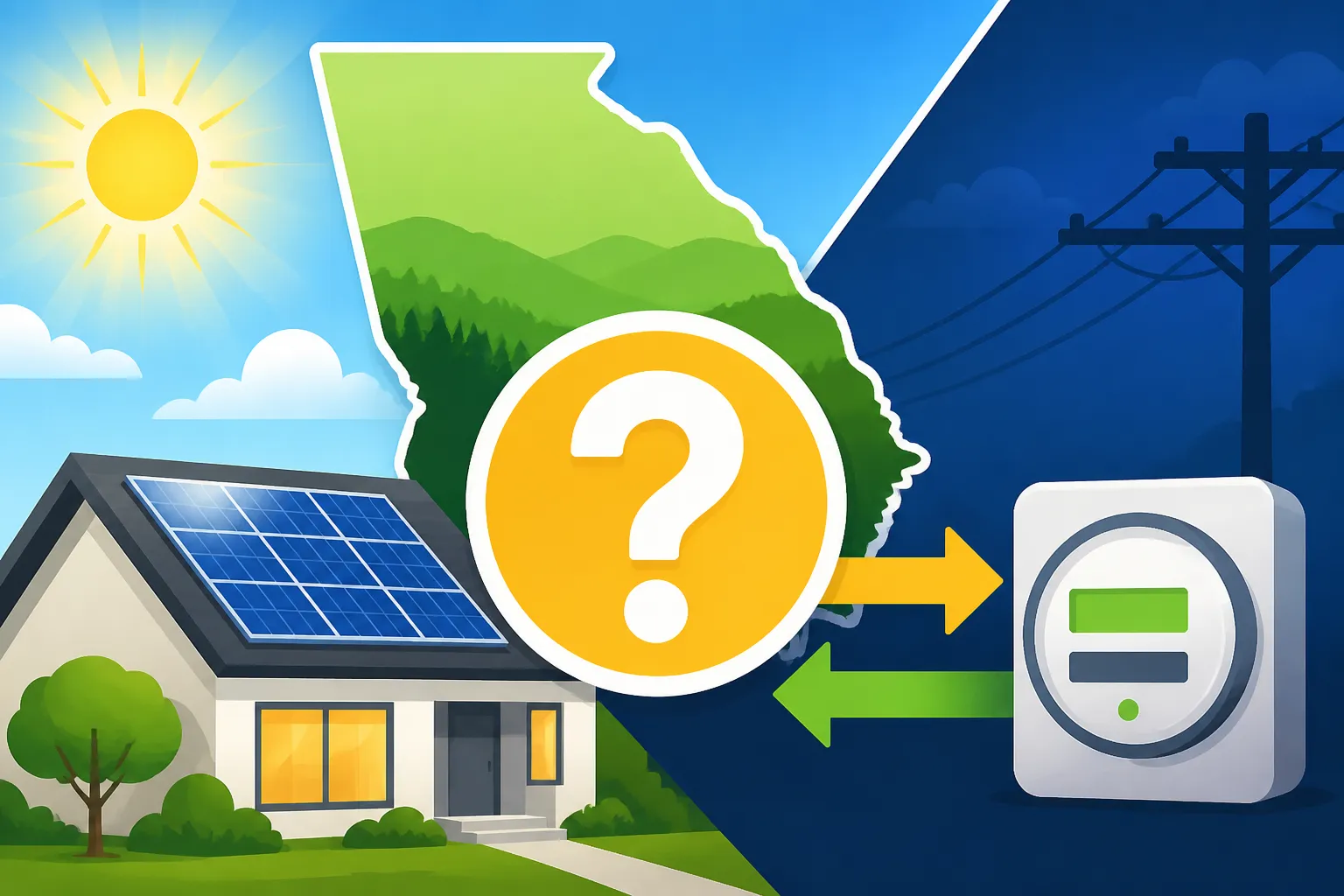
For a long time, the biggest hurdle for Georgia homeowners has been the lack of a statewide 1:1 net metering mandate. If you live in a state like New Jersey or Massachusetts, your meter essentially spins backward at the same rate you pay for power. In Georgia, we have a much more fragmented system. As we move forward, the primary utility, Georgia Power, continues to use a billing structure that differentiates between the power you pull from the grid and the power you send back.
A few years ago, there was a pilot program that allowed 5,000 lucky customers to enjoy true monthly net metering. That cap was hit faster than a Chick-fil-A line at noon, and since then, the state has been locked in a debate about whether to expand it. For the rest of us, we are typically placed on a "Buy-Back" or "RNR" (Renewable Non-Renewable) tariff. This means your excess energy is credited at a much lower rate than what you pay to buy it. When you're asking Does Georgia Have Solar Incentives?, the answer is yes, but they aren't as straightforward as a simple 1:1 credit.
This "avoided-cost" rate is often only a few cents per kilowatt-hour, while you might be paying 12 to 16 cents to buy that same energy back at night. It feels unfair—and honestly, it is a bit of a headache—but it doesn't mean solar is a bad investment. It just means you have to be smarter about how you use the energy you produce. You can't just rely on the grid to act as a free "battery" for you anymore.
Georgia Power and the Avoided Cost Rate
If you are a Georgia Power customer, you are likely dealing with the "Instantaneous Net Metering" or the "Standard Buy-Back" rate. Under these rules, any electricity your panels produce that you use immediately in your home saves you the full retail price. However, the second your panels produce more than your AC and fridge need, that "overflow" goes to the grid, and Georgia Power buys it at the wholesale rate.
This wholesale rate is what the utility would have paid to buy power from a massive power plant. Because that price is so much lower than the retail price, your "credits" don't stack up as quickly as you might hope. This is why many residents are looking into Avoided-Cost Rate & Export Credits Explained to understand the math behind their monthly statements. It is a protective measure for the utilities, but for the homeowner, it means you need to maximize "self-consumption."
EMCs and Municipal Utilities
The story is a little different if you get your power from an Electric Membership Corporation (EMC) like Walton EMC, Jackson EMC, or Cobb EMC. Because these are member-owned cooperatives, they have their own boards and their own rules. Some Georgia EMCs have been much more progressive than the big investor-owned utilities, offering better rates for solar exports.
Before you sign a contract, you must call your specific provider. Some municipal utilities in smaller towns also offer localized rebates or better billing terms. It is always worth checking Does My Utility Offer a Solar Rebate? because those local perks can sometimes offset the lack of a statewide net metering law. Some EMCs may even offer a "community solar" option if your roof isn't a good fit, which can be a great middle ground.
How Solar Billing Works Without 1:1 Net Metering
Since we aren't getting that 1:1 credit in most parts of Georgia in 2026, the strategy has shifted. In the past, people would over-size their solar arrays to try and "zero out" their bill. Today, that isn't always the best financial move because the extra power you send back isn't worth as much as it used to be. Instead, the goal is "right-sizing" your system.
You want a system that covers your daytime needs without sending too much back to the grid for pennies. This requires a deep look at your energy habits. Are you home during the day? Do you run your dishwasher and laundry at noon? If you can shift your heavy energy usage to the middle of the day when your panels are peaking, you are effectively "net metering" yourself at the full retail rate. This is the secret to making Are Solar Panels Worth It in 2026? a resounding yes for Georgia residents.
The Importance of Solar Batteries
A solar battery is no longer a luxury in Georgia; it is a vital part of the financial equation. Since the utility won't give you a fair price for your excess daytime power, the best thing you can do is keep that power for yourself. A battery allows you to store that "overflow" and use it at night. This keeps you from having to buy expensive power from the grid once the sun goes down.
While batteries add to the upfront cost, there are specific Solar Battery Incentives in 2026 that can help take the sting out of the purchase. By using a battery to avoid "buying" power at night, you are essentially creating your own private 1:1 net metering system. Plus, with the increasing frequency of summer storms and grid strain, having that backup power for your AC is a huge quality-of-life upgrade that most Georgians find worth the extra investment.
Comparing Billing Structures in Georgia
To give you a better idea of how your wallet is affected, let's look at the three main ways you might be billed for solar in Georgia right now.
| Billing Type | How It Works | Financial Impact |
|---|---|---|
| 1:1 Net Metering (Pilot) | 1 kWh sent = 1 kWh credited at retail price. | Highest savings; very limited availability. |
| Instantaneous Net Metering | Savings only occur if power is used the moment it's made. | Moderate savings; requires lifestyle changes. |
| Avoided-Cost Buy-Back | Excess power bought by utility at wholesale prices. | Lower export value; makes batteries nearly essential. |
| Solar + Battery Storage | Excess power is stored and used later by the homeowner. | High savings; protects against utility rate hikes. |
Other Georgia Solar Incentives and Savings
Even without a mandatory net metering law, Georgia offers several ways to bring down the cost of going solar. It is important to remember that net metering is just one piece of the puzzle. When you look at the total How Much Do Solar Panels Cost? 2026 Guide, you have to factor in the tax breaks and exemptions that are still very much alive in the state.
Georgia doesn't currently have a state-level income tax credit for solar (though there is always talk in the legislature about bringing it back), but there are other "hidden" ways the state makes it easier on your bank account.
Property Tax Exemptions
One of the best perks in Georgia is the property tax treatment of solar. In many states, adding $30,000 worth of solar panels to your roof would cause your property taxes to spike because you've increased the value of your home. However, Georgia law generally prevents your local tax assessor from including the value of the solar equipment in your home's assessed value for property tax purposes.
This means you get the benefit of a more valuable home—and research shows solar panels really do help with resale—without the penalty of higher annual taxes. You can read more about how this works in the Solar Property Tax Exemptions by State guide. It is an "invisible" incentive that adds up to thousands of dollars over the 25-year life of your system.
Sales Tax Benefits
Depending on when and where you buy, there may be specific sales tax holidays or exemptions available for "energy-efficient" home upgrades. While Georgia doesn't have a permanent, blanket sales tax exemption for all solar components like some of our neighbors, certain local jurisdictions and periodic state programs can offer relief. It's always worth asking your installer if there are any current Solar Sales Tax Exemptions by State that apply to your specific Georgia county. Every 6% to 8% you save on a large solar purchase is money that stays in your pocket on day one.
Is Solar Still Worth It in Georgia?
Despite the lack of 1:1 net metering, solar remains a very strong investment for the average Georgia homeowner in 2026. Why? Because utility rates are not staying still. Georgia Power and the various EMCs have been steadily increasing rates to pay for grid upgrades and new generation projects. Every time the utility raises its rates, your solar panels become more valuable because they are shielding you from those increases.
When you sit down to calculate your Solar Panel Payback Period Explained, don't just look at today's electricity price. Look at what you'll be paying in five or ten years. Most Georgia homeowners find that their system pays for itself in 9 to 12 years, especially if they take advantage of the remaining federal tax credits and "right-size" their system to their actual needs.
Choosing the Right System Size
The biggest mistake people make in Georgia is buying a system that is too big for their daytime usage without also buying a battery. If you have a massive array but you're at work all day, you are sending all that "gold" to the grid for "silver" prices. A smaller, more efficient system might actually give you a better return on investment.
You should start by asking How Many Solar Panels Do I Need for My Home? and then look at your hourly energy usage. If you see big spikes in the evening, that is a sign you should either invest in a battery or look into Is It Worth Adding a Battery to My Solar System? to bridge the gap. In Georgia, efficiency and timing are more important than sheer panel count.
The Value of Energy Independence
Finally, we have to talk about the "peace of mind" factor. Georgia summers are getting hotter, and the grid is feeling the pressure. For many of us, the decision to go solar isn't just about the "Avoided-Cost" rate or the net metering rules—it's about knowing that when a thunderstorm knocks out power in the neighborhood, our lights stay on and our AC keeps running.
That sense of security is hard to put a dollar sign on, but for most families, it is the tipping point. When you combine the energy savings with the backup capabilities, the "Georgia solar problem" starts to look much more like a "Georgia solar opportunity."
Disclaimer
This guide is for informational purposes only and does not constitute financial, tax, or legal advice. Solar policies, utility rates, and incentive programs in Georgia are subject to change by the Georgia Public Service Commission and individual utility boards. Always consult with a qualified tax professional and get multiple quotes from licensed installers to understand the specific economics of your home.