Florida Solar Incentives in 2026
Thinking about making the leap to solar in Florida can feel a bit like wading through quicksand – you know there are potential savings and benefits, but figuring out the exact incentives and how they apply to your home can be confusing. Many homeowners are left scratching their heads, wondering if the "Sunshine State" truly lives up to its name when it comes to supporting solar. This guide is here to untangle the specifics of Florida's solar incentives for 2026, offering clear, actionable insights into what's available and how you can take advantage of it.
The Sunshine State's Approach to Solar Incentives
Florida, with its abundant sunshine, seems like a natural fit for solar energy. However, the state's approach to solar incentives can sometimes be a bit different from what you might find in states with more aggressive renewable energy mandates. It's less about direct state-funded rebates and more about supportive policies that reduce costs and encourage private investment.
Understanding Florida's General Stance
Florida has a robust solar market, not necessarily due to a myriad of direct state grants or tax credits, but largely thanks to its strong solar resource and supportive policy framework concerning taxes. The state primarily relies on property tax exemptions and sales tax exemptions to make solar more attractive to homeowners. Unlike some other states that offer significant direct financial incentives, Florida's strategy is to minimize the financial burden associated with the upfront cost of solar through tax relief. This means while you might not get a check from the state, you'll save money on your taxes, which can add up significantly over the life of your solar energy system.
For instance, if you install a solar system, its value might technically increase your home's worth. In many places, that would mean higher property taxes. But in Florida, this isn't the case for solar. This passive form of incentive is often overlooked but provides real, long-term savings. The same goes for the sales tax—when you're buying thousands of dollars worth of equipment, not paying sales tax can shave a decent chunk off the total bill.
Key Drivers and Challenges for Solar Adoption in Florida
The primary driver for solar adoption in Florida remains the high cost of grid electricity and the desire for energy independence. Homeowners are increasingly looking for ways to lock in their energy costs and protect themselves from rising utility rates. The abundant sunshine ensures that solar panels operate efficiently for a significant portion of the year, maximizing energy production. Florida averages around 230 sunny days per year, far above the national average of 205 days, providing an ideal environment for solar generation.
However, challenges persist. One major area of concern for many residents has been the evolving landscape of net metering, which dictates how homeowners are credited for excess solar power sent back to the grid. While net metering has historically been a significant incentive, changes or proposed changes can create uncertainty. Another challenge is the initial upfront cost of installation, even with federal and state tax exemptions. While these policies help, the sticker price can still be a hurdle for some. It’s crucial for homeowners to understand the full financial picture, including the cost of solar panels themselves and potential financing options.
State-Level Solar Incentives in Florida
Florida might not offer a sprawling list of direct rebates like some other states, but the incentives it does provide are substantial and designed to make solar ownership more financially palatable for the average homeowner. These state-level benefits primarily come in the form of tax exemptions, which directly reduce the overall cost of going solar.
Property Tax Exemptions for Solar Energy Systems
This is a big one, and it's something Florida homeowners should absolutely pay attention to. When you install a solar energy system on your home, it undeniably adds value to your property. In many states, an increase in property value would mean a corresponding increase in your annual property taxes. But not in Florida for solar.
Florida law provides a 100% property tax exemption for the added value of a renewable energy system, including solar panels. What this means in practical terms is that if your solar system increases your home's appraisal value by, say, $20,000, you will not pay any additional property taxes on that $20,000. This is a powerful, long-term saving. Imagine living in a home with solar for 25 years – those avoided property tax increases can add up to thousands of dollars over the system's lifespan. This exemption significantly improves the overall return on investment (ROI) for solar homeowners, making it a truly attractive proposition. This benefit is outlined further in our detailed guide on Solar Property Tax Exemptions by State.
Consider a hypothetical scenario: The Millers in Orlando install a 7 kW solar system that adds an estimated $25,000 to their home's value. Without this exemption, and assuming a property tax rate of 1.5%, they would pay an extra $375 per year in taxes. Over 25 years, that's $9,375 in savings! This often goes unnoticed in initial cost calculations but is a very real financial advantage.
Sales Tax Exemptions on Solar Equipment
Another significant financial break for Florida solar adopters comes in the form of a sales tax exemption. When you purchase a solar energy system in Florida, you don't have to pay state sales tax on the equipment. Given that solar panel systems can cost tens of thousands of dollars, this exemption can lead to immediate and substantial savings right off the bat.
Florida's statewide sales tax rate is 6%, and local sales taxes can add another 0.5% to 2.5%, depending on the county. So, for a solar energy system costing $25,000 before taxes, that 6% statewide sales tax would be $1,500. Add in local sales tax, and you could easily be looking at $1,750 or more in savings on the purchase price alone. This is an upfront saving that reduces your out-of-pocket expenses immediately, making solar more accessible. This incentive is a direct boost to affordability, lowering the initial financial hurdle for many families. To learn more about how this works across different regions, you can check out our article on Solar Sales Tax Exemptions by State.
Let's say the Johnsons in Miami decide on a $30,000 solar system. With Florida's state sales tax at 6% and Miami-Dade County's surtax bringing it to 7%, they would normally pay $2,100 in sales tax. Thanks to this exemption, that $2,100 stays right in their pocket, directly reducing their total investment.
Net Metering Policies in Florida
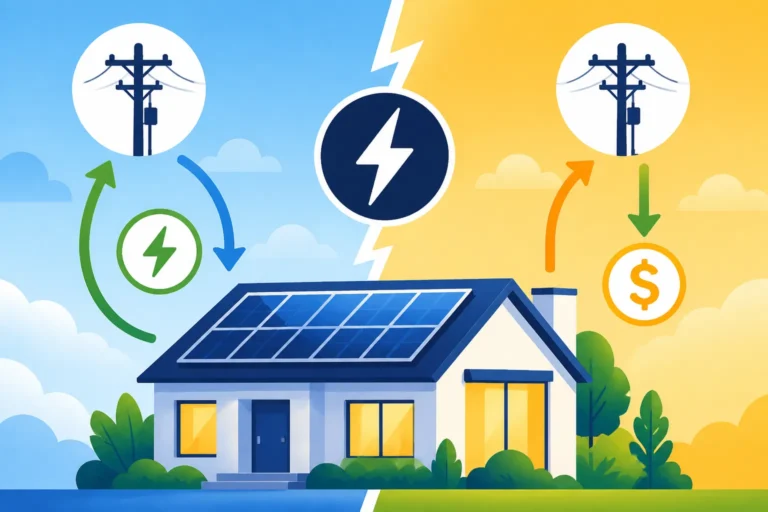
Net metering is a crucial policy for homeowners with grid-tied solar systems. It allows you to send any excess electricity your solar panels produce back to the utility grid and receive credits on your bill, which can then be used to offset the cost of electricity you pull from the grid when your panels aren't producing enough (like at night). Understanding Net Metering Explained: How It Works by State is key to maximizing solar savings.
In Florida, net metering has seen some legislative debate and changes. Currently, Florida's investor-owned utilities (like Florida Power & Light, Duke Energy Florida, and Tampa Electric) are required to offer net metering. This means that for residential solar customers, they typically receive credits at the utility's full retail rate for excess power generated, up to the amount of electricity they consume annually. Any surplus generation beyond annual consumption might be credited at an avoided-cost rate, which is usually lower.
However, it's essential for homeowners to stay updated on these policies. While current net metering rules provide good value, there have been attempts to alter or reduce the benefits. These discussions highlight the importance of connecting with your local utility provider to understand their specific net metering tariffs and any potential future changes, as they can significantly impact your long-term savings. The details of these programs, including specific credit rates, are often found on utility websites or by contacting their renewable energy departments directly.
For example, homeowners under Florida Power & Light (FPL) can bank excess credits month-to-month. If their panels overproduce in a sunny spring month, those credits can offset usage in a hotter summer month when AC demand is higher. However, at the end of an annual billing cycle, any remaining credits might be cashed out at a much lower wholesale "avoided-cost" rate, not the retail rate, which is why right-sizing your system to your annual consumption is critical. This is a common practice across many utilities, and knowing your Avoided-Cost Rate & Export Credits Explained can help you plan.
Local and Utility-Specific Solar Programs
Beyond state-wide tax exemptions, many Florida residents can also tap into incentives offered by their local utility companies or even specific municipal programs. These can vary significantly by location, so it's worth doing a bit of digging to see what's available in your specific area.
Utility Company Rebates and Programs
Florida's major utility companies often have their own programs to encourage solar adoption. These programs might include rebates for installing solar, assistance with interconnection, or specific rate structures for solar customers. While outright cash rebates might not be as common as they once were, utilities sometimes offer other valuable services or incentives.
For instance, Duke Energy Florida provides resources and information for customers interested in solar, outlining their interconnection process and net metering details. Tampa Electric (TECO) also offers support for customers connecting solar to the grid and participates in net metering. Even though direct rebates can be rare, understanding each utility's specific solar programs is crucial for maximizing savings. Checking our guide on Utility Solar Rebates: How to Find Yours can be a great starting point.
It's not just about what you get from the utility, but also how smoothly the process goes. Utilities like FPL have online portals and dedicated teams to help customers navigate the interconnection process, which can be a significant hurdle if not managed properly. They often have clear guidelines for system requirements and safety standards that must be met before your system can be given Permission to Operate (PTO).
Here's a quick overview of some major Florida utilities and what they generally offer (note: specifics can change, always check directly with your utility):
| Utility Provider | General Solar Offering | Key Feature |
|---|---|---|
| Florida Power & Light (FPL) | Net Metering, Interconnection Services | Credits for excess generation up to annual consumption, annual cash-out at avoided-cost rate. |
| Duke Energy Florida | Net Metering, Interconnection Services, Smart Energy Programs | Supports residential solar with standard net metering rules and system interconnection guidelines. |
| Tampa Electric (TECO) | Net Metering, Interconnection Services | Provides net metering at retail rates for excess generation, focused on streamlined connection. |
| Lakeland Electric | Net Metering, Solar Resources | Offers net metering and provides educational resources for customers. |
| JEA (Jacksonville) | Net Metering, GreenChoice Program | Retail rate net metering for residential systems, potential for community solar participation. |
Always confirm the latest policies directly with your specific utility provider, as programs and terms can evolve.
Exploring Local Government Initiatives
While less common for direct financial incentives, some local governments in Florida may have initiatives that indirectly support solar adoption. These could include streamlined permitting processes, local zoning benefits for solar installations, or participation in broader community solar programs.
For example, a city like Gainesville might have local ordinances that make solar installation permits easier to obtain or less expensive than in other areas, thereby reducing a hidden cost of going solar. Some communities might also participate in programs that allow residents to buy into a larger solar project without installing panels on their own roof, often called Community Solar: How It Works & Who Qualifies. While these aren't direct cash incentives for rooftop solar, they still contribute to making solar more accessible and affordable within the community. It’s always a good idea to check with your local municipal planning or energy department.
Federal Incentives Still Available for Florida Homeowners
Even though Florida's state-level incentives are primarily tax exemptions, don't forget about the powerful federal incentives that apply to homeowners across the entire United States, including those in the Sunshine State. These federal benefits are crucial for making solar economically viable for many.
The Investment Tax Credit (ITC)
The most significant federal incentive for residential solar systems is the Solar Investment Tax Credit (ITC), often referred to as the federal solar tax credit. This credit allows homeowners to deduct a percentage of the cost of their solar energy system from their federal income taxes. As of 2026, the ITC is still a robust 30%. This means if your solar system costs $25,000, you could get $7,500 back as a tax credit. This is a dollar-for-dollar reduction in your tax liability, making it incredibly valuable.
It's important to understand that the ITC is a credit, not a deduction. A deduction reduces your taxable income, but a credit directly reduces the amount of tax you owe. If you don't owe enough in taxes to use the full credit in one year, you can typically carry forward the unused portion to future tax years, which is a fantastic feature for long-term planning. Our guide on the Federal Solar Incentives That Still Exist in 2026 delves deeper into this and other related federal programs.
For instance, the Johnsons in Miami, after their $30,000 system installation, would be eligible for a $9,000 federal tax credit (30% of $30,000). This, combined with the state sales tax exemption, significantly reduces their net out-of-pocket expense, making the project much more affordable. Keep in mind that you must own the solar system to claim the ITC, meaning it generally applies if you purchase the system outright or finance it with a solar loan. It typically does not apply to leased solar systems or power purchase agreements (PPAs), an important distinction covered in Does Leased Solar Still Get Incentives in 2026?.
Other Federal Programs to Consider
Beyond the main ITC, there are a few other federal programs and considerations that can benefit Florida homeowners, especially those looking at solar batteries.
- Solar Battery Incentives: The ITC doesn't just apply to solar panels. If you install a solar battery storage system in conjunction with your solar panels, or even add one to an existing solar system, it can also qualify for the 30% federal tax credit. This is excellent news for Floridians, especially given the state's susceptibility to hurricanes and power outages. A solar battery like a Tesla Powerwall or Enphase IQ Battery can provide critical backup power during grid disruptions, offering both peace of mind and further financial savings. This is elaborated in our article on Solar Battery Incentives in 2026.
- USDA Rural Energy for America Program (REAP) Grants: While primarily aimed at agricultural producers and rural small businesses, some homeowners who run a small business from their home in a rural area might qualify for REAP grants or guaranteed loans. This is a niche program, but if you fit the criteria, it's worth exploring as it can provide significant financial assistance.
- Energy Efficient Home Improvement Credit: While separate from the solar ITC, this federal credit can help offset the costs of other energy-efficient home improvements you might undertake alongside your solar installation, such as upgrading windows or insulation. It's not a solar-specific incentive but complements the overall goal of reducing your home's energy consumption.
Understanding these additional federal layers ensures you're leveraging every possible avenue for savings, stacking incentives to make your solar investment as strong as possible. For many, these incentives are critical to making the switch.
Florida Solar Incentive Summary
To help you keep track of the main incentives available for homeowners going solar in Florida in 2026, here's a quick overview:
| Incentive Type | Description | Eligibility & Benefit |
|---|---|---|
| Federal Solar ITC | Federal income tax credit for solar system installation costs. | 30% of system cost for owned systems. Can be carried forward if not fully used in one year. |
| Property Tax Exemption | Exemption from increased property taxes due to the added value of a solar system. | 100% of the assessed value added by the solar system is exempt from property taxes. |
| Sales Tax Exemption | Exemption from state sales tax on the purchase and installation of solar equipment. | Saves 6% (state) plus any local sales tax on the total cost of eligible solar equipment and installation. |
| Net Metering | Receive credits for excess solar electricity sent back to the grid. | Typically retail rate credits for excess generation up to annual consumption; annual cash-out at a lower avoided-cost rate. |
| Utility Programs | Offerings from local utility companies (e.g., FPL, Duke Energy, TECO). | Varies by utility; primarily covers interconnection services and potentially specific solar tariffs. |
This table provides a snapshot, but remember to always verify the latest details with your tax professional and local utility provider.
Disclaimer
This article is for general informational purposes only and does not constitute professional advice. Laws, prices and regulations vary by location and change over time. Consult a qualified professional for guidance on your specific situation.